Socio Economic Impact and Merit Debate Surrounding NEET Examination
Source:The Hindu ↗
Why It Matters
The NEET controversy is a critical multi-dimensional UPSC topic touching upon educational reforms, federalism (GS-2), social justice and equity (GS-1 & GS-2), and governance/public examinations. It illustrates the tension between administrative standardization and socio-cultural diversity in policy design.
Summary
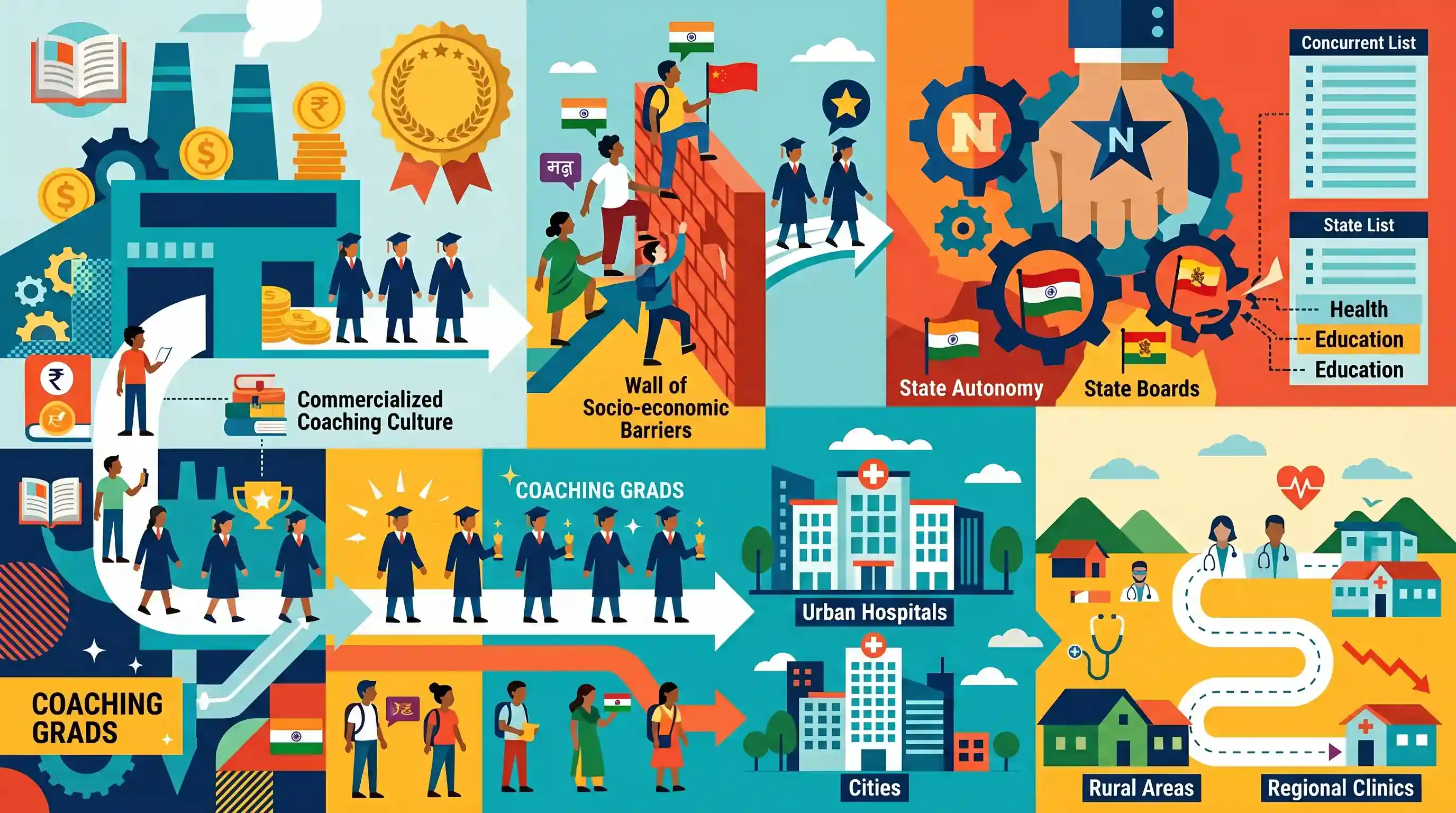
This podcast episode from The Hindu analyzes the ongoing debate on whether the National Eligibility cum Entrance Test (NEET) should be scrapped. It focuses specifically on how the centralized exam undermines genuine academic 'merit' by encouraging a hyper-commercialized coaching culture. The discussion centers on the socio-economic inequalities NEET fosters, the bias against regional-language and state-board students, the federal challenges to state autonomy, and the long-term adverse implications on the distribution of healthcare professionals in rural areas.
Key Points
- Redefining Merit: Critics argue that NEET reduces 'merit' to high-stakes test-taking abilities and rote memorization, which are heavily dependent on intensive coaching rather than holistic academic capability or genuine medical aptitude.
- Socio-Economic Barriers and Coaching Hegemony: The commercialization of medical test preparation (e.g., through major coaching hubs like Kota) creates a massive barrier for rural, vernacular-medium, and economically underprivileged students who cannot afford expensive coaching.
- Federal Friction and State Board Disadvantage: A single standardized exam favors CBSE curricula, placing students from regional state boards at a disadvantage. This challenges state-level educational and federal autonomy (education is a Concurrent List subject).
- Impact on Rural Healthcare: Centrally selected medical students who hail predominantly from urban, affluent backgrounds are less likely to fulfill local healthcare needs or serve in primary healthcare centers (PHCs) in rural regions compared to candidates from regional backgrounds.
- Vulnerabilities of Centralization: High-stakes centralized examinations serve as single points of failure, exposing the assessment system to systematic malpractices, paper leaks, and administration glitches, as observed in the 2024 controversies.
Important Terms
National Eligibility cum Entrance Test (NEET)

A centralized, national-level entrance exam in India for undergraduate and postgraduate medical courses, designed to establish a uniform standard of merit-based assessment across all central and state medical colleges.
UPSC context
GS Paper 2: Social sector/education, federalism. Tests critical capacity on centralized education policies and socio-economic equity.
Public Examinations (Prevention of Unfair Means) Act, 2024
A central legislation designed to combat malpractices—such as paper leaks, cheating, impersonation, and hacking—in public examinations conducted by major national testing and recruitment agencies, imposing stringent criminal penalties.
UPSC context
GS Paper 2: Governance and education integrity. Tests knowledge of regulatory frameworks to uphold meritocracy and prevent corruption.
National Testing Agency (NTA)
An autonomous, self-sustained premier testing organization under the Ministry of Education, established in 2017 to conduct standardized, transparent, and international-level entrance examinations for higher education in India.
UPSC context
GS Paper 2: Statutory and regulatory bodies. Tests understanding of educational governance and public examination reforms.
42nd Constitutional Amendment Act, 1976
A sweeping amendment—often called the "Mini-Constitution"—that transferred "Education" from the State List to the Concurrent List, empowering both the central and state governments to formulate educational policies and laws.
UPSC context
GS Paper 2: Federal structure and Centre-State relations. Tests historical constitutional amendments altering the division of power.
National Education Policy (NEP) 2020
A comprehensive framework based on the Kasturirangan committee's recommendations, aiming to transform India's educational landscape from school to higher education, replacing rote learning with holistic, multidisciplinary education.
UPSC context
GS Paper 2: Educational policy and reforms. Tests strategic insights on global alignment with sustainable development goals.
Prelims Trap
The Public Examinations (Prevention of Unfair Means) Act, 2024, uniformly governs all state-level school boards and state-university entrance exams.
The 2024 Act covers public exams conducted by central authorities (NTA, UPSC, SSC, etc.). It does not automatically govern state-level board or state-university exams unless adopted by individual state legislatures.
Static Concepts Connected
How does the Constitution divide legislative powers over medical education between Centre and States?
- Concurrent List placement: Entry 25 of List III places medical education under the Concurrent List, allowing both Parliament and State Legislatures to make laws.
- Union List supremacy: Entry 66 of List I grants the Union exclusive power over 'coordination and determination of standards' in higher education.
- Judicial harmonization: State laws on admission procedures cannot dilute or conflict with the standards set by Union regulations under Entry 66.
Can the State mandate a uniform entrance test like NEET for minority-run institutions?
- Article 30 limits: Article 30(1) grants minorities the right to administer educational institutions, but this right is not absolute and is subject to state regulation.
- Judicial precedent: In the CMC Vellore (2020) case, the Supreme Court ruled that a uniform exam promotes meritocracy and prevents commercialization without violating minority rights.
Cross-Topic Patterns
Centralized testing & rural healthcare deficit
Centralized entrance tests favor urban-centric, high-cost coaching candidates, directly reducing the pool of regional doctors willing to serve in provincial Primary Health Centers (PHCs).
Educational standardization vs asymmetric federalism
Over-centralization of national curricula (CBSE dominance in NEET) creates structural disadvantages for regional-board students, transforming education from a Concurrent subject into a de facto Union-led domain.

Mains 2026 will likely test the tension between Union standard-setting (Entry 66, List I) and State educational autonomy in the Concurrent List.
Linked PYQs · 4
Linked PYQs · 4
- 2024MainsGS2
What are the aims and objects of recently passed and enforced, The Public Examination (Prevention of Unfair Means) Act, 2024? Whether University/State Education Board examinations, too, are covered under the Act ?
- 2024MainsGS1
Despite comprehensive policies for equity and social justice, underprivileged sections are not yet getting the full benefits of affirmative action envisaged by the Constitution. Comment.
- 2020MainsGS2
National Education Policy 2020 is in conformity with the Sustainable Development Goal-4 (2030). It intends to restructure and reorient education system in India. Critically examine the statement.
- 2024MainsGS2
What changes has the Union Government recently introduced in the domain of Centre-State relations ? Suggest measures to be adopted to build the trust between the Centre and the States and for strengthening federalism.
