Risks Faced by Indian Seafarers on Sanctioned Ships
Source:The Hindu ↗
Why It Matters
It connects global geopolitical conflicts and economic sanctions to the real-world maritime security risks and labour challenges faced by Indian seafarers, emphasizing gaps in international shipping governance.
Summary
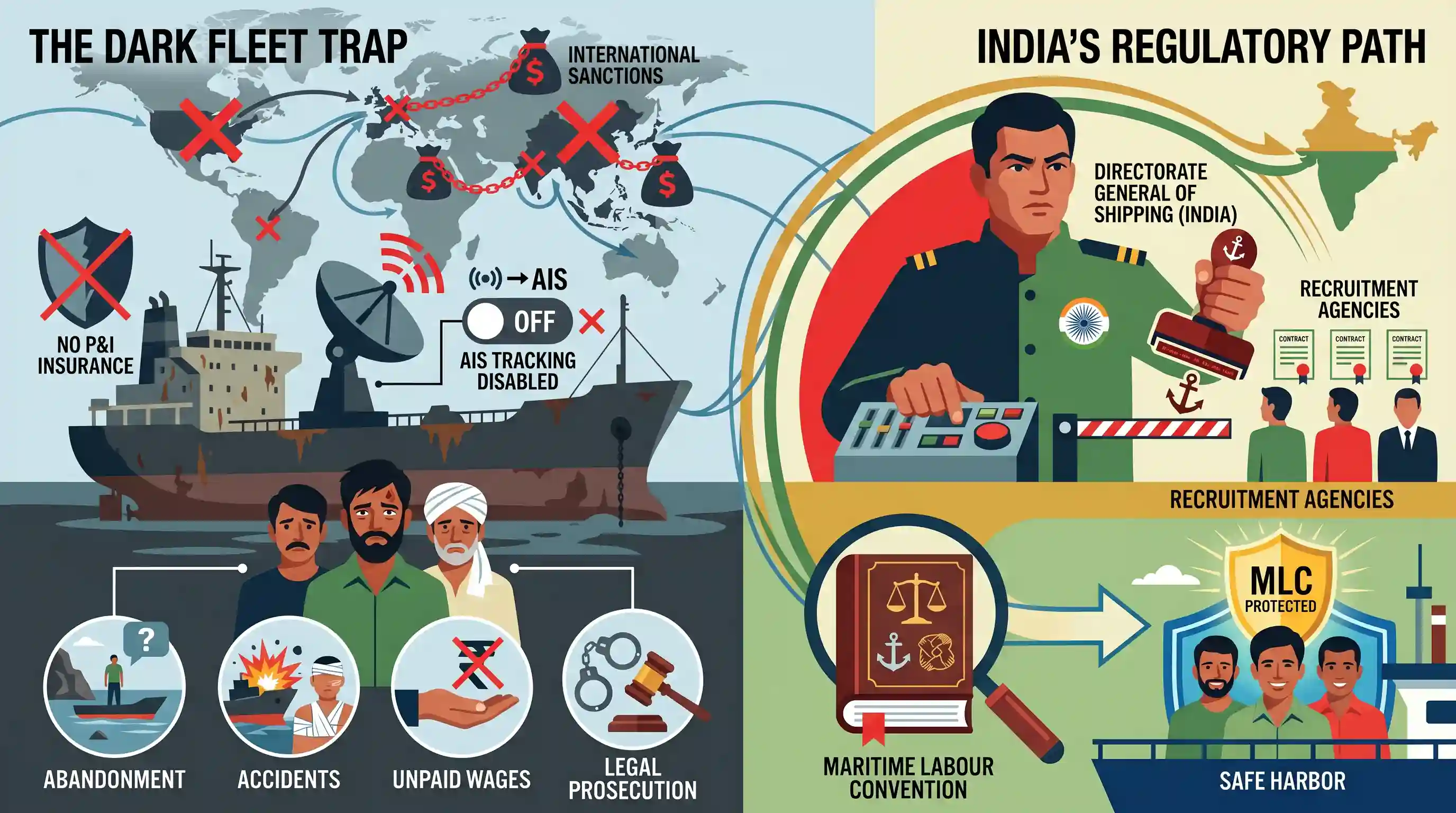
The article highlights the growing dangers faced by Indian seafarers working on sanctioned ships or the 'dark fleet.' Operating outside the bounds of traditional maritime law to circumvent geopolitical sanctions (like those against Russia or Iran), these vessels often lack standard Protection and Indemnity (P&I) insurance, employ deceptive practices such as turning off tracking systems (AIS), and operate in poor conditions. Consequently, seafarers face high risks of abandonment, accidents, unpaid wages, and legal prosecution. The piece advocates for India's Directorate General of Shipping to enhance the regulation of recruitment agencies to stop Indian nationals from being placed on such perilous vessels, ensuring their protection under frameworks like the Maritime Labour Convention.
Key Points
- The rise of a global "dark fleet" transporting sanctioned crude oil bypasses standard maritime regulations, creating severe risks for crew members.
- Indian seafarers, a major component of the global maritime workforce, face life-threatening risks on sanctioned ships due to poor maintenance, absence of legitimate P&I insurance, and deceptive shipping practices like disabling AIS trackers.
- Crew members on sanctioned vessels face the threat of abandonment, unpaid wages, and legal prosecution by international authorities enforcing sanctions.
- There is an urgent need for the Directorate General of Shipping (DGS) to tighten oversight of Recruitment and Placement Services (RPSL) to halt the deployment of Indian seafarers on these high-risk vessels.
Important Terms
Maritime Labour Convention (MLC), 2006

An ILO treaty, known as the 'Seafarers’ Bill of Rights,' establishing global minimum standards for maritime working conditions, including wages, health, and repatriation.
UPSC context
GS-II: International Relations/Labor Rights; tests knowledge of international legal frameworks protecting India’s massive overseas workforce.
Directorate General of Shipping (DGS)
India's apex maritime regulator under the Ministry of Ports, Shipping and Waterways, responsible for vessel certification, seafarer training, and safety standards.
UPSC context
GS-III: Infrastructure/Security; critical for understanding the executive governance of India's shipping industry and maritime security.
International Maritime Organization (IMO)
The United Nations' specialized agency responsible for the safety, security, and environmental performance of international shipping.
UPSC context
GS-II: International Institutions; relevant for questions on global maritime governance and safety treaties like SOLAS.
Protection and Indemnity (P&I) clubs
Mutual insurance associations of shipowners that provide liability cover for third-party risks, such as environmental damage, crew injuries, and legal penalties.
UPSC context
GS-III: Economy/Security; tests understanding of maritime risk management and vulnerabilities within the 'dark fleet' economy.
US OFAC sanctions
Economic restrictions managed by the U.S. Office of Foreign Assets Control to blacklist entities or vessels from the American financial system.
UPSC context
GS-II: International Relations; crucial for analyzing unilateral sanctions’ impact on global supply chains and Indian citizens abroad.
Prelims Trap
The Maritime Labour Convention (MLC), 2006 is administered by the International Maritime Organization (IMO).
The MLC is an International Labour Organization (ILO) convention, not an International Maritime Organization (IMO) instrument. Aspirants often assume all maritime agreements stem from the IMO.
Static Concepts Connected
What is a 'Flag of Convenience' (FoC) in international maritime law?
- Definition: Registering a ship in a state different from the owners to reduce costs, avoid taxes, or bypass stringent safety and labor regulations.
- UNCLOS Mandate: UNCLOS Article 91 requires a 'genuine link' between the state and the ship, a principle frequently undermined by open registries or FoCs.
What is the Maritime Labour Convention (MLC), 2006?
- ILO Origin: Adopted by the International Labour Organization (ILO), not the IMO. It is globally recognized as the 'Seafarers' Bill of Rights'.
- Core Mandate: Ensures decent working conditions, fair employment terms, safe workplaces, and access to medical care and repatriation for seafarers.
- India's Obligation: India has ratified the MLC, obligating domestic bodies like the Directorate General of Shipping (DGS) to enforce its standards for Indian nationals.
Cross-Topic Patterns
Dark Fleets & Energy Geopolitics
Western sanctions on Russian and Iranian crude spawned the shadow fleet. This links energy security with rising maritime safety and environmental hazards (uninsured oil spills).
Maritime Domain Awareness vs. Spoofing
Dark fleet vessels routinely disable or spoof AIS trackers, challenging India’s Information Fusion Centre for the Indian Ocean Region (IFC-IOR) and complicating regional maritime security.

Expect a 2026 Prelims question mixing UNCLOS 'genuine link' rules (Flags of Convenience) with ILO's Maritime Labour Convention provisions.
Linked PYQs · 2
Linked PYQs · 2
- 2025MainsGS3
Why is maritime security vital to protect India's sea trade? Discuss maritime and coastal security challenges and the way forward.
- 2022MainsGS3
What are the maritime security challenges in India ? Discuss the organisational, technical and procedural initiatives taken to improve the maritime security.
