Climate Leadership: Balancing India's Growth and Global South Role
Source:The Hindu ↗
Why It Matters
Understanding India's climate diplomacy is crucial for UPSC aspirants as it intersects environment (GS3), international relations (GS2), and economic development (GS3). Questions frequently test knowledge of India's climate commitments (like Panchamrit/Paris Agreement), the principle of CBDR, and the socio-economic challenges of transitioning to renewable energy.
Summary
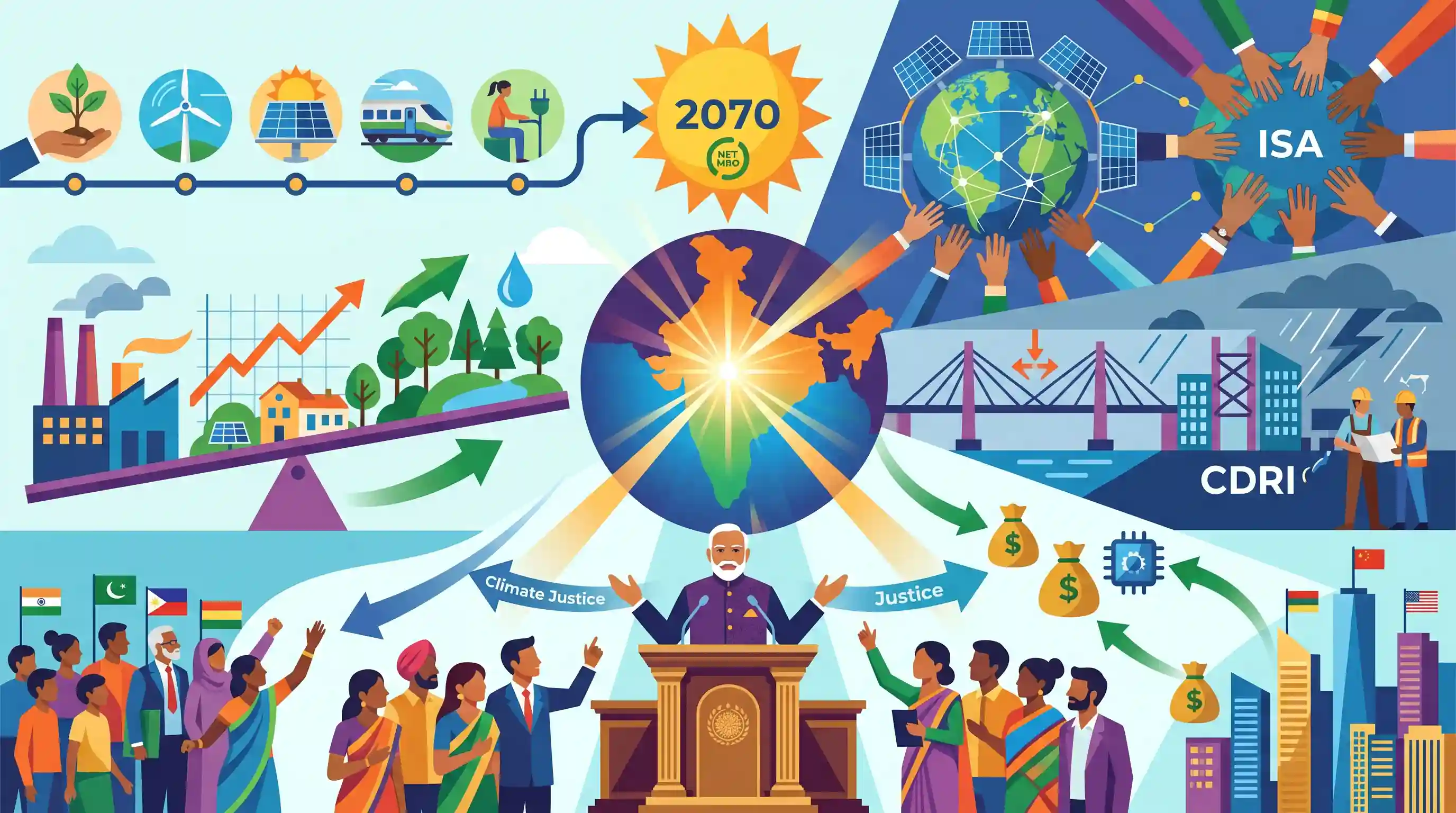
The article explores whether India is well-equipped and strategically motivated to take on a leadership role in global climate change initiatives. It examines India's ambitious climate commitments, such as the Panchamrit goals, Net Zero by 2070, and its proactive stance in initiating platforms like the International Solar Alliance (ISA) and the Coalition for Disaster Resilient Infrastructure (CDRI). The narrative evaluates the complexities India faces, notably balancing rapid economic growth and poverty eradication with the urgent need for a green energy transition. Furthermore, it highlights India's potential to serve as the voice of the Global South, advocating for climate justice, equitable climate finance, and technology transfer from developed nations, thereby enhancing its geopolitical influence.
Key Points
- India is uniquely positioned to champion climate justice and represent the interests of the Global South in international climate negotiations.
- The country has committed to ambitious climate action, notably the 'Panchamrit' pledges from COP26, including achieving Net Zero emissions by 2070 and a significant expansion of renewable energy capacity.
- Effective global climate leadership requires advocating for critical issues like climate finance, technology transfer, and Common But Differentiated Responsibilities (CBDR) between developed and developing nations.
- Domestically, India faces the dual challenge of ensuring rapid economic growth, energy security, and poverty eradication while transitioning away from a fossil fuel-dependent economy.
- Assuming a leadership role in climate diplomacy can significantly boost India's geopolitical standing, foster green technological innovation, and attract sustainable investments.
Important Terms
Panchamrit

India's five-point climate action plan announced at COP26, including targets for 500GW non-fossil energy capacity and reaching Net Zero emissions by 2070.
UPSC context
GS III Environment; tests understanding of India's strategic climate roadmap and its leadership role in the global green transition.
International Solar Alliance (ISA)
An India-France led intergovernmental organization headquartered in Gurugram, India, focused on increasing solar energy deployment to reduce global dependence on fossil fuels.
UPSC context
GS II IR/GS III Energy; tests knowledge of India's proactive climate diplomacy and leadership in renewable energy governance.
Coalition for Disaster Resilient Infrastructure (CDRI)
A global partnership launched by India in 2019 to promote the resilience of infrastructure systems to climate and disaster risks through knowledge exchange.
UPSC context
GS III Disaster Management; tests understanding of Indian-led initiatives for global infrastructure resilience and climate adaptation strategies.
Paris Agreement
A 2015 legally binding international treaty under the UNFCCC aiming to limit global warming to well below 2°C, primarily through Nationally Determined Contributions (NDCs).
UPSC context
GS III Environment; central to global climate governance, NDCs, and the principle of Common But Differentiated Responsibilities (CBDR).
UNFCCC
The 1992 United Nations Framework Convention on Climate Change, providing the foundational legal framework for international cooperation and negotiations on stabilizing greenhouse gases.
UPSC context
GS III Environment; essential for understanding the institutional framework of global climate treaties and multilateral environmental negotiations.
IPCC
The UN scientific body established in 1988 to provide comprehensive assessments of climate change, its risks, and options for adaptation and mitigation.
UPSC context
GS III Environment; tests knowledge of the scientific basis and reports that drive international climate policies and consensus.
Prelims Trap
India committed to achieving 500 GW of renewable energy capacity by 2030 under the Panchamrit strategy.
The 500 GW target is specifically for 'non-fossil fuel' capacity, which includes nuclear and large hydro. It is not exclusively for 'renewable energy' sources like solar and wind.
Static Concepts Connected
What is the principle of CBDR-RC under the UNFCCC framework?
- Origin: Formalized at the 1992 Earth Summit (Rio Declaration), establishing the foundation for international climate negotiations.
- Core Logic: Acknowledges that while all states share a climate obligation, historically industrialized nations bear greater responsibility for cumulative emissions.
- Implementation: Serves as the legal and moral basis for developing nations to demand climate finance and technology transfer from the developed world.
How do India-led initiatives ISA and CDRI differ in mandate?
- ISA Focus: Dedicated to deploying solar energy globally. Initially restricted to countries between the Tropics, it is now open to all UN members. HQ is in Gurugram.
- CDRI Focus: Focuses on promoting resilience of new and existing infrastructure systems to climate and disaster risks. It spans multiple sectors globally. HQ is in New Delhi.
Cross-Topic Patterns
Climate Justice vs. Carbon Border Taxes
India's push for Common But Differentiated Responsibilities (CBDR) directly clashes with developed nations' protectionist measures like the EU's Carbon Border Adjustment Mechanism (CBAM), linking climate diplomacy to WTO trade disputes.
Climate leadership as leverage for UNSC
Championing Global South causes, such as equitable climate finance, serves as a strategic pillar in India's broader geopolitical campaign for reformed multilateralism and permanent UNSC membership.

Expect a 2026 prelims statement swapping Panchamrit's 'non-fossil' target for 'renewable' or confusing CDRI and ISA membership rules.
Linked PYQs · 5
Linked PYQs · 5
- 2021MainsGS3
Describe the major outcomes of the 26th session of the Conference of the Parties (COP) to the United Nations Framework Convention on Climate Change (UNFCCC). What are the commitments made by India in this conference?
- 2025MainsGS3
Write a review on India's climate commitments under the Paris Agreement (2015) and mention how these have been further strengthened in COP26 (2021). In this direction, how has the first Nationally Determined Contribution intended by India been updated in 2022?
- 2025MainsGS3
How can India achieve energy independence through clean technology by 2047? How can biotechnology can play a crucial role in this endeavour?
- 2022MainsGS3
Do you think India will meet 50 percent of its energy needs from renewable energy by 2030 ? Justify your answer. How will the shift of subsidies from fossil fuels to renewables help achieve the above objective ? Explain.
- 2020MainsGS3
Explain intra-generational and inter-generational issues of equity from the perspective of inclusive growth and sustainable development.
