India-China Border Dispute and Economic Normalisation Dilemma
Source:The Hindu ↗
Why It Matters
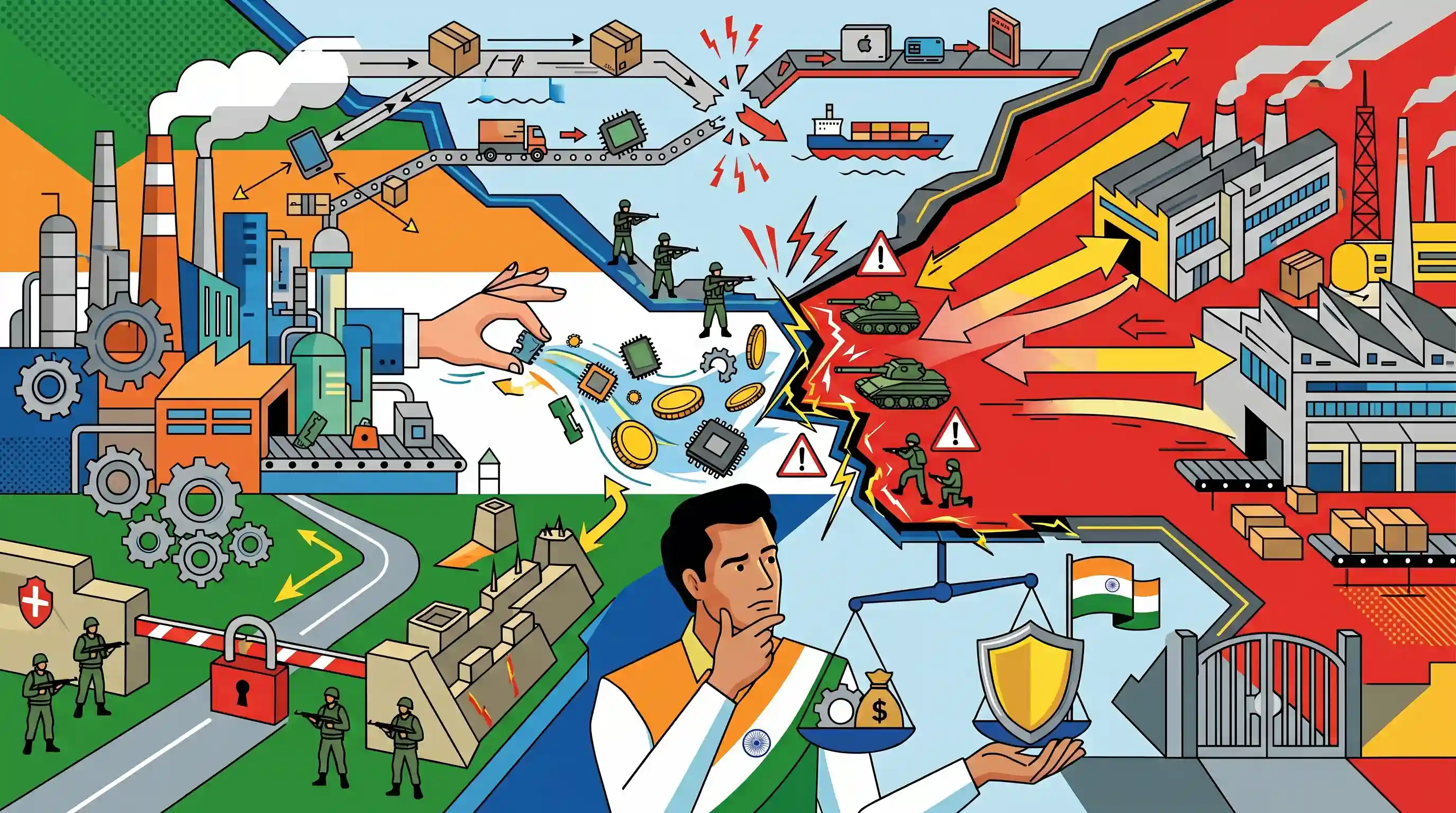
As the military standoff at the LAC persists, India's policy choice—whether to restrict Chinese economic involvement or selectively allow it to aid domestic manufacturing—will fundamentally shape its long-term strategic and economic trajectory in the region.
Summary
The article analyzes the ongoing strategic dilemma of whether India should separate its economic and diplomatic engagement with China from the protracted border dispute at the Line of Actual Control (LAC). It explores the tension between India's economic need for Chinese investment and components to strengthen its manufacturing sector, and the security imperative to deter territorial aggression by making border resolution a strict precondition for normalized ties. The piece underscores the complex trade-offs between economic pragmatism and national sovereignty in shaping India's foreign policy toward China.
Key Points
- The article examines the debate over whether India should de-link its economic and diplomatic relations with China from the unresolved border standoff along the Line of Actual Control (LAC).
- Advocates for economic pragmatism argue that India needs Chinese investments, components, and technical expertise to boost domestic manufacturing and integrate into global supply chains.
- Conversely, security experts warn that normalizing relations without restoring the status quo ante at the border would legitimize territorial aggression and compromise national security.
- The overarching strategic dilemma highlights the difficulty of balancing India's economic growth ambitions against its sovereignty and border security imperatives.
Prelims Trap
Press Note 3 (2020) explicitly restricts Foreign Direct Investment originating from China to prevent opportunistic takeovers.
Press Note 3 applies to FDI from ANY country sharing a land border with India (e.g., Bangladesh, Pakistan, Nepal, Bhutan, Myanmar), not just China.
Static Concepts Connected
How does Press Note 3 (2020) alter FDI rules for neighbouring countries?
- Approval route: Investments from countries sharing a land border with India, previously allowed under the automatic route, now mandate prior government approval.
- Beneficial ownership: The restriction also applies if the beneficial owner of an investment is situated in or is a citizen of these land-bordering nations.
- Strategic rationale: It was enacted to prevent opportunistic takeovers or acquisitions of vulnerable Indian companies during the economic stress of the COVID-19 pandemic.
What distinguishes the LAC from the LoC in India's border architecture?
- Legal status: The LoC is a delineated, legally recognized boundary backed by the Shimla Agreement (1972), whereas the LAC is a non-demarcated, conceptual military line.
- Geographic scope: The LoC divides Indian and Pakistani-administered parts of Jammu & Kashmir; the LAC separates Indian and Chinese-controlled territories.
Cross-Topic Patterns
Pharma APIs + China Dependency
India's Production-Linked Incentive (PLI) scheme for bulk drugs directly attempts to counter the 70% API reliance on China, linking geopolitical border disputes with internal health security vulnerabilities.
China Plus One Paradox
Western 'China Plus One' strategies aim to build Indian manufacturing, but India still paradoxically requires Chinese capital goods and expertise to develop this alternative capacity.

Expect a 2026 Prelims question combining Press Note 3 FDI rules, API import reliance, and the economic paradox of the China Plus One strategy.
Linked PYQs · 3
Linked PYQs · 3
- 2012MainsGS2
Do you think that China's emergence as one of the largest trading partners of India has adversely affected the settlement of the outstanding border problem?
- 2024MainsGS2
‘The West is fostering India as an alternative to reduce dependence on China's supply chain and as a strategic ally to counter China's political and economic dominance.’ Explain this statement with examples.
- 2024MainsGS3
India has a long and troubled border with China and Pakistan fraught with contentious issues. Examine the conflicting issues and security challenges along the border. Also give out the development being undertaken in these areas under the Border Area Development Programme (BADP) and Border Infrastructure and Management (BIM) Scheme.
