Maharashtra State Commemoration Of Agra Escape Anniversary
Source:mid-day ↗
Why It Matters
The event highlights Maharashtra's rich historical legacy and state-sponsored efforts to commemorate Chhatrapati Shivaji Maharaj's strategic escape from Mughal captivity, a defining moment in Maratha-Mughal history crucial for MPSC aspirants.
Summary
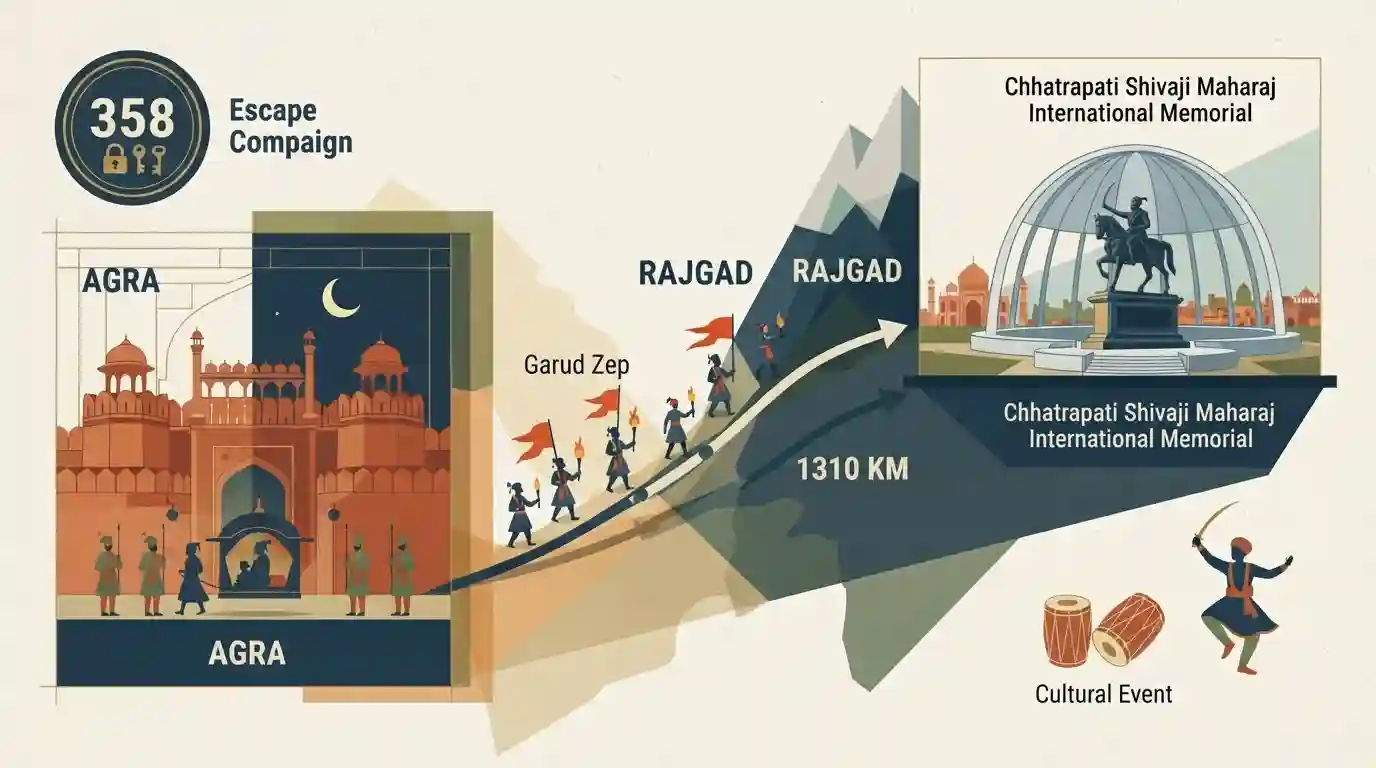
The Maharashtra government marked August 17 as 'Shivchaturya Din' to commemorate the 358th anniversary of Chhatrapati Shivaji Maharaj's daring escape from Agra. As part of the celebrations, a 1,310-km 'Garud Zep' campaign was flagged off, retracing the historical route from Agra to Rajgad. The state also announced the creation of a grand Chhatrapati Shivaji Maharaj International Memorial in Agra, further honoring his legacy through cultural events held at Agra Fort.
Key Points
- The Maharashtra government observed 'Shivchaturya Din' on August 17 to commemorate the 358th anniversary of Chhatrapati Shivaji Maharaj's historic escape from Agra in 1666.
- A 1,310-km 'Garud Zep' campaign was flagged off, retracing the legendary escape route from Agra to Rajgad in Pune.
- Plans were announced to establish the 'Chhatrapati Shivaji Maharaj International Memorial' in Agra to honor his legacy.
- Cultural programmes celebrating Maratha history were organized at the Diwan-e-Aam in Agra Fort, coordinated by Maharashtra's Protocol Minister Jaykumar Rawal.
Important Terms
Shivchaturya Din

An annual observance by the Maharashtra government on August 17 to commemorate Chhatrapati Shivaji Maharaj's historic 1666 escape from Agra, celebrating his strategic brilliance.
UPSC context
Crucial for MPSC GS-1 (History of Maharashtra) and Current Affairs, highlighting state commemorations of key Maratha events.
Garud Zep Campaign
A 1,310-km commemorative foot and cycling expedition retracing Chhatrapati Shivaji Maharaj's historic escape route from Agra back to Rajgad Fort, promoting awareness of Swarajya.
UPSC context
Relevant for MPSC GS-1 and Current Affairs, testing knowledge of cultural initiatives connecting citizens with Maharashtra's historical milestones.
Chhatrapati Shivaji Maharaj International Memorial
A grand cultural memorial in Agra, jointly coordinated by the Uttar Pradesh and Maharashtra governments, honoring Shivaji Maharaj's historic stay and successful escape in 1666.
UPSC context
Important for MPSC GS-1 and inter-state current affairs, emphasizing monumental national tributes and the promotion of Maratha history.
Prelims Trap
The 'Garud Zep' campaign retraces Shivaji Maharaj's escape route from Agra to Raigad.
Aspirants confuse Raigad with Rajgad. The escape in 1666 ended at Rajgad, the then-capital. Raigad became the capital later in 1674.
Static Concepts Connected
What were the primary terms of the 1665 Treaty of Purandar?
- Forts surrendered: Shivaji Maharaj was forced to cede 23 forts to the Mughal empire, retaining only 12 for himself.
- Military alliance: Shivaji Maharaj agreed to assist Mughals against Bijapur; his son Sambhaji was granted a Mansab of 5,000.
- Agra visit: The treaty, negotiated by Mirza Raja Jai Singh, directly precipitated Shivaji Maharaj's visit to Agra.
Which forts served as the primary capitals of Chhatrapati Shivaji Maharaj?
- Rajgad: The first capital of the Swarajya, serving as the seat of government for nearly 26 years, and the destination of the 1666 escape.
- Raigad: The second capital, chosen for its impregnability, where the official coronation (Rajyabhishek) occurred in 1674.
Cross-Topic Patterns
Chronology of Maratha history
State-led commemorations frequently trigger chronology-based questions in MPSC (e.g., Treaty of Purandar → Agra visit → Escape → Coronation).
State diplomacy via heritage
Maharashtra building a memorial in UP (Agra) reflects a growing trend of inter-state cultural diplomacy and heritage tourism promotion.

Expect a multi-statement question pairing current facts ('Shivchaturya Din', Garud Zep) with the 1665-1666 Purandar-to-Agra chronology.
Linked PYQs · 1
Linked PYQs · 1
- 2026MPSC_PRELIMSGS1
Match the following Sanskrit authors of the Mughal India and their works. | (a) | (i) | |---|---| | (a) Anantadeva | (i) Chaitanya Charitamritam | | (b) Gangadhara | (ii) Nirnaya Sindhu | | (c) Kamlakara Bhatta | (iii) Manorama | | (d) Krishna Das Kaviraja | (iv) Samskarakaustubha | Answer Options:
