Karnataka Regional Politics and Caste Based Electoral Strategies
Source:Indian Express ↗
Why It Matters
Provides practical insights into how regional leadership and caste dynamics influence political strategies and electoral outcomes, relevant for GS-1 (Society/Caste) and GS-2 (State Politics/Elections).
Summary
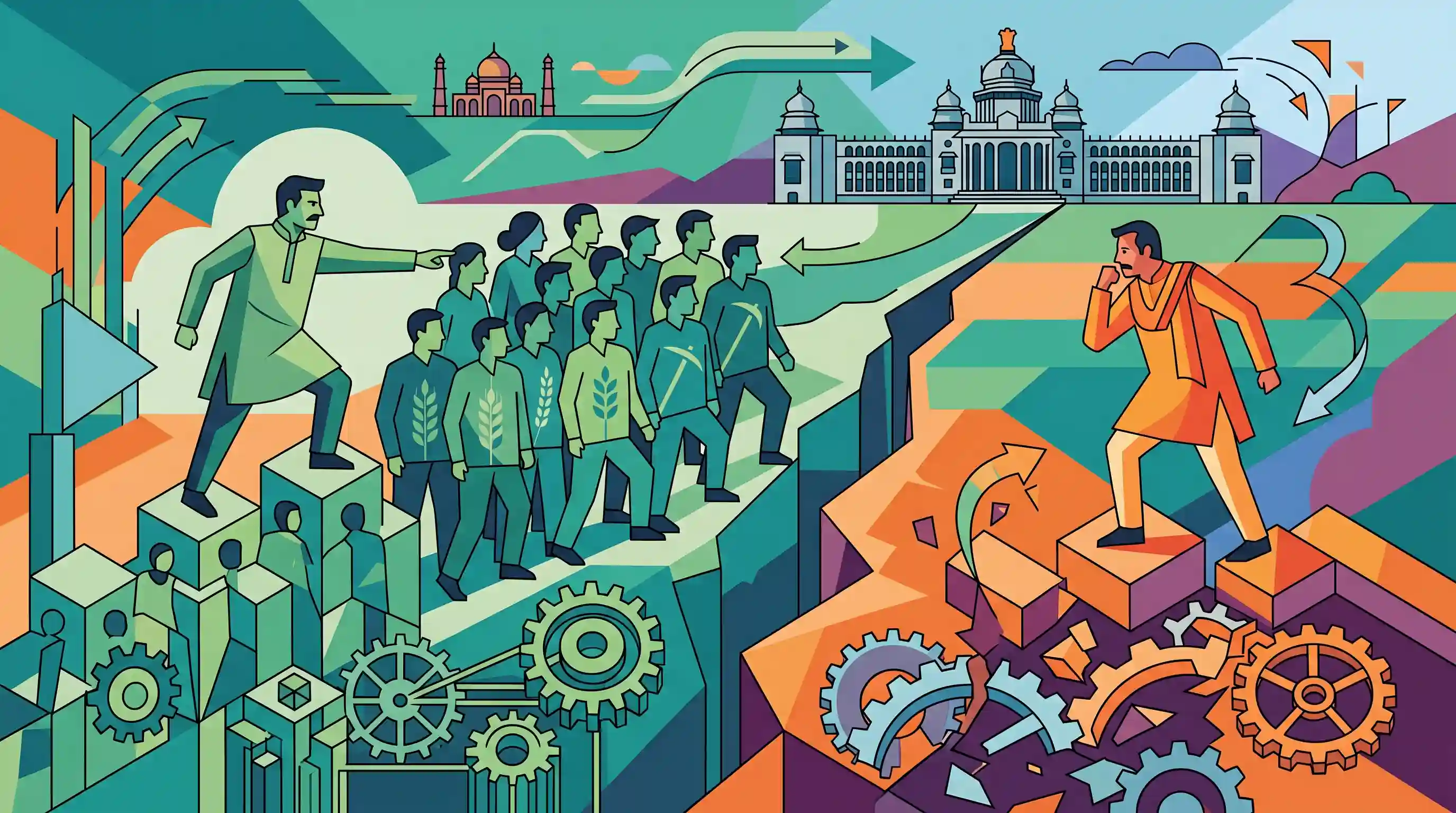
The article analyzes the evolving political dynamics in Karnataka, focusing on how Deputy Chief Minister D.K. Shivakumar's assertive leadership and caste-based consolidation (particularly among Vokkaligas) are forcing the opposition BJP to recalibrate its political strategy in the state. By bridging gaps in the Congress party's traditional vote base and aggressively expanding organizational reach, Shivakumar is countering the BJP's established methods of electoral engineering, highlighting broader themes of regionalism, caste arithmetic, and realpolitik in state-level governance.
Key Points
- D.K. Shivakumar's strategic consolidation of the Vokkaliga community and his organizational prowess are bolstering the Congress party's position in Karnataka.
- The BJP, which traditionally relied on Lingayat support and Hindutva consolidation in the state, is being compelled to rework its electoral and organizational playbook to counter this shift.
- Intra-party dynamics within both the BJP and the Congress play a crucial role in shaping the state's fluid political landscape.
- The changing strategies underscore the continued salience of caste associations and robust regional leadership in determining state-level electoral outcomes in India.
Important Terms
Vokkaliga

A powerful agrarian community in Karnataka, primarily in the Old Mysore region. Historically a 'dominant caste,' they wield significant influence in state politics through land ownership and numerical strength.
UPSC context
GS Paper 1 (Society) and GS Paper 2 (Polity); tests understanding of regional caste dynamics and political mobilization.
Caste Arithmetic
The strategic calculation of various caste groups' numerical strength and voting patterns to build a winning electoral coalition, often used by political parties to manage 'vote banks.'
UPSC context
GS Paper 2 (Polity); tests knowledge of the 'politicization of caste' and its impact on democratic processes.
Electoral Engineering
The deliberate design or manipulation of electoral rules, social alignments, or constituency boundaries to influence election outcomes and shape party systems toward a specific goal.
UPSC context
GS Paper 2 (Electoral Reforms); tests understanding of how institutional structures and strategic planning influence democratic representation.
Realpolitik
A pragmatic political strategy focusing on power, practical considerations, and state interests rather than following moral, ethical, or strictly ideological premises.
UPSC context
GS Paper 2 (International Relations) and PSIR Optional; tests the ability to analyze realistic power dynamics in governance.
Regionalism
Loyalty to a specific geographic region based on shared language, culture, or history. In India, it influences federal relations and can manifest as cultural pride or separatist demands.
UPSC context
GS Paper 1 (Social Issues) and GS Paper 2 (Federalism); tests knowledge of challenges to national integration and diversity management.
Prelims Trap
"Lingayats currently enjoy the status of a distinct religious minority at the national level."
While the Karnataka state government historically recommended religious minority status for Lingayats, the Central government has not recognized them as a distinct national religious minority.
Static Concepts Connected
What are the core criteria of a "Dominant Caste" (M.N. Srinivas)?
- Economic Power: Ownership of a sizable amount of arable land in the local area, translating to economic clout.
- Numerical Strength: A significant population size that provides overwhelming electoral and political leverage in democratic setups.
- Ritual Status: A respectable or intermediate position in the local caste hierarchy, not necessarily the highest (Brahmin) status.
What were the key features of the 12th-century Lingayat movement?
- Rejection of Orthodoxy: Basaveshwara vehemently rejected Vedic rituals, temple worship, and the rigid caste hierarchy, promoting egalitarianism.
- Anubhava Mantapa: Established the "Hall of Spiritual Experience," an early parliament-like forum for open philosophical and social debate among all castes and genders.
- Vachana Sahitya: Propagated complex philosophy through simple Kannada poetry, making spiritual knowledge accessible to the masses.
Cross-Topic Patterns
Regional leadership vs. National mandates
State elections increasingly pivot on strong regional satraps and localized caste arithmetic (like AHINDA), frequently diverging from the outcomes of general elections driven by national mandates.
Politicisation of caste as democratization
Rajni Kothari's thesis argues that caste acts as a modern interest group. Rather than disappearing, caste associations mobilize voters, forcing parties to democratize power among middle and backward classes.

Expect a multi-statement Prelims question on Basaveshwara's Anubhava Mantapa or a GS2 Mains question on the 'politicisation of caste'.
Linked PYQs · 2
Linked PYQs · 2
- 2018MainsGS1
Caste system is assuming new identities and associational forms. Hence, caste system cannot be eradicated in India." Comment.
- 2022MainsGS1
Analyse the salience of 'sect' in Indian society vis-a-vis caste, region and religion.
