सुप्रीम कोर्ट ने शिवसेना चुनाव चिह्न विवाद पर अगस्त में सुनवाई तय की
स्रोत:इंडियन एक्सप्रेस ↗
क्यों मायने रखता है
This case highlights the Election Commission's quasi-judicial role under the Election Symbols (Reservation and Allotment) Order, 1968, to settle intra-party disputes resulting from splits. It also emphasizes the extent and limits of judicial review by the Supreme Court over ECI's decisions.
सारांश
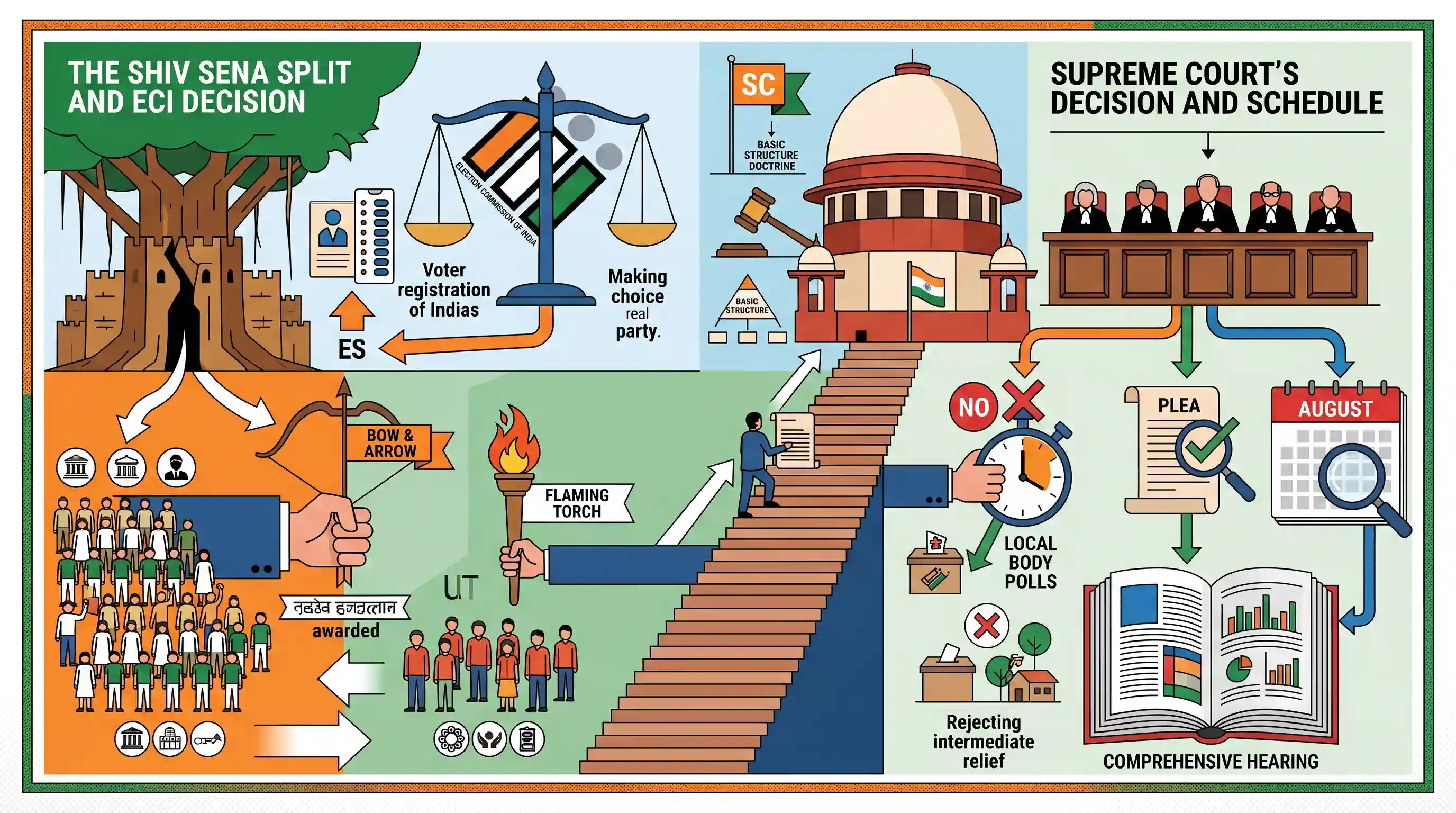
The Supreme Court has agreed to hear a plea by the Uddhav Thackeray faction challenging the Election Commission's decision to recognise the Eknath Shinde-led group as the real Shiv Sena and assigning them the 'Bow & Arrow' symbol. Rejecting an appeal for immediate interim relief ahead of Maharashtra's local body polls, the bench decided to list the main case for a comprehensive hearing in August.
मुख्य बिंदु
- The Supreme Court will hear Uddhav Thackeray\'s plea in August challenging the Election Commission\'s decision to recognise the Eknath Shinde faction as the official Shiv Sena.
- The Election Commission had allocated the traditional 'Bow & Arrow' symbol to the Shinde faction in February 2023.
- The Uddhav faction was granted the name 'Shiv Sena (Uddhav Balasaheb Thackeray)' and the 'flaming torch' symbol.
- The Thackeray faction requested interim relief citing upcoming local body polls in Maharashtra, but the Supreme Court opted to hear the main case instead.
महत्वपूर्ण शब्द
Supreme Court of India

Highest judicial body under the Indian Constitution (Articles 124-147); it conducts judicial review and resolves disputes between citizens/states and constitutional interpretations.
UPSC context
GS Paper 2: Judiciary; tests understanding of original, appellate, and advisory jurisdictions in political-legal disputes.
Election Commission of India (ECI)
Autonomous constitutional authority (Article 324) responsible for administering national and state elections, including party registration and symbol allotment.
UPSC context
GS Paper 2: Constitutional Bodies; covers powers to resolve party splits and maintain electoral integrity.
Tenth Schedule (Anti-Defection Law)
Provisions added via the 52nd Amendment (1985) to disqualify legislators for defecting from their political party to ensure government stability.
UPSC context
GS Paper 2: Indian Constitution; tests disqualification grounds, exceptions like mergers, and the Speaker's role.
Election Symbols Order, 1968
Legislative framework (Para 15) empowering the Election Commission to decide on rival claims for a party’s name and symbol during a split.
UPSC context
GS Paper 2: Statutory/Regulatory Bodies; tests ECI's quasi-judicial power in political party recognition.
Speaker of the Legislative Assembly
The presiding officer of the Legislative Assembly who serves as the primary adjudicatory authority for disqualification petitions under the Tenth Schedule.
UPSC context
GS Paper 2: Parliament and State Legislatures; tests the Speaker’s neutral role and judicial review of their decisions.
प्रारंभिक ट्रैप
The Speaker of the Lok Sabha or Assembly decides which faction gets the party symbol during a split.
The Speaker decides disqualification under the 10th Schedule, but the ECI exclusively adjudicates party splits and allocates symbols under the Election Symbols Order, 1968.
संबंधित अवधारणाएँ
How does the ECI resolve disputes over party symbols during a split?
- Symbols Order 1968: The ECI derives statutory authority to adjudicate factional disputes and allocate party names and symbols from Paragraph 15 of this order.
- Test of Majority: Following the landmark Sadiq Ali case (1971), the ECI evaluates the numerical strength of rival factions in both their legislative and organisational wings.
- Quasi-judicial role: When resolving disputes between rival factions of a recognised political party, the Election Commission acts as a quasi-judicial body.
How does the Tenth Schedule deal with political party splits and mergers?
- Split exemption removed: The 91st Constitutional Amendment Act (2003) deleted the provision that protected legislators from disqualification if one-third of them formed a split faction.
- Merger exception: Legislators are protected from defection only if their original political party merges with another, and at least two-thirds of the legislators agree to the merger.
- Adjudicating authority: The Presiding Officer (Speaker/Chairman) of the respective House acts as the final adjudicating authority for disqualification under the Tenth Schedule.
अंतर-विषय पैटर्न
Tenth Schedule vs ECI Mandate
Parallel operations of the Speaker deciding disqualifications (10th Schedule) and the ECI allocating symbols (Symbols Order 1968) create constitutional friction, frequently requiring Supreme Court adjudication.
Plenary powers of Article 324
Beyond statutory laws, Article 324 acts as a reservoir of plenary powers, allowing the ECI to issue binding orders on symbol allotments to ensure free and fair elections where legislation is absent.

A 2026 prelims question will likely contrast ECI's 'Test of Majority' (Symbols Order) with the Speaker’s role under the 10th Schedule.
संबद्ध PYQ · 4
संबद्ध PYQ · 4
- 2022MainsGS2
Discuss the role of the Election Commission of India in the light of the evolution of the Model Code of Conduct.
- 2017PrelimsGS1
Consider the following statements: 1. The Election Commission of India is a five-member body. 2. Union Ministry of Home Affairs decides the election schedule for the conduct of both general elections and bye-elections. 3. Election Commission resolves the disputes relating to splits/mergers of recognised political parties. Which of the statements given above is/are correct?
- 2014PrelimsGS1
Which one of the following Schedules of the Constitution of India contains provisions regarding anti-defection?
- 1998PrelimsGS1
Which one of the following Schedules of the Constitution of India contains provisions regarding Anti-Defection Act?
