Shipwrecks and Coastal State Jurisdiction Under UNCLOS
Source:Indian Express ↗
Why It Matters
Incidents involving foreign vessels in Indian waters test the jurisdictional limits of state police and national laws against international conventions like UNCLOS. Similar to the historical Enrica Lexie (Italian Marines) case, this event is highly relevant for understanding the overlap of domestic jurisdiction and international treaties (GS2) as well as coastal security challenges (GS3).
Summary
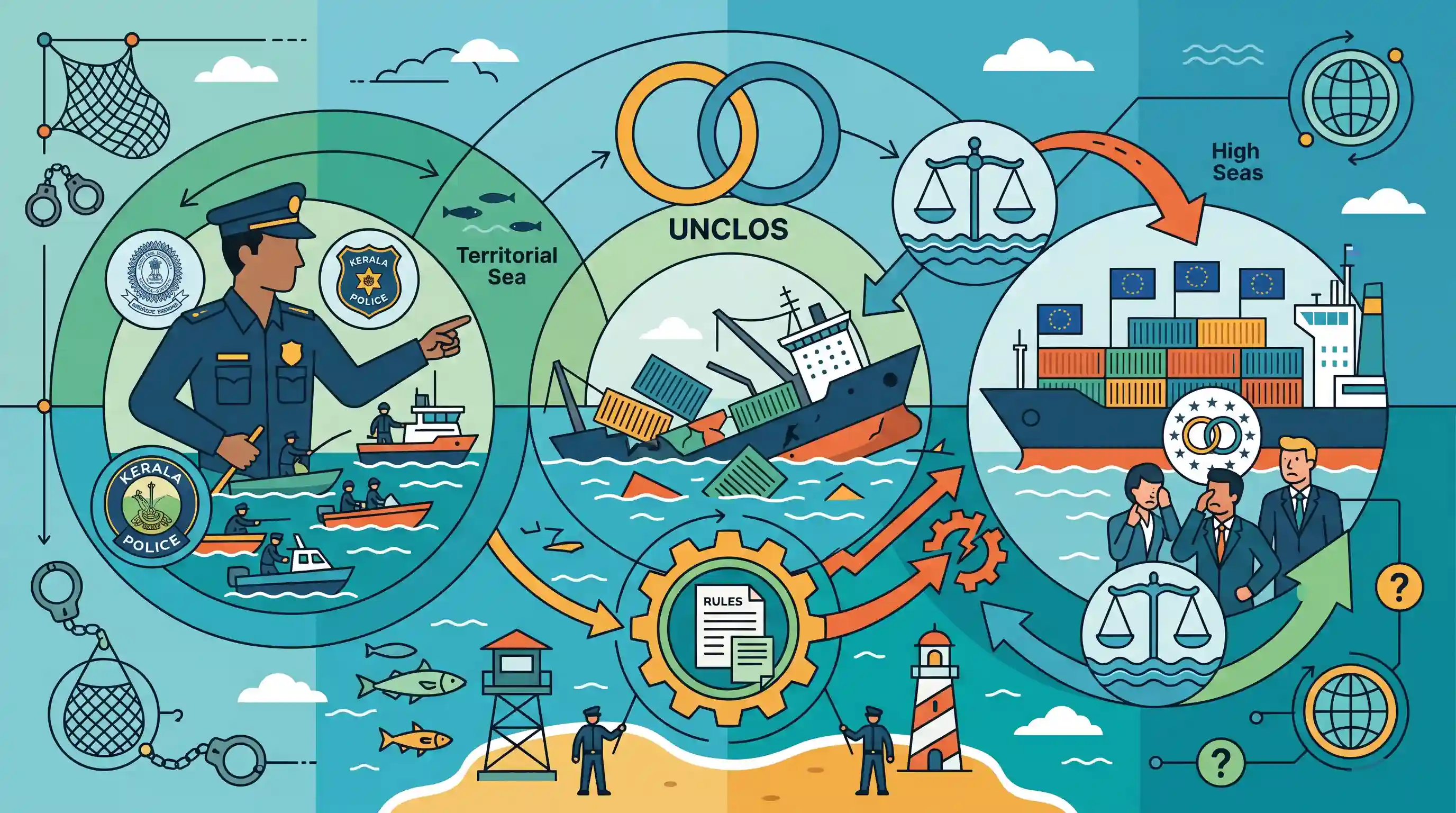
Weeks after a shipwreck off its coast, the Kerala Police registered a criminal case against a European shipping company. The legal action highlights the complex jurisdictional intersection between state police powers, national maritime boundaries, and international law under UNCLOS. The incident underscores the ongoing challenges in ensuring maritime safety, enforcing coastal security, and holding foreign entities accountable for accidents in Indian waters.
Key Points
- Kerala Police has registered a criminal case against a European shipping company following a recent shipwreck incident.
- The move invokes questions of maritime jurisdiction, specifically the legal powers of state authorities to prosecute foreign shipping entities under domestic law.
- The case brings into focus the provisions of the United Nations Convention on the Law of the Sea (UNCLOS) concerning coastal state jurisdiction in territorial waters and the EEZ.
- Highlights ongoing challenges in coastal security, maritime safety, and fixing liability for marine accidents or potential environmental damage.
Important Terms
United Nations Convention on the Law of the Sea (UNCLOS)

1982 international treaty establishing the legal framework for marine activities, defining rights/responsibilities of nations regarding use of the world's oceans and resource management.
UPSC context
GS-II: International Relations; crucial for maritime security, territorial disputes (e.g., South China Sea), and India's Indo-Pacific strategy.
Exclusive Economic Zone (EEZ)
A sea zone extending up to 200 nautical miles from the baseline where a coastal state has sovereign rights for resource exploration and exploitation.
UPSC context
GS-III: Economy/Security; tests understanding of India's maritime resources and jurisdictional limits for law enforcement.
Admiralty Jurisdiction
Legal authority vested in specific courts to hear and decide cases involving maritime contracts, torts, injuries, and ship arrests (actions in rem).
UPSC context
GS-II: Indian Judiciary; relevant to the Admiralty Act 2017 and how India holds foreign entities accountable for accidents.
International Maritime Organisation (IMO)
A specialized United Nations agency responsible for regulating global shipping, ensuring vessel safety, and preventing marine pollution.
UPSC context
GS-II: International Organizations; tests knowledge of global governance standards for shipping and environmental protection.
Territorial Waters
A belt of coastal waters extending up to 12 nautical miles from the baseline over which a state exercises full sovereignty.
UPSC context
GS-III: Internal Security; fundamental to coastal security and the limits of state police vs. central agencies' powers.
Maritime Zones Act, 1976
Indian legislation providing the domestic legal framework for defining and regulating the territorial sea, contiguous zone, EEZ, and continental shelf.
UPSC context
GS-II: Indian Polity/Law; significant for understanding how international maritime law is enacted within India's legal system.
Prelims Trap
State police stations cannot register or investigate criminal cases for incidents occurring in India's Exclusive Economic Zone (EEZ).
The MHA has specifically empowered 10 designated coastal police stations across India to legally register and investigate offences committed anywhere within the 200-NM EEZ.
Static Concepts Connected
How is criminal jurisdiction applied across India's maritime zones?
- Territorial Sea: Full sovereignty up to 12 NM. Criminal jurisdiction applies, though UNCLOS Article 27 limits it on foreign ships in innocent passage unless local peace is disturbed.
- EEZ Jurisdiction: Extends to 200 NM. India's Maritime Zones Act 1976 empowers the Union to extend IPC/CrPC here, actively delegated to specific designated coastal police stations.
- High Seas: Governed by flag state jurisdiction. No single state has criminal jurisdiction over a foreign vessel on the high seas.
What constitutes India's three-tier coastal security grid?
- Marine Police: State-level forces tasked with patrolling shallow coastal and territorial waters up to 12 nautical miles from the baseline.
- Coast Guard: Secures the intermediate zone from 12 to 200 nautical miles, actively policing the Exclusive Economic Zone (EEZ) for violations.
- Indian Navy: Patrols the high seas beyond 200 nautical miles and retains overall apex command and coordination for national maritime security.
Cross-Topic Patterns
Maritime Law meets Federalism
The Enrica Lexie ruling forced the Union to formally delegate EEZ investigative powers to specific state police stations, linking international maritime law directly to Center-State relations and federalism.
Shipwrecks & Environmental Liability
Shipwrecks trigger environmental compensation under the Merchant Shipping Act alongside IPC criminal negligence, marrying UNCLOS obligations with domestic ecological protection frameworks.

Expect a multi-statement question crossing UNCLOS innocent passage exceptions with India's designated EEZ police station jurisdiction.
Linked PYQs · 4
Linked PYQs · 4
- 2022PrelimsGS1
With reference to the United Nations Convention on the Law of Sea, consider the following statements : 1. A coastal state has the right to establish the breadth of its territorial sea up to a limit not exceeding 12 nautical miles, measured from baseline determined in accordance with the convention. 2. Ships of all states, whether coastal or land-locked, enjoy the right of innocent passage through the territorial sea. 3. The Exclusive Economic Zone shall not extend beyond 200 nautical miles from the baseline from which the breadth of the territorial sea is measured. Which of the statements given above are correct?
- 2023MainsGS2
‘Sea is an important Component of the Cosmos’ Discuss in the light of the above statement the role of the IMO (International Maritime Organisation) in protecting environment and enhancing maritime safety and security.
- 2025MainsGS3
Why is maritime security vital to protect India's sea trade? Discuss maritime and coastal security challenges and the way forward.
- 2022MainsGS3
What are the maritime security challenges in India ? Discuss the organisational, technical and procedural initiatives taken to improve the maritime security.
