Crackdown on Undocumented Immigrants in Mumbai
Source:Indian Express ↗
Why It Matters
Illegal immigration from neighboring countries is a major internal security and demographic challenge for India. Aspirants must understand the complexities of border management, the legal mechanisms for dealing with illegal immigrants (like the Foreigners Act), and the crucial role of state police forces in maintaining national security within urban centers.
Summary
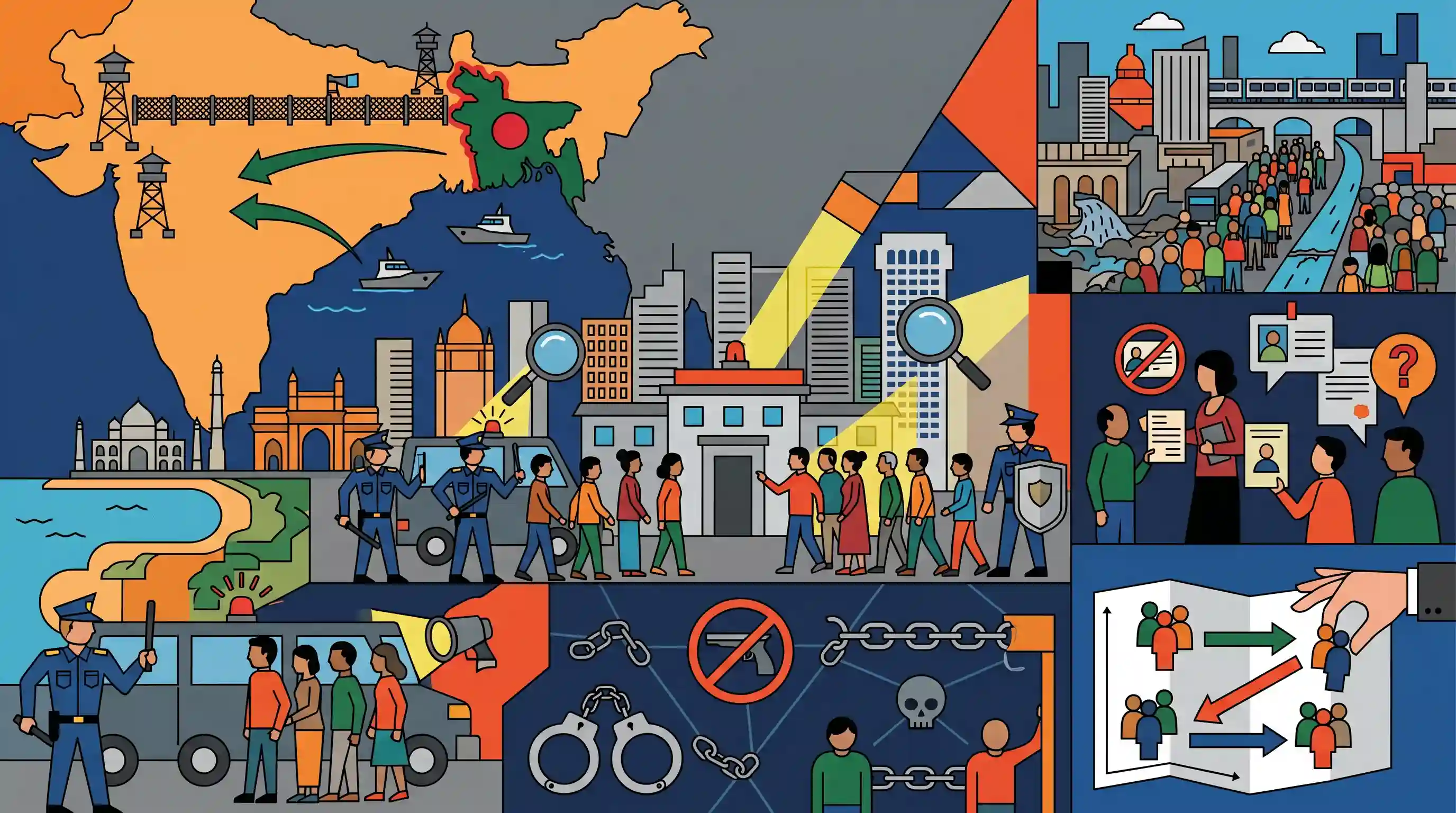
Maharashtra Chief Minister Eknath Shinde has ordered a strict crackdown on illegal Bangladeshi immigrants residing in Mumbai. The directive mandates local police and security agencies to proactively identify and take action against undocumented foreign nationals. This move underscores the ongoing challenges related to border management, the socio-economic impacts of illegal immigration on major metropolises, and broader internal security concerns including potential links to transborder crimes.
Key Points
- Maharashtra Chief Minister Eknath Shinde has directed law enforcement agencies to identify and take strict action against illegal Bangladeshi immigrants residing in Mumbai.
- The crackdown aims to address internal security concerns, mitigate potential links to transborder crimes, and alleviate the strain on urban resources.
- State authorities typically rely on legal frameworks such as the Foreigners Act, 1946, to detect, detain, and facilitate the deportation of undocumented foreign nationals.
- The issue highlights the broader national security challenge of illegal immigration across the porous India-Bangladesh border and the need for effective urban policing.
Important Terms
Foreigners Act, 1946

A colonial-era law granting the government broad powers to regulate the entry, stay, and departure of foreigners. It uniquely places the 'burden of proof' of citizenship on the individual.
UPSC context
GS Paper 2/3: Essential for understanding the legal framework governing undocumented migration and the NRC process.
Passport (Entry into India) Act, 1920
Legislation mandating that all persons entering India possess valid passports. It empowers authorities to arrest and remove individuals who enter the country without proper travel documentation.
UPSC context
GS Paper 2: Relevant for immigration control evolution and the legal requirements for international travel to India.
Deportation
The formal legal process of removing a foreign national for illegal entry or stay. It requires nationality verification and repatriation via diplomatic channels, following a judicial or administrative order.
UPSC context
GS Paper 3: Tests border management concepts and the legal distinction between formal removal and informal 'pushbacks.'
Immigration and Foreigners Act, 2025
A major legislative reform that consolidated and replaced the 1946 Foreigners Act and 1920 Passport Act. it emphasizes digital reporting and centralized monitoring of foreign nationals.
UPSC context
GS Paper 3: Tests knowledge of recent policy shifts toward technology-led border management and streamlined immigration laws.
Internal Security
The maintenance of peace and sovereignty within a nation's borders. Illegal migration is viewed as a challenge due to potential demographic shifts, radicalization, and socio-economic strain.
UPSC context
GS Paper 3 Syllabus: Tests the ability to analyze multidimensional threats like communalism and resource-driven conflict.
Prelims Trap
"The burden of proof to establish that a person is an illegal immigrant lies with the State."
Section 9 of the Foreigners Act, 1946 applies a 'reverse onus', placing the burden entirely on the suspected individual to prove they are NOT a foreigner.
Static Concepts Connected
Which Fundamental Rights are explicitly denied to foreign nationals in India?
- Available rights: Article 14 (Equality before law) and Article 21 (Right to life and personal liberty) apply to all persons, including illegal immigrants.
- Denied rights: Articles 15, 16, 19 (e.g., right to reside and settle), 29, and 30 are available exclusively to Indian citizens.
How is the Union's power over deportation executed by State governments?
- Union Subject: Deportation and citizenship fall under the Union List, governed centrally by the Foreigners Act, 1946 and the Passport (Entry into India) Act, 1920.
- Constitutional Delegation: Under Article 258(1) of the Constitution, the Centre delegates the statutory power to identify, detain, and deport foreigners to State Governments and local authorities.
Cross-Topic Patterns
Demography as External Aggression
The Sarbananda Sonowal case (2005) famously interpreted large-scale illegal immigration as "external aggression" under Article 355, linking demographic shifts directly to internal security and Union constitutional duties.
Border Porosity & CIBMS
Urban crackdowns highlight the failure of physical fencing along the 4,096 km India-Bangladesh border, driving the push for the Comprehensive Integrated Border Management System (CIBMS) to secure porous riverine stretches.

Expect a multi-statement Prelims question combining the Foreigners Act's 'reverse onus' and Article 19 vs 21 rights for non-citizens.
Linked PYQs · 3
Linked PYQs · 3
- 2020MainsGS3
Analyze internal security threats and transborder crimes along Myanmar, Bangladesh and Pakistan borders including Line of Control (LoC). Also discuss the role played by various security forces in this regard.
- 2024MainsGS3
India has a long and troubled border with China and Pakistan fraught with contentious issues. Examine the conflicting issues and security challenges along the border. Also give out the development being undertaken in these areas under the Border Area Development Programme (BADP) and Border Infrastructure and Management (BIM) Scheme.
- 2023PrelimsGS1
With reference to Home Guards, consider the following statements: 1. Home Guards are raised under the Home Guards Act and Rules of the Central Government. 2. The role of the Home Guards is to serve as an auxiliary force to the police in maintenance of internal security. 3. To prevent infiltration on the international border/coastal areas, the Border Wing Home Guards Battalions have been raised in some States. How many of the above statements are correct?
