Opposition threatens legal action over delayed local body elections
Source:hindustantimes ↗
Why It Matters
Highlights the operational challenges and political interference in the timely constitution of Panchayati Raj Institutions (PRIs). It is highly relevant for GS-2 Polity, emphasizing the necessity of functional autonomy for local bodies and the role of constitutional mandates and judicial interventions in ensuring timely local elections.
Summary
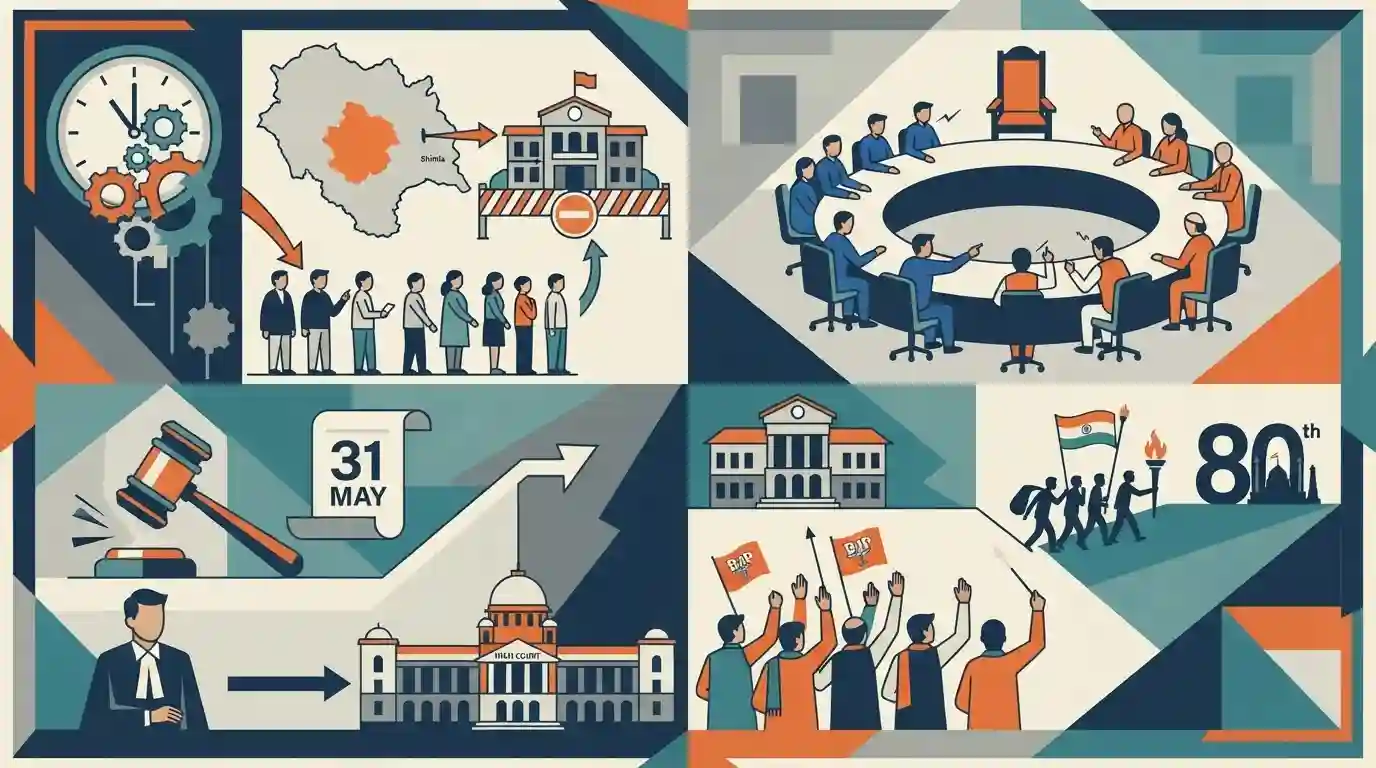
The BJP in Himachal Pradesh has criticized the Congress-led state government for deliberately delaying the election of the chairperson and vice-chairperson of the Shimla Zila Parishad. Accusing the administration of stalling due to a lack of majority, BJP leaders, including Leader of Opposition Jai Ram Thakur, have threatened to escalate the issue to the High Court. They cited a Supreme Court mandate requiring all Panchayati Raj polls to be completed by May 31. The BJP claims to have secured majorities in other districts and urged the Deputy Commissioner of Shimla to notify the polls promptly. Additionally, the party highlighted its ongoing 'Tiranga Yatra' to mark the 80th year of India's independence.
Key Points
- The BJP has accused the Congress government in Himachal Pradesh of intentionally delaying the elections for the chairperson and vice-chairperson of the Shimla Zila Parishad.
- Leader of Opposition Jai Ram Thakur claimed the delay is a tactic used by the Congress because they lack a majority in the Zila Parishad.
- The BJP threatened to approach the High Court if the Shimla Deputy Commissioner does not immediately schedule the polls, citing a Supreme Court order to complete Panchayati Raj elections by May 31.
- The BJP claims to have secured majority victories in Zila Parishads across several other districts and in most panchayat president elections.
- The party is also organizing a 'Tiranga Yatra' to commemorate the 80th year of Indian Independence.
Important Terms
Zila Parishad

The Zila Parishad is the highest, district-level tier of the Panchayati Raj system in India. It coordinates development activities, advises the state government on rural issues, and oversees the functioning of lower-level panchayats.
UPSC context
Important for GS Paper II (Local Self-Government). Tests understanding of the 73rd Amendment, democratic decentralisation, and Article 243-D.
State Election Commission
A constitutional body established under Articles 243K and 243ZA (73rd and 74th Amendments). It handles the superintendence, direction, and control of electoral rolls and the conduct of all elections to local municipalities and panchayats.
UPSC context
Relevant to GS Paper II. Tests knowledge of state-level constitutional bodies and their distinction from the Election Commission of India.
Supreme Court
The highest judicial court and final court of appeal under the Constitution of India. It enforces fundamental rights, settles state-central disputes, and issues directives to ensure constitutional compliance, such as timely local elections.
UPSC context
Essential for GS Paper II (Judiciary). Tests judicial review, constitutional enforcement, and the apex court's oversight of statutory deadlines.
High Court
The highest judicial institution in a state, endowed with original, appellate, and writ jurisdictions. Under Article 226, it exercises judicial oversight to enforce fundamental rights and ensure legal compliance by the state administration.
UPSC context
Core to GS Paper II (State Judiciary). Tests understanding of Article 226, judicial checks on state governments, and public interest litigation.
Prelims Trap
The Chairperson of a Zila Parishad is directly elected by the registered voters of the territorial constituencies.
Under Article 243C, while Zila Parishad members are directly elected by voters, the Chairperson is indirectly elected by and from amongst those elected members.
Static Concepts Connected
How are chairpersons elected across the three tiers of Panchayati Raj?
- Village level: The State legislature determines the method of election for the Gram Panchayat Chairperson (Sarpanch).
- Intermediate & District levels: Chairpersons must be elected indirectly by and from amongst the elected members of the respective Panchayats (Article 243C).
What does Article 243-O state regarding judicial intervention in Panchayat elections?
- Bar on Courts: Courts are barred from interfering in electoral matters, including the validity of laws relating to the delimitation of constituencies.
- Election Petitions: Panchayat elections can only be challenged via an election petition presented to the authority prescribed by the State Legislature.
Cross-Topic Patterns
Article 243-O vs. Article 226
The bar on judicial interference in Panchayat elections (Art 243-O) frequently clashes with High Court writ jurisdictions (Art 226), mirroring constitutional debates seen in Delimitation Commission challenges.
SEC Independence vs State Control
State governments repeatedly delaying local polls highlights the administrative and financial dependency of State Election Commissions on state machineries, contrasting sharply with the autonomy of the ECI.

A 2026 Prelims question will likely contrast the indirect election of Zila Parishad chairpersons (Art 243C) with SEC powers (Art 243K).
Linked PYQs · 3
Linked PYQs · 3
- 2024HPAS_PRELIMSGS1
Consider the following statements regarding Panchayati Raj system in Himachal Pradesh. Statement I : In 1949, the Punjab Village Panchayat Act of 1939 was enforced and 132 panchayats were established in Himachal. Statement II : By the end of 1956, there were 466 Gram Panchayats and 26 Tehsil Panchayats in Himachal. Choose the correct option from the following :
- 2014HPAS_PRELIMSGS1
Which of the Commissions/Committees has recommended that there should be a Minister for Panchayati Raj ?
- 2010HPAS_PRELIMSGS1
Balwant Rai Mehta Committee is related to :
