Social Security Code overrides UP maternity rules on second leave
Source:verdictum ↗
Why It Matters
This ruling is significant for UPPSC PCS Prelims as it underscores the legal supremacy of central labor codes (specifically the Code on Social Security, 2020) over state executive rules (Article 254 principles). It also highlights ongoing developments in women's workplace rights and social justice.
Summary
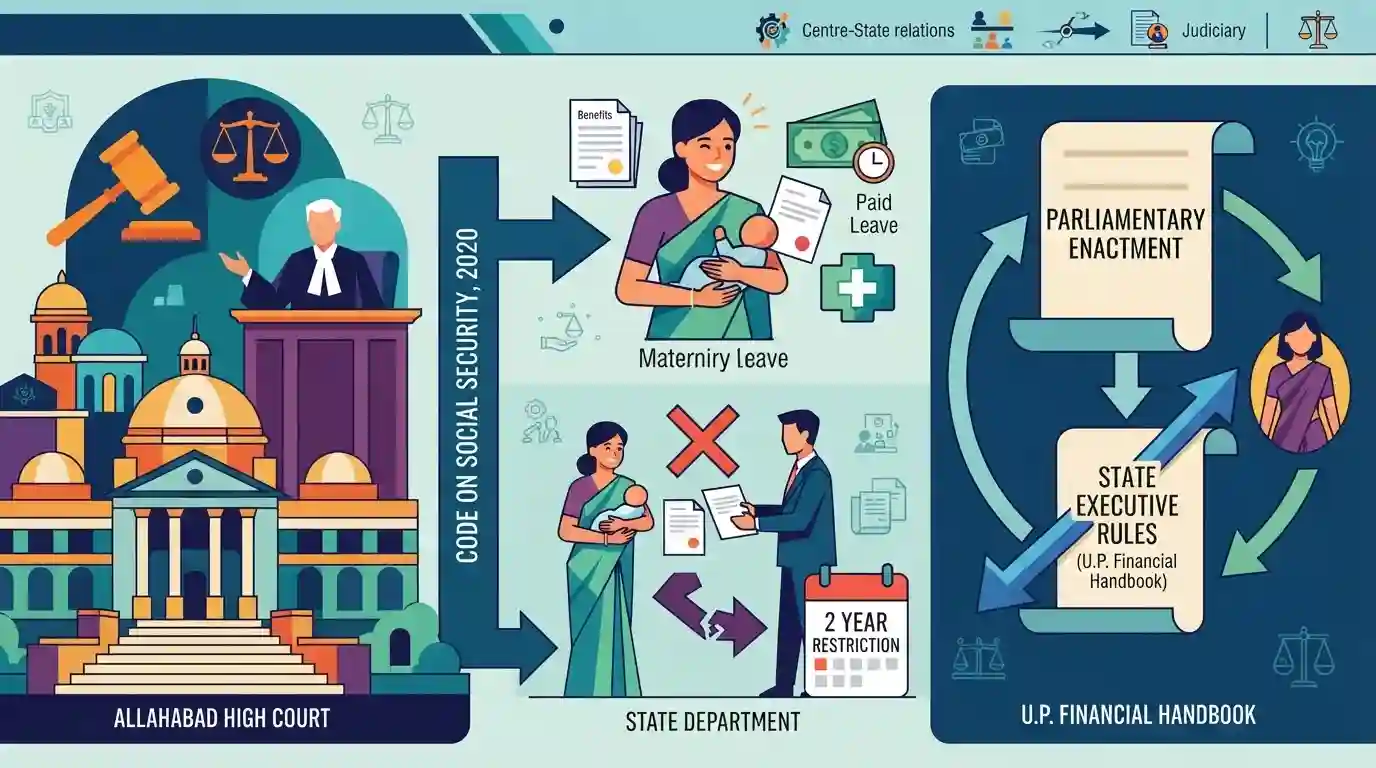
The Allahabad High Court has held that the Code on Social Security, 2020, overrides the provisions of the U.P. Financial Handbook regarding maternity benefits. The Court quashed an order that denied a second maternity leave to a state employee on the grounds that two years had not elapsed since her first maternity leave, a restriction found in the state's executive rules. The Court emphasized that executive instructions cannot supersede a parliamentary enactment, and since the Code on Social Security, 2020 imposes no such two-year limitation, the petitioner is legally entitled to her maternity leave and associated benefits.
Key Points
- The Allahabad High Court ruled that central parliamentary legislation, specifically the Code on Social Security, 2020, prevails over executive instructions such as the U.P. Financial Handbook.
- The Court struck down Rule 153(1) of the U.P. Financial Handbook which imposed a two-year bar on granting a second maternity leave, as it was repugnant to the central code.
- The Code on Social Security, 2020, provides for maternity benefits without imposing a mandatory two-year gap between two successive maternity leaves.
- The ruling ensures that women employees' statutory rights to maternity benefits under central labor codes cannot be curtailed by conflicting state-level administrative rules.
Important Terms
Code on Social Security, 2020

A central parliamentary law consolidating major labour statutes, including maternity benefits. It guarantees maternity leave without prescribing any mandatory time gap between a woman's successive pregnancies.
UPSC context
Vital for GS-2 (Social Justice/Women) and GS-3 (Labour Reforms). It tests the legislative framework supporting female workforce participation.
Maternity Benefit Act, 1961
The historical framework governing maternity rights and paid leave for working women in India, which has now been integrated into and subsumed by the Code on Social Security, 2020.
UPSC context
Important for GS-2 (Welfare Schemes). Tracing the evolution of women's labour rights and protective statutes is a recurring UPSC theme.
U.P. Financial Handbook
A manual of state-level executive instructions governing Uttar Pradesh government employees. Its Rule 153(1) previously imposed a restrictive two-year gap for availing successive maternity leaves.
UPSC context
Relevant to GS-2 (Polity); illustrates the constitutional principle that state executive instructions cannot override benefits granted by Central parliamentary enactments.
Allahabad High Court
The highest judicial body in Uttar Pradesh. It recently affirmed that central statutes like the Code on Social Security prevail over restrictive state administrative orders regarding maternity leave.
UPSC context
Fits GS-2 (Judiciary & Federalism); tests understanding of constitutional hierarchy, judicial review, and the resolution of Centre-State regulatory conflicts.
Prelims Trap
"The Code on Social Security, 2020 mandates a two-year cooling-off period between successive maternity leaves."
The two-year bar was a State executive rule (UP Financial Handbook), which was struck down by the High Court precisely because the Central Code lacks any such restriction.
Static Concepts Connected
How does the Doctrine of Repugnancy operate under Article 254?
- Concurrent List: It triggers when both the Centre and a State legislate on the same subject enumerated in the Concurrent List, leading to a direct conflict.
- Central Supremacy: The central parliamentary law prevails, and the state law becomes void to the extent of its repugnancy (inconsistency).
- Presidential Exception: A conflicting state law can prevail within that state only if it was reserved for the President's consideration and received their explicit assent.
Which Constitutional provisions explicitly or implicitly anchor maternity rights in India?
- Article 42: A Directive Principle explicitly directing the State to make provision for securing just and humane conditions of work and for maternity relief.
- Article 15(3): An exception to the rule against discrimination, empowering the State to make special, affirmative provisions for women and children.
- Article 21: The Supreme Court has repeatedly interpreted the right to maternity benefits as integral to a woman's fundamental right to life and dignity.
Cross-Topic Patterns
Gig workers & Social Security Code
The 2020 Code expands maternity and insurance coverage to unorganised and gig workers, making it a critical GS-3 point on formalizing the emerging platform economy.
Executive rules vs Parliamentary statutes
The ruling highlights a core administrative law principle for GS-2: subordinate executive instructions (like state handbooks) cannot override or dilute substantive rights granted by primary parliamentary legislation.

Expect a 2026 prelims question merging the Social Security Code's novel features (gig workers) with Article 42 and maternity benefit durations.
Linked PYQs · 3
Linked PYQs · 3
- 2021UPPSC_PRELIMSGS1
Which of the following labour related Acts have been amalgamated into the 'Code on Wages, 2019'? I. Minimum Wages Act II. Payment of Bonus Act III. The Contract Labour Act IV. Equal Remuneration Act Select the correct answer using the codes given below.
- 2024UPPSC_PRELIMSGS1
With reference to National Food Security Act , which of the following statements are correct? 1. It will cover up to 75% rural and 50% urban population. 2. It has special focus on nutritional support to women and children. 3. It was enforced on July 5, 2010. Codes :
- 2024UPPSC_PRELIMSGS1
Match List-I (Social Security Programme): (A) Pradhan Mantri Shram Yogi Maandhan (B) Pradhan Mantri Jeevan Jyoti Bima (C) Pradhan Mantri Suraksha Bima (D) Atal Pension Yojana List-II: 1. Beneficiary category 2. ₹ 55 - ₹ 200 3. ₹ 436 per year 4. ₹ 20 per year
