Modal Shift from Road to Rail for Logistics and Economy
Source:Indian Express ↗
Why It Matters
The modal shift from road to rail touches upon multiple GS3 pillars: infrastructure development, reducing logistics costs to boost economic growth, and mitigating climate change. It is critical for analyzing policies like the National Rail Plan and PM Gati Shakti, and for answering questions on sustainable economic growth.
Summary
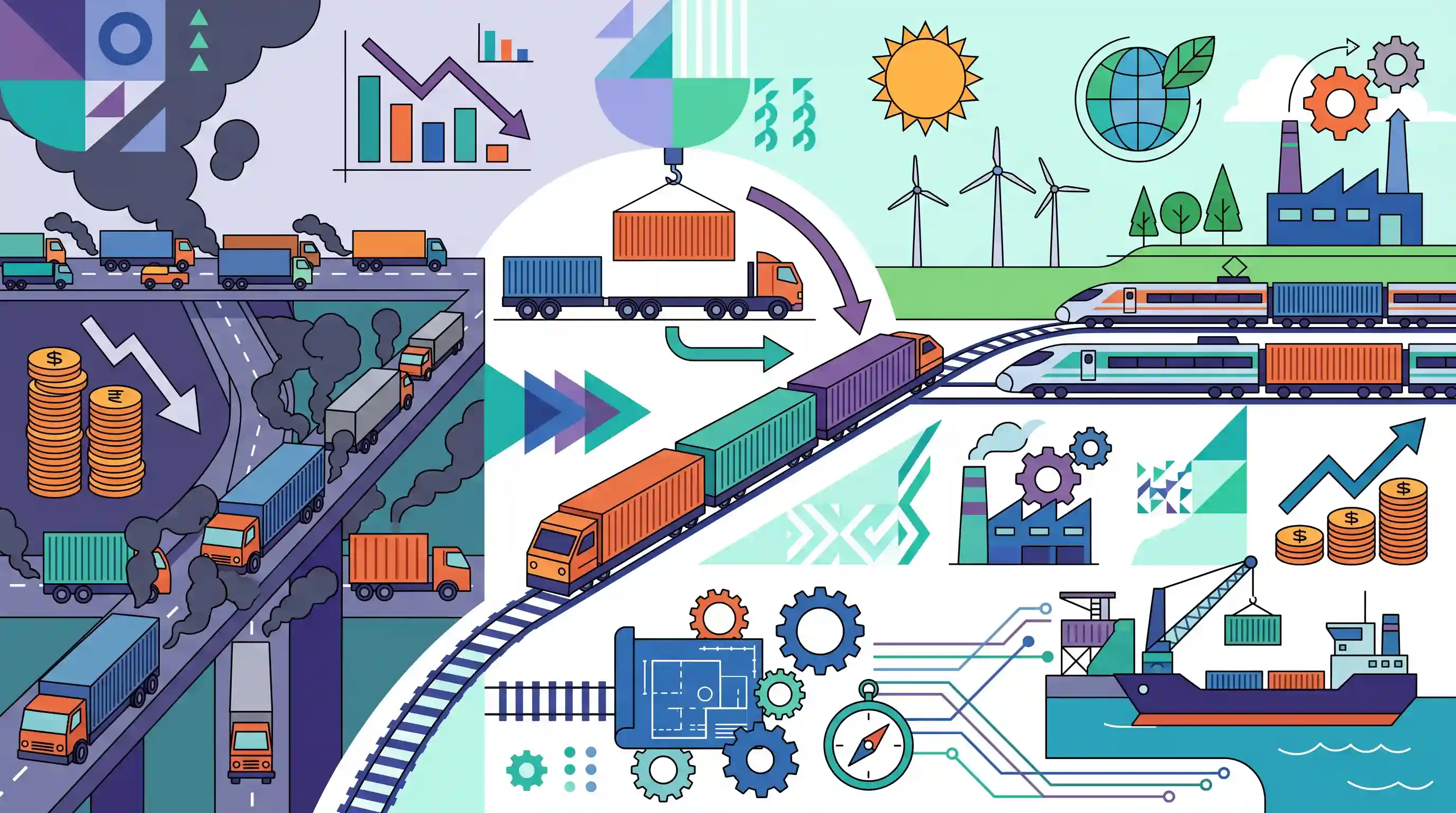
The article emphasizes the economic and environmental necessity of shifting transport—particularly freight—from road to rail in India. Currently, an over-dependence on road transport inflates India's logistics costs and contributes heavily to carbon emissions. Transitioning to a rail-centric logistics model can lower supply chain costs, thereby boosting the competitiveness of Indian manufacturing and exports. Additionally, rail transport offers superior energy efficiency and lower greenhouse gas emissions, aligning with India's climate commitments and Indian Railways' goal to achieve Net Zero carbon emissions by 2030. Achieving this modal shift requires robust infrastructure development, including Dedicated Freight Corridors and integration through the PM Gati Shakti framework.
Key Points
- India's logistics costs are currently high (around 13-14% of GDP), largely due to an over-reliance on road transport for freight movement.
- Shifting freight from road to rail can significantly reduce logistics expenses, enhancing the global competitiveness of Indian exports and domestic manufacturing.
- Rail transport is far more energy-efficient and emits substantially fewer greenhouse gases per tonne-kilometre compared to road transport.
- Indian Railways has set an ambitious target to become a 'Net Zero Carbon Emitter' by 2030, supported by 100% electrification of its broad-gauge network.
- The National Rail Plan envisions increasing the modal share of railways in freight traffic to 45% by 2030 to optimize the transport mix.
- Infrastructure projects like Dedicated Freight Corridors (DFCs) and the PM Gati Shakti master plan are essential to resolve capacity bottlenecks and ensure seamless multi-modal connectivity.
Important Terms
National Rail Plan (NRP)

A 2020 roadmap to create a 'future-ready' network by 2030, aiming to increase rail’s freight share from 27% to 45% and reduce logistics costs through capacity expansion.
UPSC context
GS III (Infrastructure/Economy). Tests planning for future capacity and resource mobilization in the transport sector.
PM Gati Shakti National Master Plan
A digital platform for integrated, multi-modal infrastructure planning across 16 ministries to break departmental silos and lower logistics costs through spatial data-driven coordination.
UPSC context
GS III (Infrastructure). Analyzes technology-led integrated governance for multi-modal connectivity and logistics efficiency.
Dedicated Freight Corridors (DFCs)
High-capacity, high-speed railway lines built exclusively for freight transport (e.g., EDFC, WDFC) to reduce congestion, transit times, and carbon emissions while boosting industrial competitiveness.
UPSC context
GS III (Infrastructure). Evaluates the impact of specialized corridors on logistics costs and carbon reduction.
Make in India
A flagship 2014 initiative to transform India into a global manufacturing hub, requiring modernized infrastructure and logistics to improve export competitiveness and attract foreign investment.
UPSC context
GS III (Economy). Examines manufacturing-led growth and infrastructure requirements for global competitiveness.
Indian Railways (IR)
The state-owned national carrier and the world's fourth-largest network, targeting Net Zero emissions by 2030 through 100% electrification and renewable energy integration.
UPSC context
GS III (Environment/Energy). Assesses the transition to green energy and achievement of climate targets in transport.
Ministry of Railways
The central government department responsible for formulating national railway policies, managing DFCs through special purpose vehicles, and driving the transition to rail-centric logistics.
UPSC context
GS II (Governance). Relates to institutional frameworks for infrastructure development and national transport policies.
Prelims Trap
India aims to achieve Net Zero carbon emissions by 2030 through shifting freight to rail.
Aspirants often confuse India's national Net Zero target (2070 under Panchamrit) with Indian Railways' specific organizational target of becoming a Net Zero Carbon Emitter by 2030.
Static Concepts Connected
What are the core pillars of the PM Gati Shakti Master Plan?
- Comprehensiveness: Brings all existing and planned initiatives of various ministries onto a single centralized portal.
- Prioritization: Allows different departments to prioritize their projects through cross-sectoral interactions.
- Optimization: Assists in selecting the most cost-effective and critical route for project planning.
- Analytical Tools: Provides GIS-based spatial planning and analytical tools with over 200 data layers.
How do Dedicated Freight Corridors (DFCs) transform Indian logistics?
- Decongestion: Separates freight from passenger traffic, drastically increasing average freight train speeds and reliability.
- Capacity Enhancement: Enables double-stack containers and heavier axle loads, reducing unit logistics costs.
- Modal Shift: Crucial for achieving the National Rail Plan's target of increasing rail freight share to 45% by 2030.
Cross-Topic Patterns
Logistics Costs and Export Parity
High logistics costs (13-14% of GDP) act as an implicit tax on Indian exports. Shifting to rail links directly to India's $1 trillion merchandise export target and the National Logistics Policy goals.
Rail Electrification & NDCs
100% electrification of broad-gauge networks significantly aids India's updated NDC goal to reduce the emissions intensity of its GDP by 45% by 2030 from 2005 levels.

Mains 2026: Expect a question linking PM Gati Shakti, DFCs, and rail modal shift to India's manufacturing competitiveness & 2030 targets.
Linked PYQs · 2
Linked PYQs · 2
- 2021MainsGS3
“Investment in infrastructure is essential for more rapid and inclusive economic growth.” Discuss in the light of India's experience.
- 2023MainsGS3
The adoption of electric vehicles is rapidly growing worldwide. How do electric vehicles contribute to reducing carbon emissions and what are the key benefits they offer compared to traditional combustion engine vehicles?
