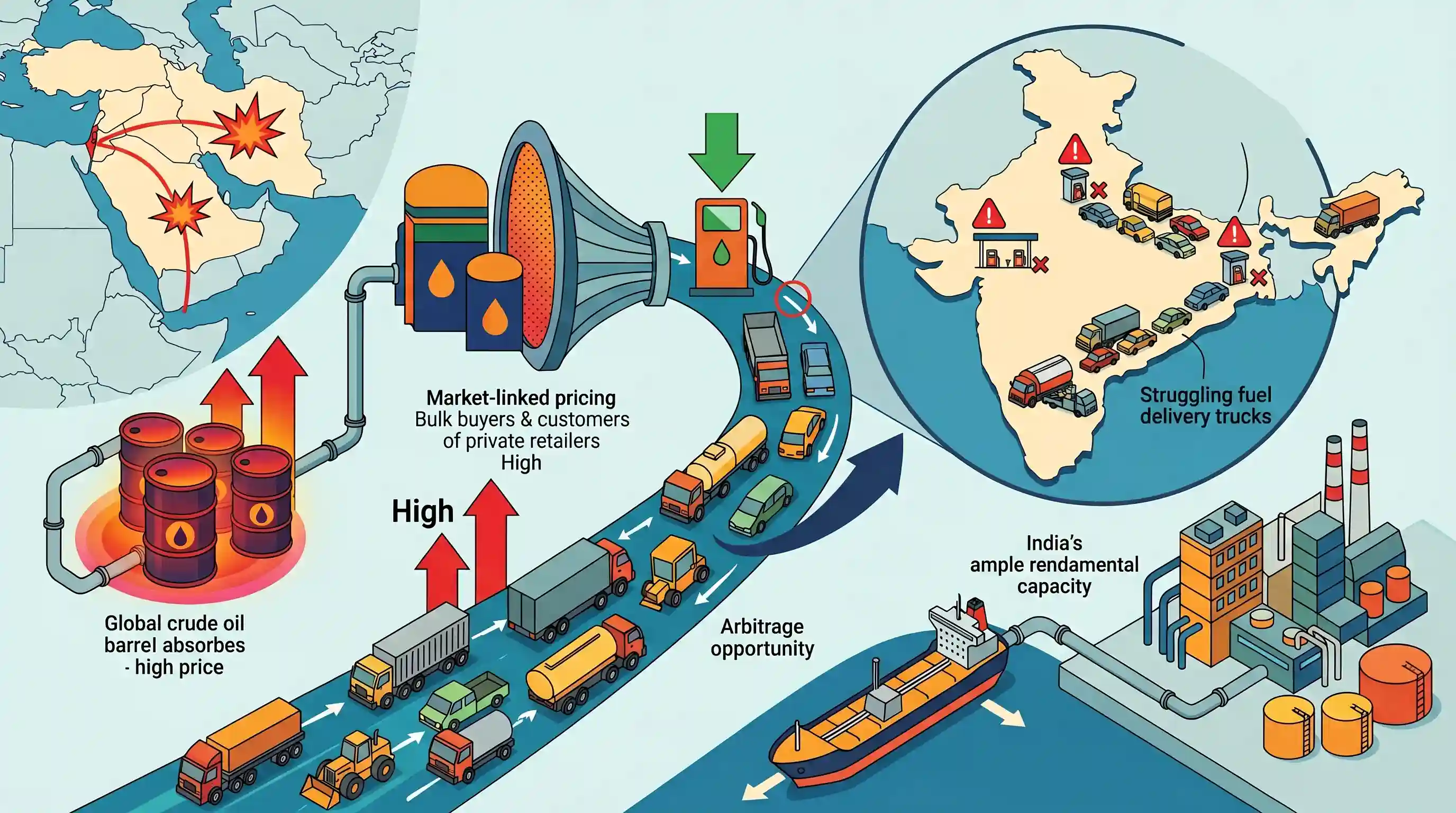
Bulk buyers shifting to OMC pumps triggers localized fuel strain
Source:Indian Express ↗
Why It Matters
Demonstrates the market distortions and logistical challenges created when de facto price controls (keeping retail fuel cheap) diverge from market-linked pricing (bulk fuel), highlighting the complexities of managing India's energy security and inflation amidst global geopolitical shocks.
Summary
The recent localized supply issues and demand surges at public sector retail fuel pumps in India are driven by a shift of bulk fuel consumers seeking cheaper rates. Because Oil Marketing Companies (OMCs) have largely absorbed the impact of rising international crude prices—exacerbated by the West Asia crisis—retail fuel prices have been kept artificially low compared to market-linked bulk rates. This de facto price control has created an arbitrage opportunity, causing bulk buyers and customers of private retailers to flock to OMC pumps. Consequently, last-mile logistical challenges have led to temporary "dry-outs" at some stations, despite India having ample refining capacity and remaining a net exporter of refined petroleum products.
Key Points
- Bulk fuel consumers are shifting their purchases to retail pumps operated by public sector Oil Marketing Companies (OMCs) to take advantage of significantly lower prices compared to bulk supply rates.
- The price disparity exists because OMCs have absorbed the surge in international crude oil prices (driven by the West Asia crisis) to keep retail fuel prices artificially low, while bulk fuel prices remain market-linked.
- Private fuel retailers have increased their prices to reflect market realities, further driving consumers toward state-owned OMC retail outlets.
- The sudden influx of bulk buyers at retail pumps has caused panic-buying and localized dry-outs, primarily due to last-mile logistical bottlenecks rather than actual fuel shortages.
- India's overall fuel production remains robust, with refineries operating at over 100% capacity and the country continuing its status as a net exporter of refined petroleum products.
Important Terms
Administered Pricing Mechanism (APM)

A system where the government regulates prices of essential commodities like fuel rather than letting market forces decide. In India, it is often used to ensure affordability.
UPSC context
GS Paper 3: Indian Economy. Tests understanding of market distortions, subsidies, and the transition toward market-linked pricing.
Oil Marketing Companies (OMCs)
Entities involved in the refining, distribution, and retailing of petroleum products. In India, state-run PSUs like IOCL, BPCL, and HPCL dominate this sector.
UPSC context
GS Paper 3: Energy and Economy. Relevant for studying fiscal health, under-recoveries, and the downstream petroleum supply chain.
Downstream Sector
The final stage of the oil and gas industry involving refining crude oil and marketing finished products like petrol and diesel to end-users.
UPSC context
GS Paper 3: Infrastructure and Energy. Crucial for understanding India's refining capacity and last-mile fuel delivery challenges.
Energy Security
The uninterrupted availability of energy sources at an affordable price. It is a strategic priority for India due to its high dependence on crude oil imports.
UPSC context
GS Paper 3: Energy Security. Focuses on mitigating global price shocks and ensuring economic stability during geopolitical crises.
Arbitrage
The practice of taking advantage of a price difference between two or more markets for the same commodity to gain a profit or save costs.
UPSC context
GS Paper 3: Economy. Explains market behavior when retail prices are kept artificially lower than bulk/industrial rates.
Public Sector Undertakings (PSUs)
Government-owned corporations in India. In the fuel sector, these entities often absorb financial losses to shield consumers from high international crude prices.
UPSC context
GS Paper 3: Economy. Tests the role of state enterprises in balancing commercial viability with social welfare objectives.
Prelims Trap
"India is a net importer of both crude oil and refined petroleum products."
While India imports roughly 85% of its crude oil, it possesses surplus domestic refining capacity. Consequently, India is actually a net exporter of refined petroleum products.
Static Concepts Connected
What is the status of fuel price deregulation in India?
- Petrol Deregulation: Petrol pricing was officially deregulated in 2010, transitioning theoretically to market-linked pricing.
- Diesel Deregulation: Diesel pricing was officially deregulated in 2014, shifting away from the Administered Pricing Mechanism (APM).
- De-facto Control: The government still informally directs public OMCs to absorb global crude price shocks, establishing a de-facto administered price to tame domestic inflation.
What does "under-recovery" mean in the petroleum sector?
- Definition: The financial loss incurred by Oil Marketing Companies (OMCs) when selling retail fuel below the international market cost of supply.
- Fiscal Impact: It erodes public sector balance sheets and creates a hidden fiscal burden, which the government historically managed through instruments like Oil Bonds.
Cross-Topic Patterns
Inflation targeting vs OMC profitability
Suppressing retail fuel prices contains CPI/WPI inflation but shifts the financial burden to state-run OMCs, effectively acting as an unstated government subsidy mechanism.
Dual-pricing market arbitrage
Divergence between strictly market-linked bulk rates and suppressed retail rates incentivizes bulk consumers to exploit retail pumps, triggering artificial last-mile logistical dry-outs.

Expect a 2026 prelims question combining India’s net-exporter status of refined petroleum products with fuel price deregulation timelines.
Linked PYQs · 4
Linked PYQs · 4
- 2017MainsGS2
The question of India's Energy Security constitutes the most important part of India's economic progress. Analyze India's energy policy cooperation with West Asian countries.
- 2025MainsGS2
"Energy security constitutes the dominant kingpin of India's foreign policy, and is linked with India's overarching influence in Middle Eastern countries.” How would you integrate energy security with India's foreign policy trajectories in the coming years?
- 2025PrelimsGS1
Consider the following activities : I. Production of crude oil II. Refining, storage and distribution of petroleum III. Marketing and sale of petroleum products IV. Production of natural gas How many of the above activities are regulated by the Petroleum and Natural Gas Regulatory Board in our country?
- 2021PrelimsGS1
With reference to furnace oil, consider the following statements : 1. It is a product of oil refineries. 2. Some industries use it to generate power. 3. Its use causes sulphur emissions into environment. Which of the statements given above are correct?
