Constitutional Choice versus Caste Honour in Inter-Caste Marriages
Source:The Hindu ↗
Why It Matters
It bridges the gap between static constitutional rights (Article 21) and dynamic social realities (caste violence, patriarchy). It is highly relevant for GS1 (Society), GS2 (Polity and Social Justice), and GS4 (Constitutional Morality vs. Traditional Values).
Summary
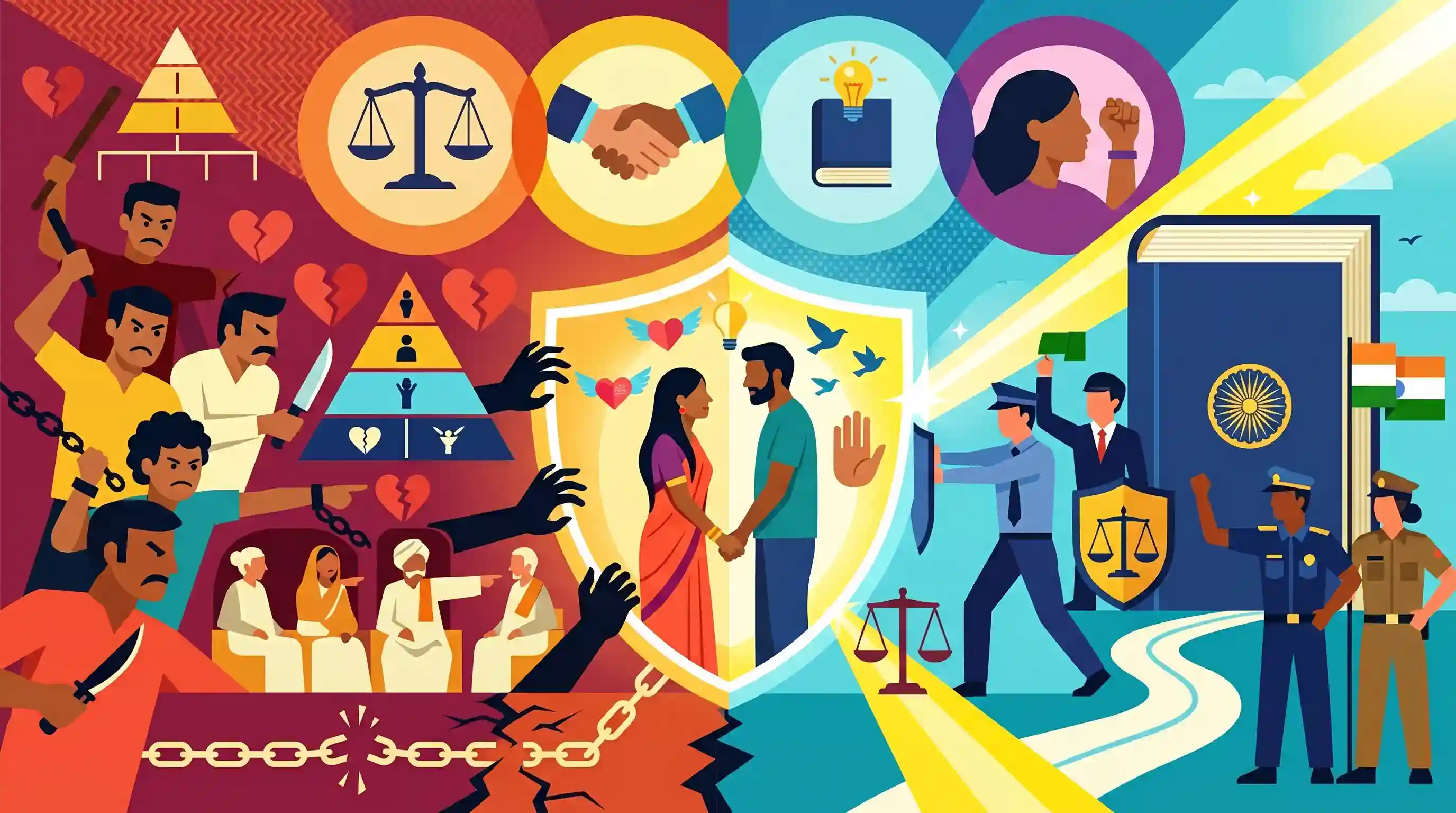
The article examines the societal resistance to inter-caste and inter-faith relationships in India, which frequently results in violence and 'honour killings'. It frames this issue as a fundamental clash between regressive, patriarchal notions of family 'honour' and the constitutional right to 'choice' and personal liberty. Emphasizing that the right to choose a life partner is protected under Article 21, the piece underscores the need for robust state intervention, strict legal frameworks, and the promotion of constitutional morality to shield couples from the extra-legal dictates of families and community bodies like Khap Panchayats.
Key Points
- Inter-caste and inter-faith relationships face severe societal backlash in India, often leading to patriarchal violence and "honour killings."
- There is a stark conflict between traditional caste-based notions of "honour," often enforced by extra-constitutional bodies like Khap Panchayats, and the individual right to "choice."
- The Supreme Court has repeatedly affirmed that the right to marry a person of one's choice is an integral part of the Right to Life and Personal Liberty under Article 21.
- Tackling this issue requires a shift from traditional morality to constitutional morality, alongside strict enforcement of judicial guidelines and potentially specific legislation against honour crimes.
Important Terms
Article 21 of the Constitution

Guarantees life and personal liberty. The Supreme Court interprets this to include the fundamental right of consenting adults to marry a person of their choice (e.g., Hadiya case).
UPSC context
GS Paper 2 (Polity/Fundamental Rights). Tests judicial interpretation and the evolution of personal liberties against societal interference.
Special Marriage Act, 1954
A secular Indian law providing a legal framework for marriages between different faiths or castes without religious conversion, emphasizing civil registration over religious ritual.
UPSC context
GS Paper 2 (Social Justice/Legislation). Essential for discussing secularism, personal laws, and barriers like the mandatory notice period.
Constitutional Morality
Adherence to constitutional values like equality and liberty over societal norms. It requires the State and citizens to uphold the spirit of the Constitution during conflicts.
UPSC context
GS Paper 2 (Polity) and GS Paper 4 (Ethics). Tests the balance between traditional societal values and modern constitutional rights.
Khap Panchayats
Extra-constitutional, unelected community councils primarily in North India that often issue regressive, patriarchal diktats against inter-caste marriages to preserve perceived traditional 'honour.'
UPSC context
GS Paper 1 (Indian Society) and GS Paper 2 (Governance). Tests understanding of informal power structures versus the rule of law.
Honour Killings
Violent crimes, often murder, committed by family members against individuals perceived to have brought 'dishonour' to the community by defying marriage or relationship norms.
UPSC context
GS Paper 1 (Social Issues) and GS Paper 2 (Social Justice). Critical for discussing patriarchy, caste hierarchy, and human rights violations.
Prelims Trap
"The Right to Marry is an explicitly enumerated Fundamental Right under Article 21 of the Constitution."
The Constitution does not explicitly list it. The Supreme Court inferred it as a fundamental facet of the Right to Life and Personal Liberty (Article 21) in the Shafin Jahan case.
Static Concepts Connected
What is 'Constitutional Morality' versus 'Social Morality'?
- Constitutional Morality: Prioritizes core constitutional principles—such as individual liberty, equality, and dignity—over popular traditions or religious norms.
- Social Morality: Rooted in societal customs, traditional values, and often patriarchal frameworks that dictate acceptable behavior within a community.
- Judicial Supremacy: The Supreme Court ruled that constitutional morality must decisively trump regressive social morality to protect individual choices (e.g., Shakti Vahini case).
How did Dr. B.R. Ambedkar define the structural essence of the caste system?
- Imposed Endogamy: Ambedkar argued that superimposing endogamy (marrying within a specific group) on exogamy is the fundamental genesis of the caste system.
- Closed Class: He defined a caste simply as an "enclosed class," maintained strictly through prohibitions on inter-marriage.
- The Ultimate Remedy: In 'Annihilation of Caste', he posited that inter-caste marriage is the only real solvent to break down the exclusionary nature of the caste system.
Cross-Topic Patterns
Special Marriage Act (SMA) hurdles
The SMA's 30-day public notice requirement is frequently weaponized by vigilante groups to stop inter-faith marriages, sparking debates on whether it violates the fundamental right to privacy (Puttaswamy judgement).
Khap Panchayats vs. PRIs
The continued socio-political dominance of extra-constitutional Khap Panchayats actively undermines the legitimate, democratic functioning of Panchayati Raj Institutions (PRIs) and the rule of law in rural governance.

Prelims 2026 will likely test 'Right to Marry' as an inferred Article 21 right, paired with the doctrine of Constitutional Morality.
Linked PYQs · 4
Linked PYQs · 4
- 2019PrelimsGS1
Which Article of the Constitution of India safeguards one's right to marry the person of one's choice?
- 2024MainsGS1
Intercaste marriages between castes which have socio-economic parity have increased, to some extent, but this is less true of interreligious marriages. Discuss.
- 2015MainsGS2
Khap Panchayats have been in the news for functioning as extra-constitutional authorities, often delivering pronouncements amounting to human rights violations. Discuss critically the actions taken by the legislative, executive and the judiciary to set the things right in this regard.
- 2019MainsGS4
What is meant by the term 'constitutional morality'? How does one uphold constitutional morality?
