Global South Redefines Climate Action Ahead of COP30
Source:Indian Express ↗
Why It Matters
Understanding the shifting geopolitical dynamics of climate negotiations is crucial for UPSC aspirants. It directly intersects with India's foreign policy (leadership of the Global South) and environmental commitments (NDCs, renewable energy targets) frequently tested in GS2 and GS3.
Summary
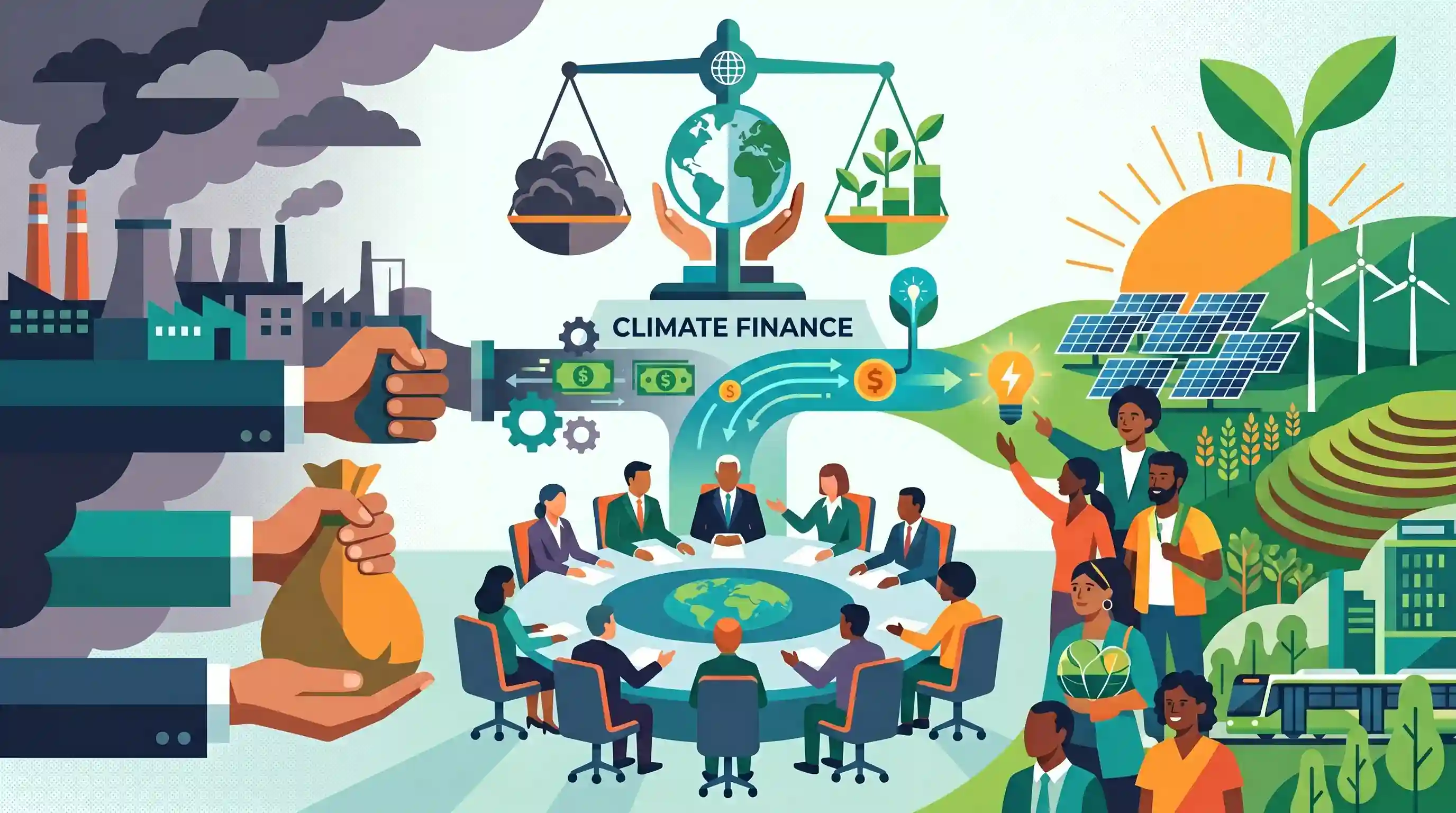
In this opinion piece, Shashi Tharoor highlights the Global South's emergence as a proactive leader in global climate action, undertaking credible initiatives despite resource constraints and the historical emission burdens of the Global North. He argues that the upcoming COP30 summit must explicitly recognize these developing-world solutions, mandate adequate climate finance, and uphold the principle of Common but Differentiated Responsibilities (CBDR) to ensure equitable global climate governance.
Key Points
- The Global South is proactively driving credible climate action and sustainable development, shifting the narrative from being passive victims to active solution providers.
- Developed nations (Global North) are criticized for their historical emissions and continued shortfall in delivering promised climate finance and technology transfer to developing nations.
- The upcoming COP30 summit provides a critical platform to formally acknowledge and institutionalize the climate leadership and grassroots initiatives emerging from developing economies.
- The principle of "Common but Differentiated Responsibilities" (CBDR) must remain central to climate negotiations to ensure climate justice and protect the developmental priorities of emerging economies.
- Southern-led frameworks, such as the International Solar Alliance and updated NDCs, showcase scalable, indigenous solutions that balance ecological preservation with economic growth.
Important Terms
Common but Differentiated Responsibilities (CBDR)

An international legal principle acknowledging that all nations share responsibility for the environment but have different duties based on historical emissions and socioeconomic capacity.
UPSC context
GS III (Environment); central to climate justice, equity, and India's position in global climate diplomacy.
Loss and Damage Fund
A financial mechanism established at COP27 to assist vulnerable developing nations in recovering from irreversible climate-driven impacts that exceed their current adaptation capacities.
UPSC context
GS III (Climate Finance); tests understanding of historical liability and the Global South's demand for reparations.
Nationally Determined Contributions (NDCs)
Individual, self-defined climate action plans submitted by countries under the Paris Agreement, outlining their targets for reducing emissions and adapting to climate change.
UPSC context
GS III (Environment); critical for tracking the Paris Agreement's 'bottom-up' approach and India's specific climate commitments.
Paris Agreement
A 2015 legally binding international treaty aiming to limit global temperature rise to well below 2°C, and preferably to 1.5°C, above pre-industrial levels.
UPSC context
GS III/International Relations; foundational framework for global climate governance and the Global Stocktake process.
UNFCCC
The primary 1992 international environmental treaty designed to stabilize greenhouse gas concentrations and prevent dangerous human interference with the climate system.
UPSC context
GS II & III; parent framework for all major climate accords, including the Kyoto Protocol and Paris Agreement.
Prelims Trap
"Under CBDR, all top-emitting countries, including India and China, have binding emission reduction targets."
CBDR deliberately avoids uniform quotas, placing the primary mitigation and financial burden on historically industrialized nations (Global North) over emerging economies.
Static Concepts Connected
What is the CBDR-RC principle under the UNFCCC framework?
- Origin: Formalized at the 1992 Earth Summit (UNCED) in Rio de Janeiro.
- Core Philosophy: Acknowledges that while all nations must protect the environment, developed countries bear greater responsibility due to historical greenhouse gas emissions.
- Application: Protects the economic developmental space of developing and least-developed nations by exempting them from immediate, binding emission caps.
What are the key developing-nation negotiating blocs at COP?
- BASIC: A coalition of Brazil, South Africa, India, and China that resists binding emission targets on developing nations.
- G77 + China: The largest intergovernmental group of developing countries, serving as the primary voice demanding climate finance and tech transfer.
- LMDC: Like-Minded Developing Countries; strongly pushes for historical responsibility and opposes attempts to rewrite the Paris Agreement.
Cross-Topic Patterns
Climate Finance vs. Green Trade Barriers (CBAM)
The EU's Carbon Border Adjustment Mechanism (CBAM) fundamentally clashes with the UNFCCC's CBDR principle, linking climate negotiations directly to WTO-level trade disputes over green protectionism.
India as a Global South Norm-Builder
India's launch of the International Solar Alliance (ISA) and Coalition for Disaster Resilient Infrastructure (CDRI) marks its GS-2 transition from a reactive norm-taker to a proactive norm-builder.

Expect a multi-statement Prelims 2026 question mapping the $300B NCQG timeline against historical CBDR tenets and BASIC bloc stances.
Linked PYQs · 4
Linked PYQs · 4
- 2025MainsGS3
Write a review on India's climate commitments under the Paris Agreement (2015) and mention how these have been further strengthened in COP26 (2021). In this direction, how has the first Nationally Determined Contribution intended by India been updated in 2022?
- 2021MainsGS3
Describe the major outcomes of the 26th session of the Conference of the Parties (COP) to the United Nations Framework Convention on Climate Change (UNFCCC). What are the commitments made by India in this conference?
- 2022MainsGS2
‘Clean energy is the order of the day.’ Describe briefly India's changing policy towards climate change in various international fora in the context of geopolitics.
- 2025PrelimsGS1
Consider the following statements : Statement I: Article 6 of the Paris Agreement on climate change is frequently discussed in global discussions on sustainable development and climate change. Statement II: Article 6 of the Paris Agreement on climate change sets out the principles of carbon markets. Statement III : Article 6 of the Paris Agreement on climate change intends to promote inter-country non-market strategies to reach their climate targets. Which one of the following is correct in respect of the above statements?
