United Nations Structural Crisis and Global Governance Reforms
Source:Indian Express ↗
हे का महत्त्वाचे आहे
Crucial for understanding India's push for UNSC reforms, the crisis of multilateralism, and the structural limitations of global governance frameworks in the 21st century.
सारांश
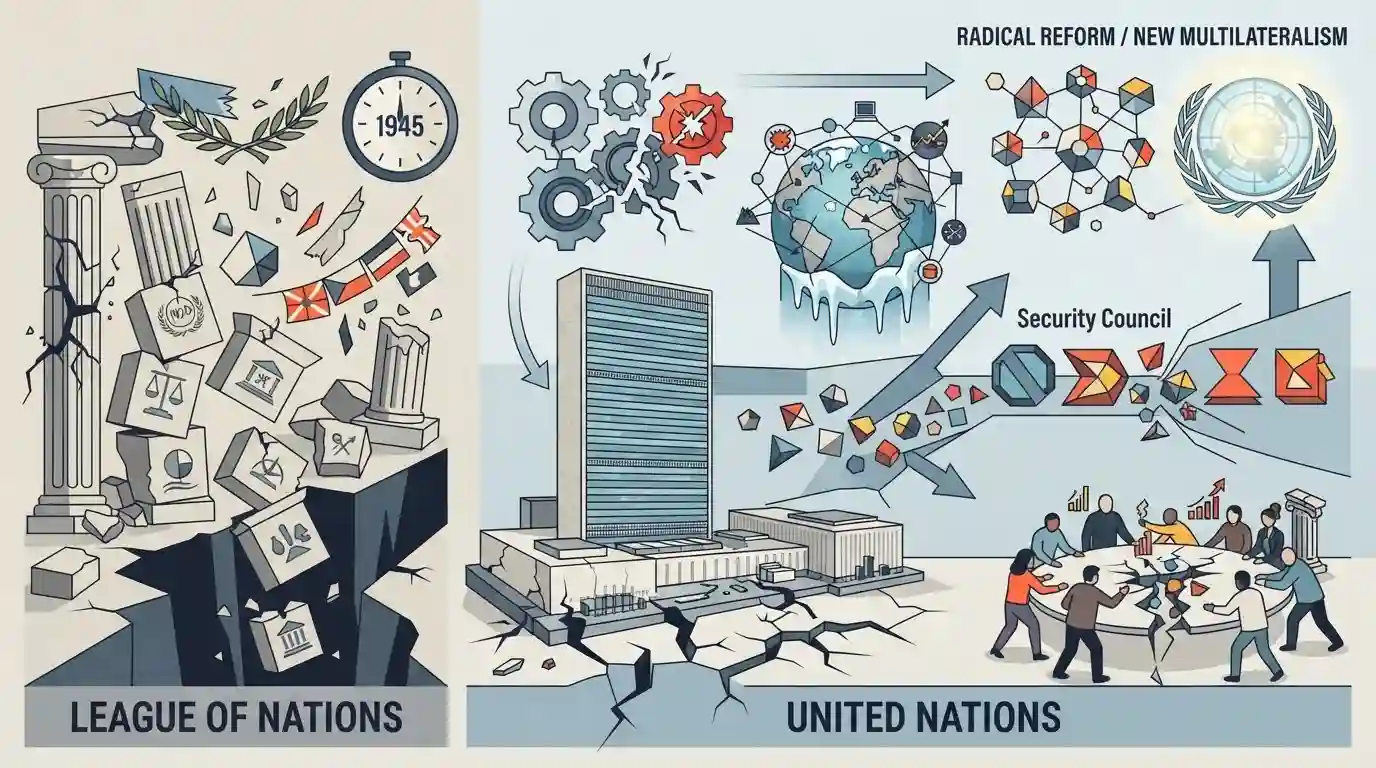
An opinion piece examining the structural failures of the United Nations 81 years after its founding, drawing parallels with the collapse of the League of Nations, and arguing for radical reform or recreation of multilateral institutions to reflect contemporary global power distribution and challenges.
मुख्य मुद्दे
- The current international architecture, centered around the United Nations, is over 80 years old and increasingly unreflective of contemporary geopolitical realities.
- Just as the League of Nations collapsed due to an inability to enforce international norms and adapt to power shifts, the UN faces severe credibility and efficacy crises.
- The UN Security Council (UNSC) remains paralyzed by the veto power of its permanent members, making it incapable of addressing major global conflicts effectively.
- There is an urgent need to recreate or radically reform global multilateral institutions to include the Global South and address 21st-century transnational challenges like climate change, pandemics, and terrorism.
महत्त्वाच्या संज्ञा
UN Charter

The foundational international treaty signed in 1945 that established the United Nations, codifying member states' obligations regarding human rights, collective security, and peaceful dispute resolution.
UPSC context
UPSC Paper II (International Relations): Essential constitutional framework governing global multilateral institutions and international law.
UN Security Council
The principal crisis-management organ of the UN featuring five permanent veto-wielding members, currently criticized for reflecting an outdated 1945 power structure.
UPSC context
UPSC Paper II (IR): Frequently tested for India's bid for permanent membership and overall UN structural reforms.
League of Nations
The first intergovernmental organization founded after World War I to maintain world peace, which ultimately collapsed due to structural weaknesses and lack of enforcement power.
UPSC context
UPSC Paper I (Modern History) & Paper II (IR): Historical precedent for studying the failure and redesign of global governance bodies.
United Nations
The premier global multilateral organization established in 1945 to promote international cooperation, prevent conflict, and address transnational challenges.
UPSC context
UPSC Paper II (International Relations): Core body for studying multilateralism, global governance, and India's multilateral diplomacy.
पूर्वपरीक्षा सापळा
Amending the UN Charter requires only a two-thirds majority vote in the UN General Assembly.
Aspirants often assume that a two-thirds majority in the UN General Assembly alone can amend the UN Charter, missing the mandatory requirement of ratification by all five permanent members (P5).
संबंधित स्थिर संकल्पना
What are the key institutional mechanisms and voting procedures for UN Charter amendment under Article 108?
- GA Majority: General Assembly Vote: Requires a vote of two-thirds of the members of the General Assembly.
- Ratification Clause: P5 Ratification: Must be ratified by two-thirds of UN member states, including all five permanent members of the Security Council.
- P5 Power: Veto Hurdle: Any single P5 member can block structural reforms by refusing to ratify the amendment.
आंतर-विषय नमुने
UN Reforms + Global South Diplomacy
India's demand for UNSC permanent membership links directly to its broader diplomatic push as voice of the Global South and leader of multilateral reform.
Multilateral Treaty Amending Mechanisms
The structural hurdles of UN Charter amendment parallel the sovereignty vs consensus debates seen in WTO and UNFCCC negotiations.

UNSC veto power, Article 108 amendment process, and G4/Ezulwini consensus differences are high-probability statement-based prelims traps.
संबंधित PYQ · 2
संबंधित PYQ · 2
- 2025MainsGS2
"The reform process in the United Nations remains unresolved, because of the delicate imbalance of East and West and entanglement of the USA vs. Russo-Chinese alliance.” Examine and critically evaluate the East-West policy confrontations in this regard.
- 2015MainsGS2
Discuss the impediments India is facing in its pursuit of a permanent seat in UN Security Council.
