Indian leaders question US strike killing seafarers off Oman
Source:Indian Express ↗
Why It Matters
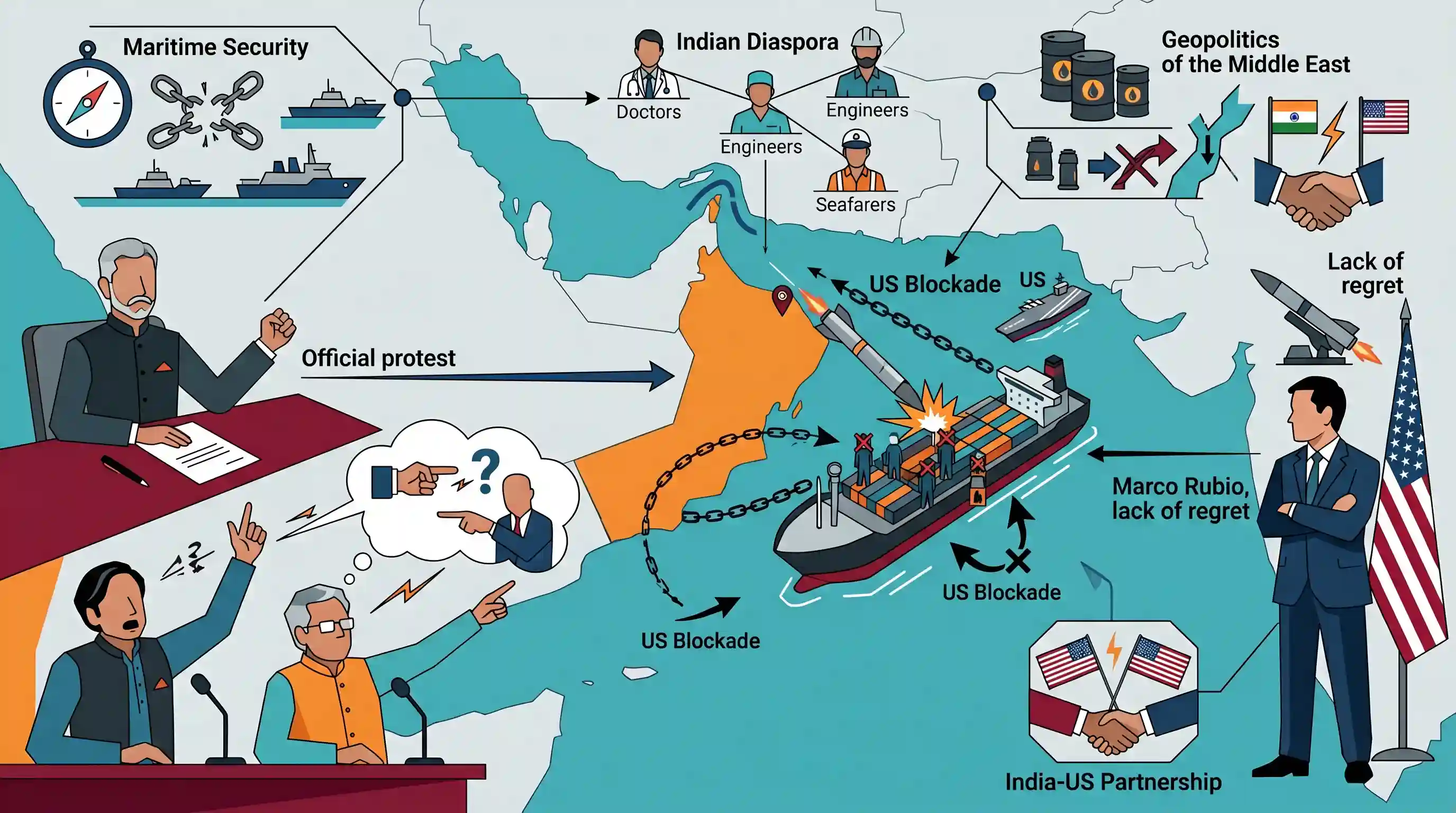
The incident directly relates to the protection of Indian diaspora and maritime workers abroad, a key element of India's foreign policy. It also tests the strength of the India-US strategic partnership when Indian lives are lost due to US military actions, highlighting the geopolitical volatility around crucial maritime chokepoints like the Strait of Hormuz.
Summary
Congress leaders Shashi Tharoor and Pawan Khera sharply criticized the United States over the killing of three Indian seafarers in a US missile strike on commercial vessels off the coast of Oman. The incident occurred in the context of a US blockade of the Strait of Hormuz. Tharoor questioned the US's use of lethal force against a non-compliant commercial vessel and condemned the lack of regret from US Secretary of State Marco Rubio. The Indian government, via External Affairs Minister S Jaishankar, had already lodged a strong diplomatic protest. The event raises critical questions about maritime security, the protection of Indian citizens working abroad, and the complexities of the India-US strategic partnership.
Key Points
- Three Indian seafarers were killed in a US missile strike on commercial vessels off the coast of Oman near the Strait of Hormuz.
- The US had blockaded the Strait of Hormuz, and Secretary of State Marco Rubio defended the use of force against vessels that did not comply with the blockade.
- Congress leaders Shashi Tharoor and Pawan Khera heavily criticized the US action, questioning the necessity of lethal force on a commercial ship and demanding an unconditional apology.
- External Affairs Minister S Jaishankar previously lodged a strong protest regarding the deaths.
- The incident highlights challenges in India-US bilateral relations and underscores the vulnerability of the Indian diaspora and seafarers caught in international geopolitical conflicts.
Important Terms
Strait of Hormuz

A strategically vital waterway between Iran and Oman connecting the Persian Gulf to the Gulf of Oman; it handles approximately 20% of the world's daily oil consumption.
UPSC context
GS Paper 1 (Geography/Chokepoints) and GS Paper 2 (Energy Security/West Asia); tests understanding of global energy lifelines.
Maritime Security
The protection of sea lines of communication (SLOCs), marine resources, and the ensuring of freedom of navigation against threats like piracy, terrorism, and unilateral blockades.
UPSC context
GS Paper 3 (Internal Security) and GS Paper 2 (Indo-Pacific); focus on India's 'Net Security Provider' role in the IOR.
Indian Diaspora
The diverse community of over 32 million Indian citizens (NRIs) and persons of Indian origin (OCIs) living abroad, whose welfare is a core Indian foreign policy pillar.
UPSC context
GS Paper 2 (International Relations); tests knowledge of the 'Effect of policies of developed countries on India's interests.'
UNCLOS
A 1982 international treaty establishing the legal framework for all maritime activities, defining 'Innocent Passage' and the rights of states in international waters.
UPSC context
GS Paper 2 (International Law/Institutions); critical for questions on South China Sea, Red Sea crisis, and freedom of navigation.
Diplomatic Demarche
A formal diplomatic representation, protest, or petition issued by a government to another through official channels, signaling serious concern or a shift in policy.
UPSC context
GS Paper 2 (International Relations); tests understanding of diplomatic protocols and India's tools for expressing sovereign dissatisfaction.
India-US Strategic Partnership
The institutionalized 'Comprehensive Global Strategic Partnership' between India and the US, encompassing defense (2+2 Dialogue), technology (iCET), and trade while navigating strategic autonomy.
UPSC context
GS Paper 2 (Bilateral Relations); central to India’s foreign policy, defense modernization, and balancing China in the Indo-Pacific.
Prelims Trap
"The Strait of Hormuz is bordered by Iran to the north and the United Arab Emirates to the south."
While the UAE is nearby, the actual southern shore of the Strait of Hormuz is the Musandam Peninsula, which is an exclave of Oman.
Static Concepts Connected
Which major water bodies and nations border the Strait of Hormuz?
- Connecting Waters: Connects the Persian Gulf (northwest) to the Gulf of Oman and the Arabian Sea (southeast).
- Northern Shore: Bordered by Iran to the north.
- Southern Shore: Bordered by Oman (specifically the Musandam Peninsula exclave) to the south.
How does UNCLOS protect commercial shipping in international straits?
- Transit Passage: Vessels enjoy unimpeded navigation and overflight solely for continuous and expeditious transit through international straits.
- Freedom of Navigation: All states enjoy the freedom of navigation outside territorial waters, free from unilateral blockades in peacetime.
- Use of Force: Unilateral lethal force against non-combatant merchant ships during peacetime violates international maritime law.
Cross-Topic Patterns
Energy security & Current Account Deficit
Disruption at maritime chokepoints like Hormuz links directly to India's macroeconomics, as sudden spikes in crude/LNG import bills widen the current account deficit and drive imported inflation.
Indo-Pacific alignment vs West Asian autonomy
Highlights the tension between India's Indo-Pacific alignment with the US and its distinct West Asian interests, where 8+ million Indian expats and vital energy supplies require non-aligned stability.

Map-based pairing of West Asian straits (Hormuz, Bab-el-Mandeb) with UNCLOS 'transit passage' rules is highly probable in 2026 Prelims.
Linked PYQs · 4
Linked PYQs · 4
- 2023MainsGS2
Indian diaspora has scaled new heights in the West. Describe its economic and political benefits for India.
- 2023MainsGS2
‘The expansion and strengthening of NATO and a stronger US-Europe strategic partnership works well for India.’ What is your opinion about this statement ? Give reasons and examples to support your answer.
- 2025MainsGS3
Why is maritime security vital to protect India's sea trade? Discuss maritime and coastal security challenges and the way forward.
- 2024PrelimsGS1
Consider the following statements : Statement-I : Sumed pipeline is a strategic route for Persian Gulf oil and natural gas shipments to Europe. Statement-II : Sumed pipeline connects the Red Sea with the Mediterranean Sea. Which one of the following is correct in respect of the above statements?
