VB G RAM G Bill Triggers Opposition Debate Over Federal Fiscal Burden
Source:Indian Express ↗
Why It Matters
The proposed transformation of MGNREGA into the VB-G RAM G Bill represents a fundamental shift in India's rural safety net architecture and federal fiscal relations. For UPSC aspirants, understanding the debate over demand-driven rights versus executive notification, and the implications of cost-sharing on fiscal federalism, is crucial for GS Paper 2 (Polity & Governance) and evaluating welfare policies.
Summary
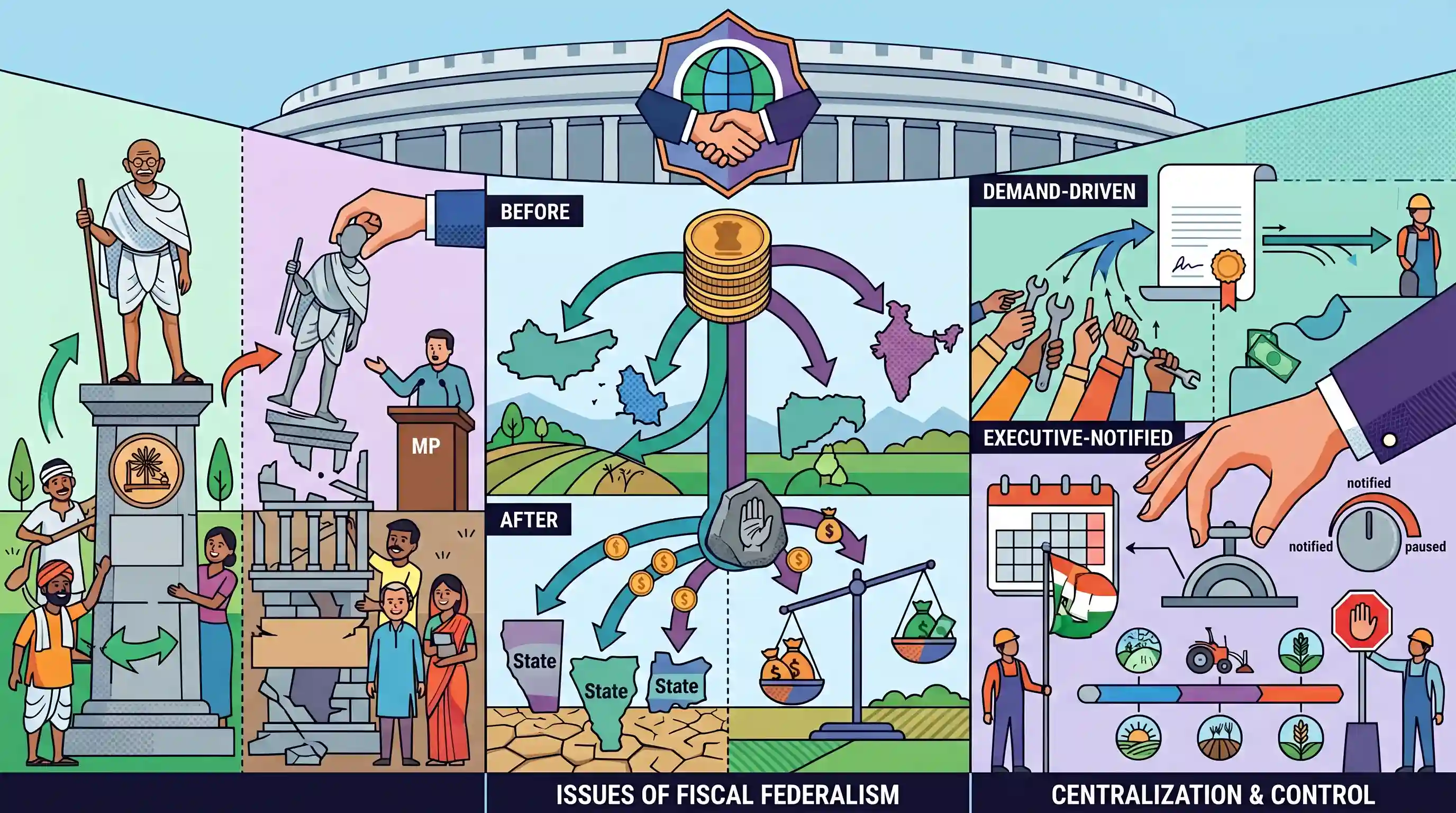
The introduction of the VB-G RAM G Bill to replace MGNREGA has triggered debate over the future of rural employment guarantees in India. Congress MP Shashi Tharoor outlined three major objections to the proposed legislation in the Lok Sabha. He criticized the removal of Mahatma Gandhi's name as an erosion of the scheme's philosophical foundation of Gram Swaraj. Crucially, Tharoor highlighted structural concerns, noting that shifting 40% of the financial burden to states threatens fiscal federalism and could cripple the program in poorer regions. Furthermore, the transition from a demand-driven, universal legal right to an executive-notified scheme—coupled with a pause during agricultural seasons—centralizes Union control and undermines the fundamental safety-net purpose of the employment guarantee.
Key Points
- The Centre introduced the VB-G RAM G Bill to replace MGNREGA, increasing guaranteed days from 100 to 125 but introducing structural changes to funding and implementation.
- Congress MP Shashi Tharoor argued that dropping Mahatma Gandhi’s name from the scheme severs its philosophical ties to Gram Swaraj and the welfare of the poorest.
- A key concern is the shift of 40% of the financial burden to states, which critics argue undermines fiscal federalism and disadvantages economically weaker states.
- The Bill changes the scheme from a universal, demand-driven right to one contingent upon executive notification, effectively centralizing control over when and where it operates.
- The introduction of a 'pause' during the agricultural season was criticized for destroying the scheme's utility as a dependable, year-round safety net for rural laborers.
Important Terms
VB-G RAM G Bill

A 2025 legislation replacing MGNREGA, increasing guaranteed work to 125 days while shifting to a 60:40 Centre-State funding ratio and an allocation-based model.
UPSC context
GS Paper II (Welfare Schemes); tests understanding of legislative overhauls and rights-based vs. budget-capped welfare frameworks.
MGNREGA
India’s landmark 2005 social security law providing a demand-driven right to 100 days of unskilled manual work per rural household.
UPSC context
GS Paper III (Employment/Poverty); vital for analyzing social safety nets and the transition to the new 'Viksit Bharat' framework.
Fiscal Federalism
The financial relationship and division of funding responsibilities between the Union and State governments within a federal system.
UPSC context
GS Paper II (Federal Structure); tests ability to evaluate how shifting financial burdens (e.g., 40% to states) impacts Centre-State relations.
Centrally Sponsored Scheme (CSS)
Schemes funded jointly by the Centre and States (often 60:40 ratio), implemented by State governments to achieve national development goals.
UPSC context
GS Paper II (Governance/Finance); tests knowledge of devolution of finances and the mechanics of public service delivery.
Demand-driven Model
A rights-based framework where the state is legally obligated to provide work or an allowance immediately upon a citizen's request.
UPSC context
GS Paper III (Economy/Welfare); tests comprehension of the legal accountability mechanisms within poverty alleviation programs.
Gram Swaraj
Mahatma Gandhi’s vision of self-reliant village republics, emphasizing decentralized governance and the empowerment of local bodies (Panchayats).
UPSC context
GS Paper II/Ethics; tests understanding of the philosophical foundations of Indian rural development and decentralized democracy.
Prelims Trap
VB-G RAM G retains the demand-driven legal right to work while increasing the guaranteed employment to 125 days.
The new bill explicitly transitions the scheme from a universal, demand-driven statutory right to an executive-notified scheme, fundamentally altering its legal guarantee status.
Static Concepts Connected
What is the constitutional basis for rural employment guarantees?
- Article 41 (DPSP): Directs the State, within its economic capacity, to make effective provision for securing the right to work and public assistance in cases of unemployment.
- Article 40 (DPSP): Mandates the state to organize village panchayats and endow them with powers, serving as the philosophical bedrock (Gram Swaraj) for decentralized scheme implementation.
How do Centrally Sponsored Schemes (CSS) affect Fiscal Federalism?
- Funding patterns: Unlike Central Sector Schemes (100% Union funded), CSS require state matching funds. MGNREGA was unique as the Centre bore 100% of unskilled labor costs.
- State fiscal strain: Mandating states to bear a 40% burden under the new bill puts pressure on state exchequers and FRBM limits, disproportionately impacting economically weaker states.
Cross-Topic Patterns
Rural wages & farm labor supply
The "agricultural pause" in the new bill directly responds to wealthy farmers' long-standing complaints that MGNREGA caused seasonal farm labor shortages and artificially drove up agricultural wage rates.
Executive discretion vs. Statutory rights
Moving from a demand-driven right to an executive-notified scheme highlights a broader governance shift from statutory rights-based entitlements (RTI, RTE, NFSA) to executive-controlled welfare delivery (labharthi models).

Expect a multi-statement Prelims 2026 question contrasting MGNREGA's demand-driven statutory nature with VB-G RAM G's executive notification.
Linked PYQs · 4
Linked PYQs · 4
- 2025MainsGS4
Mahatma Gandhi National Rural Employment Guarantee Program, MGNREGA was earlier known as National Rural Employment Scheme, NREGA. It is an Indian Social Welfare Program that aimed at fulfilling the 'Right to Work' provisions made in the Constitution. MGNREGA was launched in 2006 under Rural Employment Sector by the Ministry of Rural Development. Main objective of the program is to give legal guarantee of wage employment to the adult members of rural households who are willing to do unskilled manual labour work subject to a maximum of 100 days per year for every household. Every rural household has the right to register under the scheme, job card is issued to the registered, Job Card holder can seek employment; State Government shall pay 25% of minimum wage for the first 30 days as compensatory daily unemployment allowance to the families and of wage for remaining period of the year. MGNREGA work was undertaken by various Gram Panchayats. You have been appointed as an Administrator Incharge of the District. You have been given the responsibility of monitoring MGNREGA work undertaken by various Gram Panchayats. You are also given the authority to give technical sanctions to all MGNREGA works. In one of the Panchayats in your jurisdiction, you notice that your predecessor has mismanaged the Program in terms of : Money not disbursed to actual job-seekers. Muster Rolls of the Labourers not properly maintained. Mismatch between the work done and payments made. Payments made to fictitious persons. Job Cards were given without looking into the need of person. Mismanagement of funds and to the extent of siphoning of funds. Approved works that never existed. (a) What is your reaction to the above situation and how do you restore the proper functioning of MGNREGA Program in this regard ? (b) What actions would you initiate to solve the various issues listed above ? (c) How would you deal with the above situation ?
- 2025MainsGS2
Examine the evolving pattern of Centre-State financial relations in the context of planned development in India. How far have the recent reforms impacted the fiscal federalism in India?
- 2024MainsGS2
What changes has the Union Government recently introduced in the domain of Centre-State relations ? Suggest measures to be adopted to build the trust between the Centre and the States and for strengthening federalism.
- 2017MainsGS2
Poverty alleviation programmes in India remain mere showpieces until and unless they are backed up by political will." Discuss with reference to the performance of the major poverty alleviation programmes in India.
