Economic growth disparities and welfare delivery gaps in India
Source:The Hindu ↗
Why It Matters
This article bridges the gap between macroeconomic data (poverty rates, PPP) and micro-level welfare implementation (Census delays impacting PDS/NFSA). It provides critical arguments for Mains answers on 'Inclusive Growth' (GS3) and 'Effectiveness of Welfare Schemes' (GS2), illustrating how statistical gaps and regressive taxation can undermine poverty alleviation efforts.
Summary
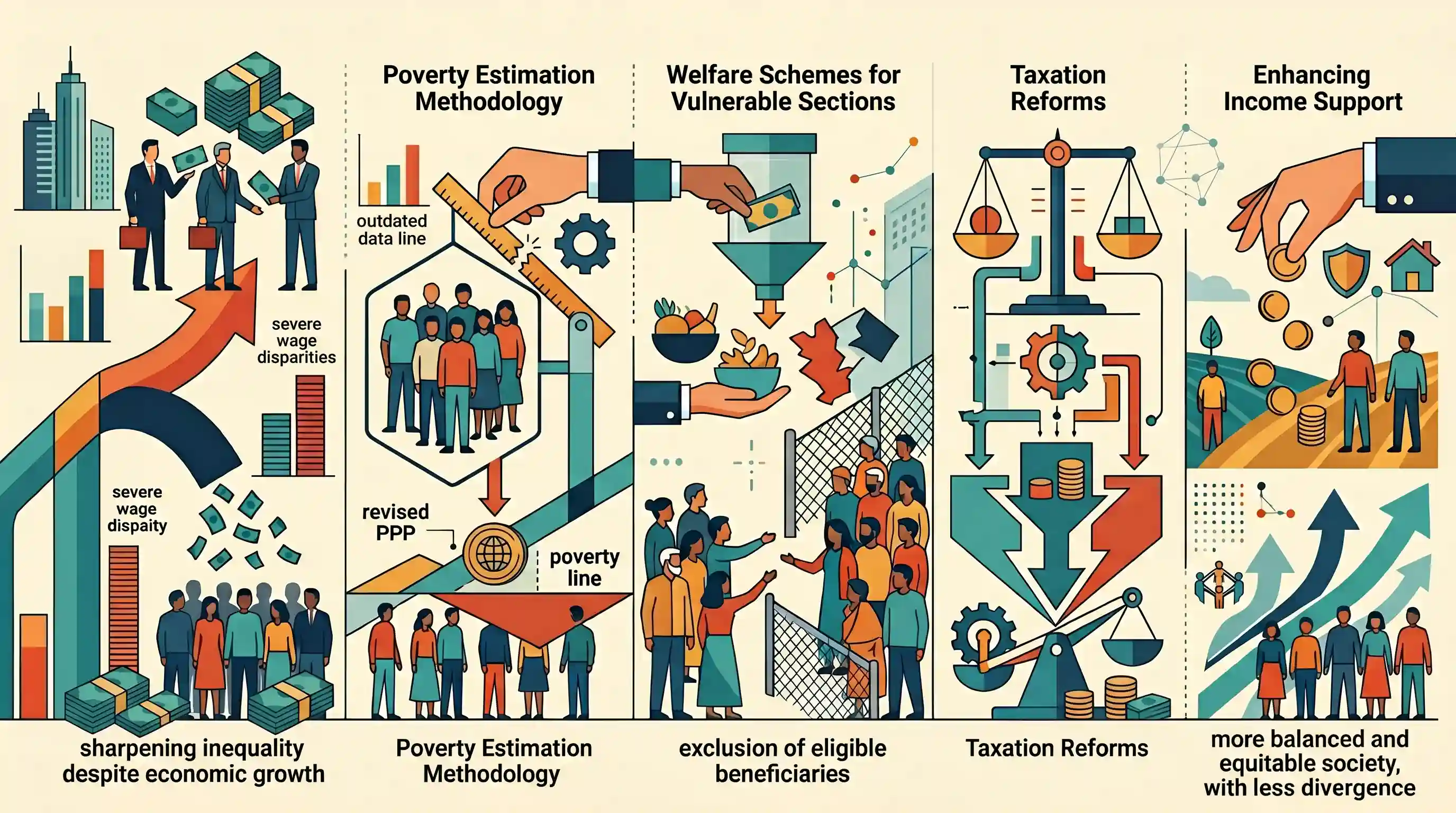
The Congress party has critiqued the nature of India's current economic growth, describing it as deeply embedded with sharpening inequality despite a fall in extreme poverty. Referencing the World Bank's Spring 2025 Poverty and Equity Brief, the opposition highlighted severe wage disparities where the top 10% earn 13 times more than the bottom 10%. The party warned that updated Purchasing Power Parity (PPP) metrics would reveal higher poverty levels. Furthermore, the lack of an updated decadal Census and a standardized poverty line since the 2014 Rangarajan Committee report has severely impaired targeted welfare, leading to the exclusion of around 10 crore eligible beneficiaries from the National Food Security Act (NFSA). Reforming the regressive GST structure and enhancing income support are proposed as necessary corrective measures.
Key Points
- Despite a drop in extreme poverty, India's recent economic growth is structurally characterized by severe wage disparities, with the top 10% earning 13 times the median of the bottom 10%.
- The World Bank's Spring 2025 Poverty and Equity Brief notes a decline in extreme poverty to 2.3% in 2022-23, though the opposition attributes this trajectory to pre-2014 welfare programs and 1991 liberalization.
- Applying the updated 2021 Purchasing Power Parity (PPP) conversion factor would likely result in a higher measured rate of extreme poverty than currently reported.
- The absence of an updated decadal Census and a clearly defined poverty line since the 2014 Rangarajan Committee has excluded nearly 10 crore eligible beneficiaries from the National Food Security Act (NFSA).
- Addressing this inequality requires structural tax reforms, particularly making the GST less regressive, alongside direct income support for vulnerable populations.
Important Terms
National Food Security Act (NFSA)

A 2013 law providing legal entitlement to subsidized food grains for 75% of rural and 50% of urban populations (roughly 81.35 crore people).
UPSC context
GS Paper II: Welfare schemes; GS Paper III: Food security. Tests understanding of statutory rights and implementation gaps like the 'Census delay'.
Rangarajan Committee
Expert group that redefined India's poverty line in 2014, raising thresholds to ₹32 (rural) and ₹47 (urban) per day, incorporating nutritional and non-food requirements.
UPSC context
GS Paper III: Indian Economy (Poverty). Essential for comparing methodologies (Tendulkar vs. Rangarajan) and understanding poverty estimation evolution.
Purchasing Power Parity (PPP)
An economic metric used to compare the buying power of different currencies by equalizing the cost of a fixed basket of goods.
UPSC context
GS Paper III: Economy. Vital for international poverty line comparisons and understanding India's relative economic size (3rd largest by PPP).
Goods and Services Tax (GST)
A comprehensive, multi-stage, destination-based indirect tax that replaced most central and state indirect taxes in India to create a unified market.
UPSC context
GS Paper III: Indian Economy/Taxation. Tests federalism (GST Council) and socio-economic impact (regressive vs. progressive taxation).
Inclusive Growth
Economic growth that creates opportunities for all segments of the population and distributes the dividends of prosperity fairly across society.
UPSC context
GS Paper III: Inclusive growth and issues arising from it. A core UPSC syllabus theme focusing on inequality and social justice.
World Bank Poverty and Equity Brief
Biannual World Bank report analyzing poverty, shared prosperity, and inequality trends using global thresholds like $2.15/day for extreme poverty.
UPSC context
GS Paper III: Economy/Poverty. Critical for current data on India’s Gini coefficient and progress toward Sustainable Development Goal 1 (No Poverty).
Prelims Trap
NFSA beneficiary quotas are dynamically updated annually based on NITI Aayog's Multidimensional Poverty Index.
NFSA coverage ratios (75% rural, 50% urban) are statutorily linked to the population figures of the decadal Census, not dynamically updated MPI metrics.
Static Concepts Connected
How have official poverty lines evolved in India?
- Tendulkar Committee (2009): Shifted from calorie-only norms to a broader basket including health and education, using a uniform reference period.
- Rangarajan Committee (2014): Reverted to a modified calorie norm (plus protein/fat) and separate rural/urban baskets. Its recommendations were never officially adopted.
- Multidimensional Poverty (MPI): Instead of absolute income-based poverty lines, NITI Aayog now measures deprivation across health, education, and living standards.
How does Purchasing Power Parity (PPP) impact poverty estimation?
- Standardized Basket: Compares the cost of a standardized basket of goods and services across countries, adjusting for differences in local price levels.
- International Poverty Line: The World Bank sets the international extreme poverty line (e.g., $2.15/day) using PPP to ensure global comparability.
- Base Year Effect: Updating the PPP base year (e.g., from 2017 to 2021) recalculates purchasing power, often altering the absolute number of people deemed extremely poor.
Cross-Topic Patterns
GST's regressive impact on inequality
Indirect taxes like GST inherently consume a higher fraction of low-income earnings. This regressive nature frequently anchors GS3 Mains debates on K-shaped economic recoveries and inclusive growth.
Data deficit and welfare targeting
The absence of a post-2011 Census doesn't just stall demographic data; it legally freezes NFSA quotas, impacts Finance Commission devolution, and skews targeted welfare, causing massive exclusion errors.

Expect a multi-statement Prelims question testing the statutory link between the decadal Census, NFSA beneficiary caps, and PPP concepts.
Linked PYQs · 5
Linked PYQs · 5
- 2022MainsGS2
Besides the welfare schemes, India needs deft management of inflation and unemployment to serve the poor and the underprivileged sections of the society. Discuss.
- 2020MainsGS3
Explain intra-generational and inter-generational issues of equity from the perspective of inclusive growth and sustainable development.
- 2022MainsGS3
Is inclusive growth possible under market economy ? State the significance of financial inclusion in achieving economic growth in India.
- 2019MainsGS3
It is argued that the strategy of inclusive growth is intended to meet the objectives of inclusiveness and sustainability together. Comment on this statement.
- 2017MainsGS3
What are the salient features of 'inclusive growth'? Has India been experiencing such a growth process? Analyse and suggest measures for inclusive growth.
