Shared Genetic Risk Factors across Mental Health Conditions
Source:The Hindu ↗
Why It Matters
Understanding the biological and genetic basis of mental health is crucial for UPSC aspirants, as it connects advancements in Science & Technology (GS3) with public health policy and the management of India's growing disease burden (GS2). It highlights the shift towards precision medicine and the need for updated, evidence-based healthcare frameworks.
Summary
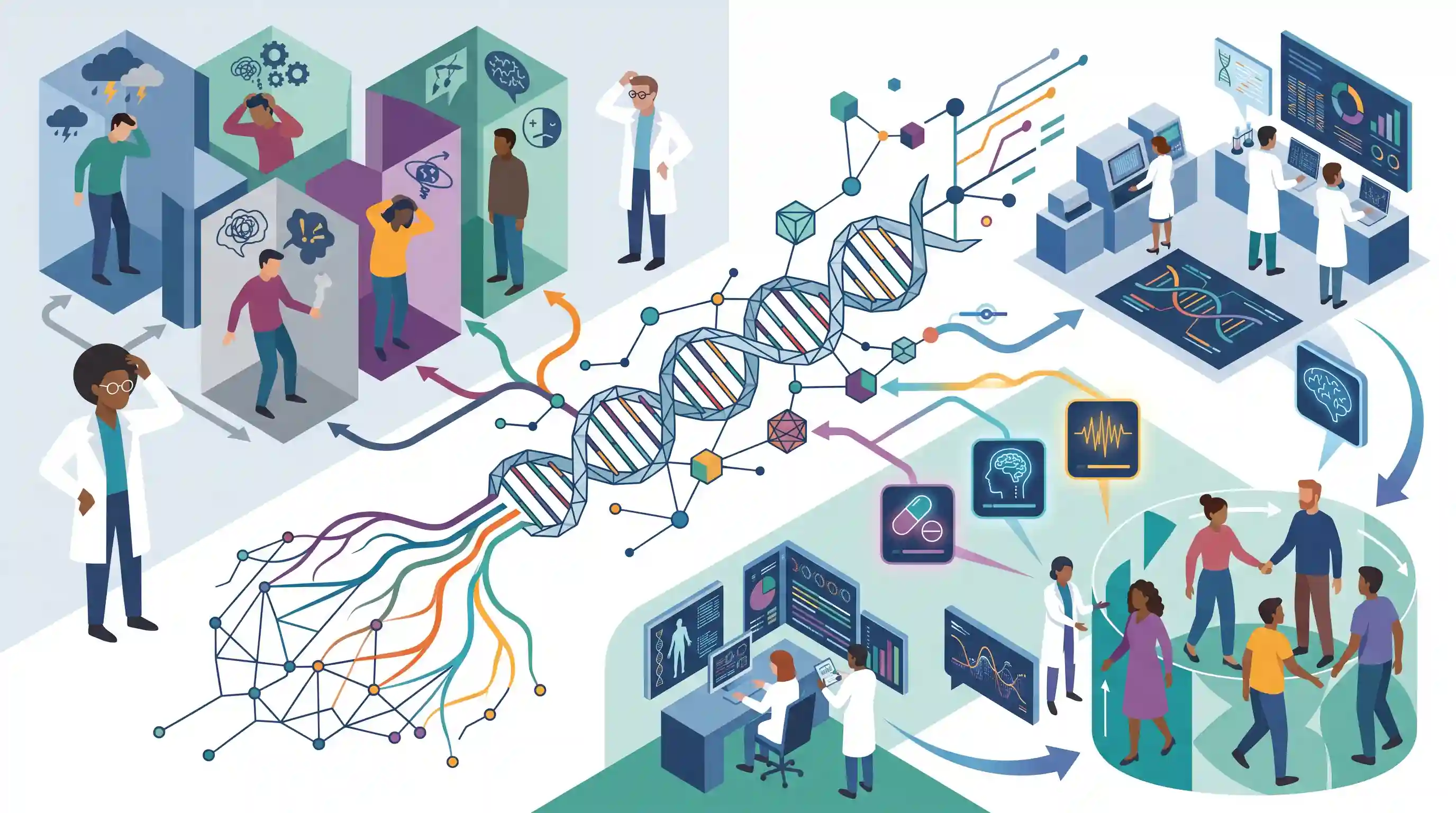
A new study highlights that the frequent overlap and co-occurrence of various mental health conditions are driven by shared genetic risk factors. By demonstrating that different psychiatric disorders possess a common underlying biological and genetic architecture, the findings challenge traditional diagnostic silos. This dimensional perspective not only explains why patients often exhibit overlapping symptoms but also paves the way for cross-diagnostic, precision treatments by targeting shared genetic pathways. The research marks a significant step towards integrating genomics into psychiatry, promising more effective and personalized therapeutic strategies.
Key Points
- A recent study reveals that the overlap and comorbidity often seen among various mental health conditions can be substantially explained by shared genetic risk factors (pleiotropy).
- The findings challenge traditional, rigid diagnostic boundaries (siloed categories), suggesting that psychiatric disorders share a common underlying biological architecture.
- This shared genetic foundation accounts for overlapping symptoms across different disorders, such as mood dysregulation, cognitive impairment, and behavioral changes.
- Understanding these shared genetic pathways opens avenues for cross-diagnostic treatments, precision psychiatry, and the potential repurposing of existing psychiatric drugs to target common mechanisms.
- The research advocates for a dimensional approach to mental health, integrating genetic data and biomarkers into clinical diagnoses rather than relying solely on symptom-based classification.
Important Terms
Mental Healthcare Act, 2017

A 2017 Indian law providing a rights-based framework for mental health. It ensures access to services, mandates treatment choice via 'Advance Directives,' and decriminalized suicide attempts by presuming severe stress.
UPSC context
GS II: Governance/Social Justice. Tests knowledge of legal protections for vulnerable groups and shifts in Indian healthcare policy.
National Mental Health Programme (NMHP)
India's flagship scheme (launched 1982) for delivering mental health services. It integrates care into the general health system via the community-based District Mental Health Programme (DMHP) for detection and rehabilitation.
UPSC context
GS II: Health/Social Justice. Relevant for understanding public health infrastructure and government responses to non-communicable disease burdens.
Genome India Project
A Department of Biotechnology (DBT) initiative to sequence 10,000 diverse Indian genomes. It creates a reference map to identify genetic variations linked to diseases, enabling precision medicine and population-specific health interventions.
UPSC context
GS III: Science & Technology (Biotechnology). Tests understanding of genomics, big data in biology, and indigenous scientific research.
Precision Medicine
An innovative medical approach that customizes treatment based on an individual's genetic makeup, environment, and lifestyle. It moves beyond 'one-size-fits-all' healthcare toward targeted, high-efficacy therapies.
UPSC context
GS III: Science & Technology. Crucial for topics on emerging technologies, biotechnology applications, and personalized healthcare solutions.
Prelims Trap
Pleiotropy means multiple genes cause a single psychiatric disorder.
That describes polygenic inheritance. Pleiotropy is the exact opposite: it occurs when a single gene or genetic variant affects multiple distinct phenotypic traits or disorders.
Static Concepts Connected
What are Pleiotropy and Polygenic inheritance in genetics?
- Pleiotropy: A single gene influences multiple distinct phenotypic traits (e.g., one genetic risk factor leading to both depression and cognitive impairment).
- Polygenic inheritance: Multiple independent genes collectively influence a single phenotypic trait (e.g., human skin color or height).
- Epistasis: The interaction between different genes where one gene masks or modifies the expression of another.
What are the core mandates of the Genome India Project (GIP)?
- Core Objective: To sequence the genomes of citizens to create a catalog of the Indian "reference genome", mapping the country's vast genetic diversity.
- Phased Rollout: Phase I sequenced 10,000 healthy individuals. Phase II targets disease-specific genomic profiling, including mental illnesses, cancer, and cardiovascular diseases.
- Precision Medicine: The resulting genomic grid facilitates precision medicine, allowing personalized, population-specific therapies instead of generalized symptom-based treatments.
Cross-Topic Patterns
Genomics + Mental Healthcare Act 2017
Precision psychiatry aligns with the Mental Healthcare Act 2017’s mandate to treat mental and physical illnesses equally, advancing mental health from subjective evaluations to objective, biomarker-driven diagnoses.
Drug repurposing + Indian Patent Act
Repurposing existing psychiatric drugs for new cross-diagnostic treatments based on shared genetic pathways touches upon Section 3(d) of the Indian Patent Act regarding evergreening and enhanced efficacy.

A basic science question matching genetic terms (Pleiotropy, Epigenetics) or a multi-statement on Genome India Project's phases in 2026.
Linked PYQs · 3
Linked PYQs · 3
- 2021MainsGS3
What are the research and developmental achievements in applied biotechnology? How will these achievements help to uplift the poorer sections of the society?
- 2024MainsGS2
In a crucial domain like the public healthcare system the Indian State should play a vital role to contain the adverse impact of marketisation of the system. Suggest some measures through which the State can enhance the reach of public healthcare at the grassroots level.
- 2022MainsGS3
The increase in life expectancy in the country has led to newer health challenges in the community. What are those challenges and what steps need to be taken to meet them?
