Russian Crude Oil Share Rises in India Energy Import Basket
Source:The Hindu ↗
Why It Matters
The article highlights the shifting dynamics of India's energy procurement strategy in a volatile geopolitical environment. It is crucial for understanding how global crises (like those in West Asia and Eastern Europe) directly impact India's energy security, import bills, and foreign policy alignments.
Summary
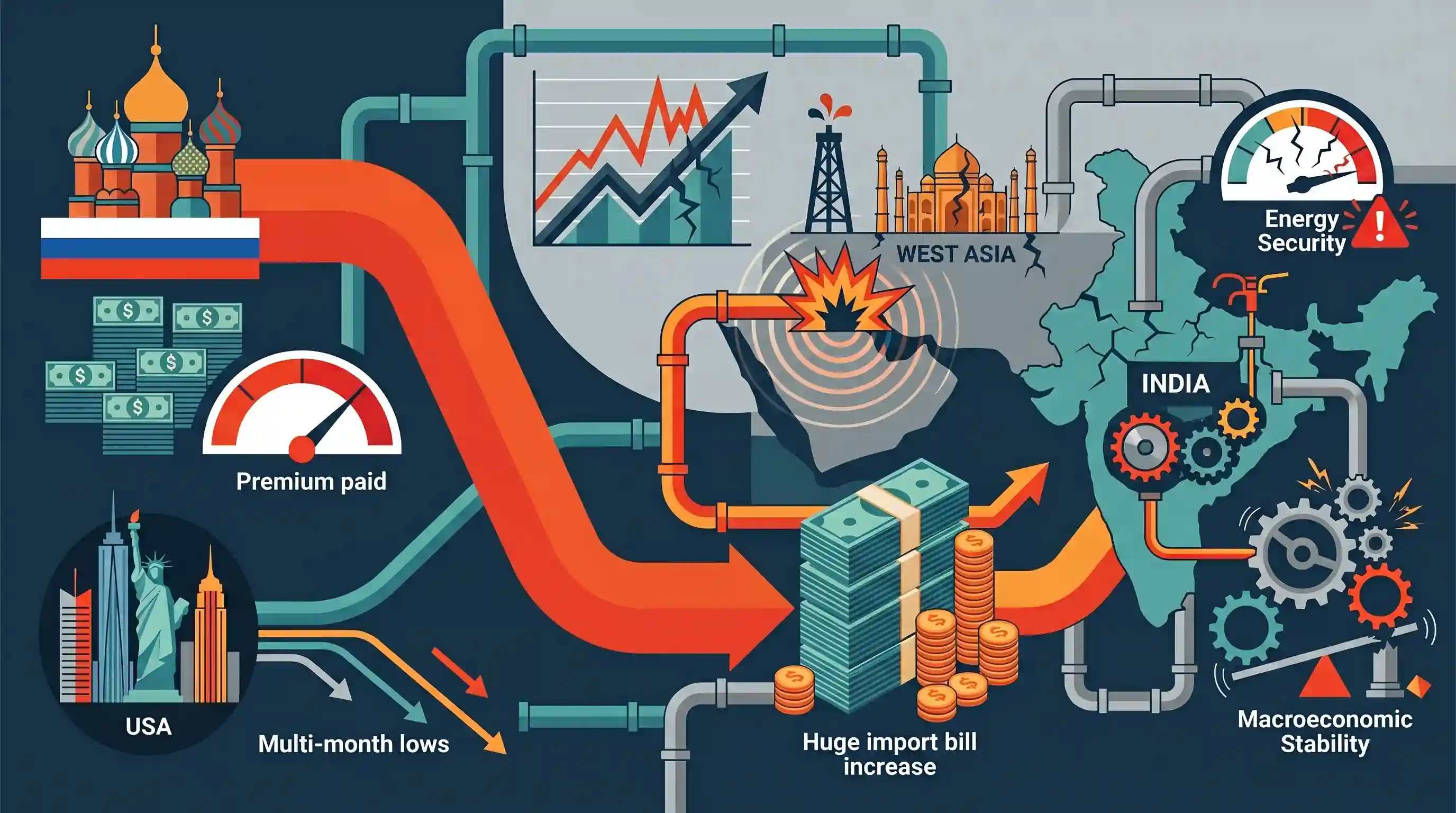
In April 2026, Russia's share of India's crude oil imports rose significantly to almost 38% by value, despite a massive 425% increase in the premium paid for Russian crude. India's overall oil import bill surged by over 61% to $15.4 billion due to rising global prices. Meanwhile, imports from the United States fell to multi-month lows, reflecting shifting trade dynamics exacerbated by the West Asia crisis. This growing dependence on costlier Russian oil presents new challenges for India's energy security and macroeconomic stability.
Key Points
- Russia accounted for 34.3% by volume and 37.7% by value of India's total crude oil imports in April 2026.
- The premium India paid for Russian oil over the overall average price jumped 425% to $77.8 per tonne in April.
- India's total oil import bill surged by 61.3% to $15.4 billion due to rising international crude prices.
- Oil imports from the U.S. fell to multi-month lows of 2.9% by value amidst ongoing geopolitical tensions in West Asia.
Prelims Trap
India currently enjoys a heavy discount on Russian crude oil due to ongoing Western sanctions.
The strategic advantage of discounted Russian crude has recently eroded. By April 2026, India was actually paying a massive premium for Russian oil.
Static Concepts Connected
What is the status and management of India's Strategic Petroleum Reserves (SPR)?
- Capacity & Cover: Phase I covers 5.33 MMT, providing only about 9.5 days of national import cover.
- Locations: Phase I sites are Visakhapatnam, Mangaluru, and Padur. Phase II plans include Chandikhol and Padur.
- Management: Managed by Indian Strategic Petroleum Reserves Limited (ISPRL), under the Ministry of Petroleum and Natural Gas.
How does a rising crude import bill affect India's macroeconomy?
- Current Account Deficit: A surging oil import bill widens the trade deficit, worsening the CAD and depreciating the Rupee.
- Imported Inflation: Higher crude prices translate to higher transport and production costs, driving up both wholesale and retail inflation.
- Fiscal Pressures: The government may be forced to cut excise duties on fuel to cushion consumers, reducing tax revenues.
Cross-Topic Patterns
Rupee-Ruble Trade & Vostro Accounts
The surging 38% volume of Russian imports stresses the payment settlement system, making the success of Special Rupee Vostro Accounts (SRVAs) critical to avoiding heavy dollar outflows.
Red Sea Crisis & Energy Transit
The sharp drop in U.S. oil imports links directly to maritime disruptions in West Asia, forcing India to re-route energy reliance and absorb higher logistics premiums.

Expect a 2026 prelims question testing India's SPR capacity (days of cover) paired with the macroeconomic effects of imported inflation.
Linked PYQs · 1
Linked PYQs · 1
- 2025MainsGS2
"Energy security constitutes the dominant kingpin of India's foreign policy, and is linked with India's overarching influence in Middle Eastern countries.” How would you integrate energy security with India's foreign policy trajectories in the coming years?
