State Election Commission and Local Body Polls in Jammu and Kashmir
Source:The Hindu ↗
Why It Matters
The conduct of local body elections in J&K is a vital case study for democratic decentralization in reorganized Union Territories. It touches upon GS-2 themes like the mandate of the State Election Commission, delimitation challenges, OBC reservations in local bodies, and the dynamics between the Lieutenant-Governor and statutory commissions in UT administration.
Summary
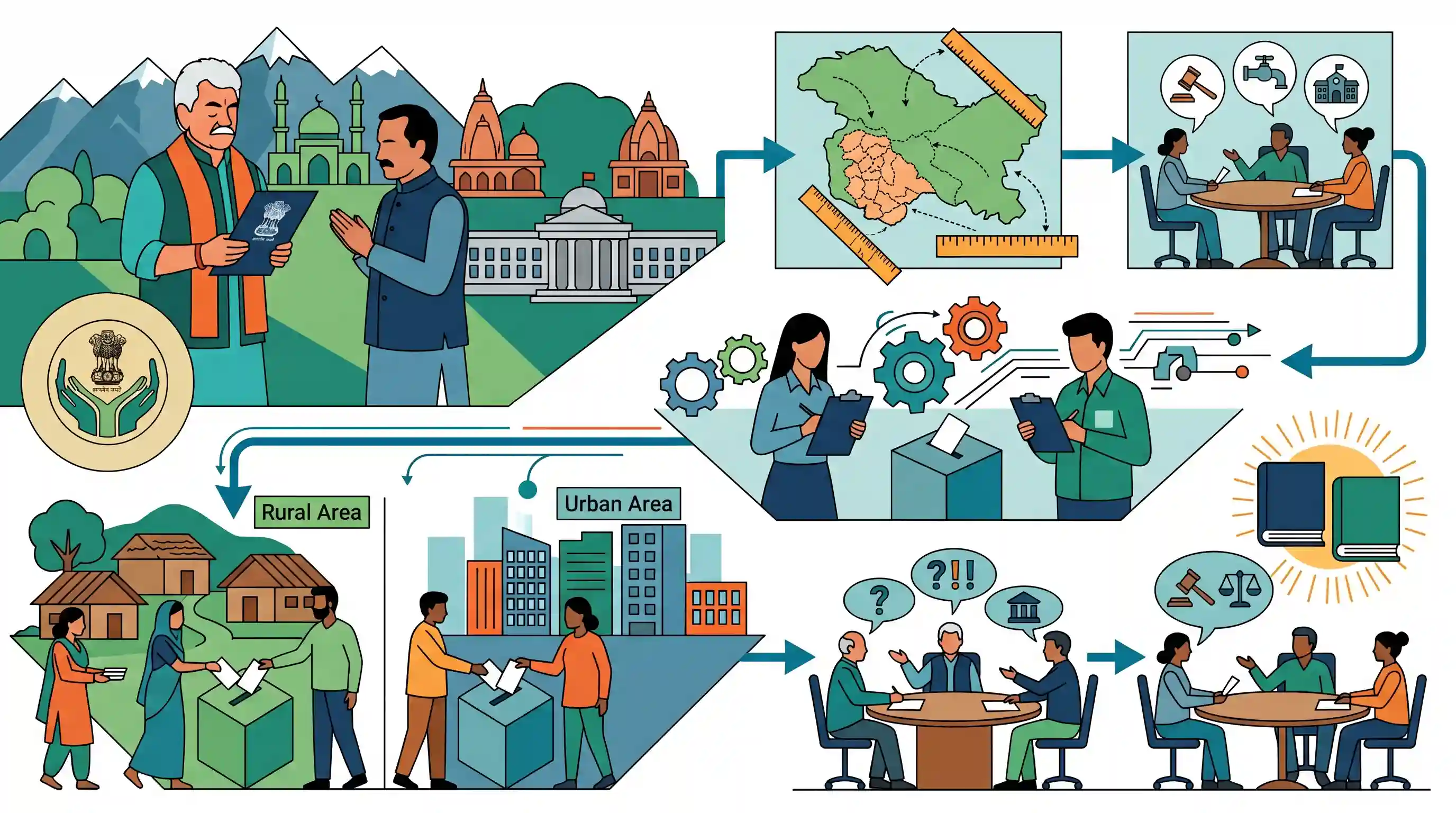
Shantmanu has been sworn in as the new State Election Commissioner (SEC) of Jammu and Kashmir, administered the oath by Lieutenant-Governor Manoj Sinha. Upon taking office, he indicated plans to conduct the much-delayed panchayat and urban local body (ULB) elections. The delay was attributed to procedural necessities like the delimitation exercise and the implementation of OBC reservations. This development is crucial for reinstating grassroots democracy and decentralized governance in the Union Territory, empowering local bodies functionally and politically as envisioned under the 73rd and 74th Constitutional Amendments.
Key Points
- Shantmanu took the oath as the State Election Commissioner (SEC) of Jammu and Kashmir, succeeding BR Sharma.
- The new SEC hinted at holding the long-delayed panchayat and urban local body (ULB) elections to restore decentralized governance.
- Elections had been delayed due to the delimitation process, incorporation of OBC reservations in local bodies, and the temporary vacancy in the SEC office.
- The SEC operates under the J&K Panchayati Raj Act and Municipal Acts, enjoying statutory autonomy and powers similar to a High Court judge to oversee local electoral processes.
Important Terms
State Election Commission (SEC)

A constitutional body (Articles 243K and 243ZA) responsible for the superintendence, direction, and control of electoral rolls and the conduct of elections to Panchayats and Municipalities.
UPSC context
GS Paper II (Constitutional Bodies); critical for understanding the independence and mechanics of local-level electoral democracy.
73rd and 74th Constitutional Amendments
Landmark 1992 acts that constitutionalized rural (Panchayats) and urban (Municipalities) local self-government, establishing a three-tier governance structure to promote democratic decentralization across India.
UPSC context
GS Paper II (Polity/Governance); fundamental for questions regarding the devolution of powers and grassroots democracy.
J&K Panchayati Raj Act, 1989
The primary legislation for rural local self-governance in Jammu and Kashmir, establishing a three-tier system: Halqa Panchayat (village), Block Development Council, and District Development Council.
UPSC context
GS Paper II (Union Territory Governance); vital for understanding J&K’s specific legal landscape and administrative transitions post-Reorganisation.
Urban Local Bodies (ULBs)
Institutions of local self-government in urban areas, such as Municipal Corporations and Nagar Panchayats, mandated by the 74th Amendment to manage civic services and planning.
UPSC context
GS Paper II (Governance); relevant for urban administration, fiscal federalism, and the delivery of essential public services.
Panchayati Raj Institutions (PRIs)
A system of rural local self-government consisting of elected bodies at village, intermediate, and district levels, empowered to implement economic development and social justice schemes.
UPSC context
GS Paper II (Local Self-Government); tests knowledge of decentralized planning and the socio-political empowerment of rural populations.
Delimitation
The process of redrawing boundaries of territorial constituencies based on population changes to ensure equal voter representation and fair electoral outcomes.
UPSC context
GS Paper II (Elections); significant for understanding electoral fairness and the procedural prerequisites for conducting delayed polls.
Prelims Trap
"The 73rd and 74th Amendments mandate compulsory reservation for OBCs in local bodies."
OBC reservation is a voluntary provision (Articles 243D & 243T), left entirely to the discretion of the State Legislature or UT Administration. Only SC/ST/Women reservations are compulsory.
Static Concepts Connected
What are the powers and independence of the State Election Commission (SEC)?
- Jurisdiction: Conducts elections exclusively for Panchayats (Art 243K) and Municipalities (Art 243ZA). It does not conduct State Assembly elections (handled by ECI).
- Security of Tenure: Appointed by the Governor/LG, but can only be removed in the same manner and on the same grounds as a High Court Judge.
How do Part IX and IXA (Local Government) apply to Union Territories?
- Constitutional Mandate: Under Articles 243L and 243ZB, the provisions for Panchayats and Municipalities apply to UTs just as they do to States.
- Role of Administrator: In the context of a UT, references to the "Governor" in the Constitution are read as the "Administrator" (e.g., Lieutenant Governor) appointed under Article 239.
Cross-Topic Patterns
J&K Reorganisation & Local Delimitation
The transition of J&K into a UT necessitated fresh delimitation exercises, stalling local elections. This links constitutional reorganization directly to grassroots electoral delays.
Voluntary Quotas & OBC Representation
The delay to implement OBC quotas in J&K local bodies mirrors the larger national debate on sub-categorization and voluntary provisions for targeted political representation.

Expect a multi-statement question on SEC autonomy, specifically testing removal procedures and voluntary OBC reservations in local bodies.
Linked PYQs · 4
Linked PYQs · 4
- 2017PrelimsGS1
Local self-government can be best explained as an exercise in
- 2024MainsGS2
Analyse the role of local bodies in providing good governance at local level and bring out the pros and cons merging the rural local bodies with the urban local bodies.
- 2016MainsGS2
Discuss the essentials of the 69th Constitutional Amendment Act and anomalies, if any, that have led to recent reported conflicts between the elected representatives and the institution of the Lieutenant Governor in the administration of Delhi. Do you think that this will give rise to a new trend in the functioning of the Indian federal politics?
- 2018MainsGS2
Whether the Supreme Court Judgement (July 2018) can settle the political tussle between the Lt. Governor and elected government of Delhi? Examine.
