India US Civil Nuclear Energy Cooperation and Private Sector
Source:Indian Express ↗
Why It Matters
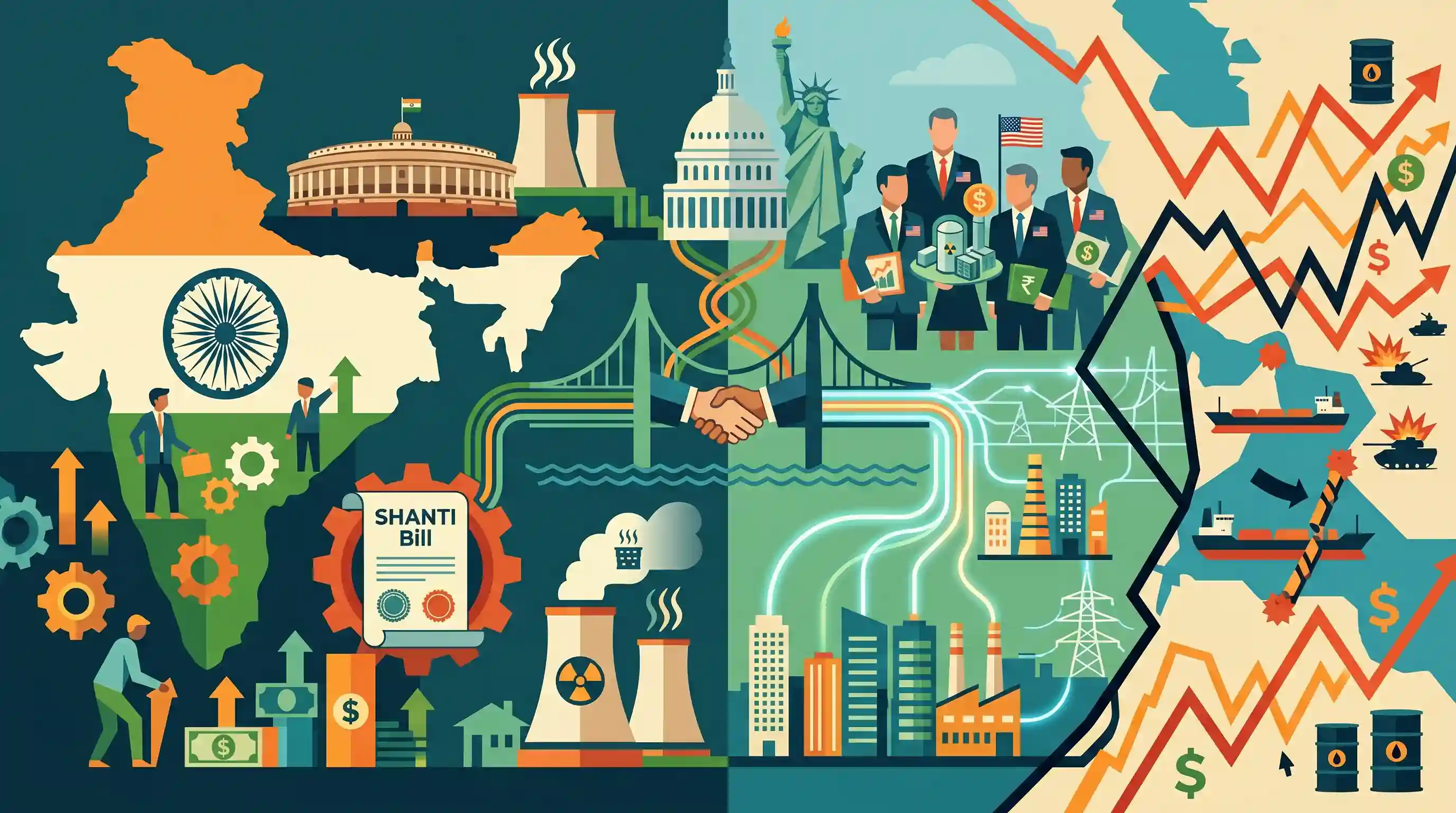
The SHANTI Bill represents a historic shift in India's nuclear policy by inviting private sector participation. This intersects with critical UPSC themes including energy security, the commercialization of strategic technologies, and how global geopolitical shocks (like West Asian conflicts) influence domestic policy and bilateral partnerships.
Summary
India and the United States are entering a new phase of civil nuclear collaboration, catalyzed by India's proposed SHANTI Bill which aims to allow private sector participation in the nuclear energy domain. A visiting US delegation, led by the Nuclear Energy Institute, noted that India's strong nuclear foundation makes it a prime destination for American technology and investment. Both nations emphasize that expanding nuclear energy is essential for securing a reliable baseload power supply that is insulated from fossil fuel price volatility and geopolitical disruptions, particularly given ongoing conflicts in West Asia and vulnerabilities around the Strait of Hormuz.
Key Points
- India has introduced the SHANTI Bill, proposing to open its traditionally state-monopolized nuclear energy sector to private players.
- A US delegation led by the Nuclear Energy Institute (NEI) is visiting India to explore investments, partnerships, and technology deployment in this newly opened market.
- The bilateral focus is shifting toward commercializing next-generation nuclear technology, including Small Modular Reactors (SMRs).
- Geopolitical instability in West Asia and threats to strategic chokepoints like the Strait of Hormuz are driving the push for nuclear energy to ensure long-term energy security and immunity from hydrocarbon price shocks.
Important Terms
SHANTI Bill/Act, 2025

A 2025 legislation (Sustainable Harnessing and Advancement of Nuclear Energy for Transforming India) that repealed the Atomic Energy Act, 1962, allowing private sector ownership and up to 49% foreign investment in India's nuclear power plants.
UPSC context
GS-III: Energy and Infrastructure. Tests understanding of policy shifts from state monopoly to private participation in strategic sectors.
India-US Civil Nuclear Agreement
A landmark 2008 bilateral pact (123 Agreement) that ended India's nuclear isolation, allowing it to engage in global nuclear trade for civilian purposes without being a signatory to the Nuclear Non-Proliferation Treaty (NPT).
UPSC context
GS-II: International Relations. A foundational topic for India-US strategic ties and global non-proliferation architecture.
Small Modular Reactors (SMRs)
Advanced nuclear reactors with a capacity of up to 300 MW(e) per unit, designed to be factory-built and easily transported for flexible, cost-effective deployment, unlike traditional large-scale reactors.
UPSC context
GS-III: Science and Technology. Relevant for clean energy transitions and decentralized power generation strategies.
Strait of Hormuz
A critical maritime chokepoint between Iran and Oman connecting the Persian Gulf to the Gulf of Oman; it carries nearly 20% of global oil and is vital for India’s energy imports.
UPSC context
GS-I: World Geography; GS-II: International Relations. Tests knowledge of maritime security and energy supply chain vulnerabilities.
Energy Security
The availability of uninterrupted energy sources at an affordable price. In the nuclear context, it refers to 'baseload power'—reliable electricity generation independent of weather or fuel-price shocks.
UPSC context
GS-III: Economic Development and Environment. Essential for India’s Net Zero 2070 goal and reducing fossil fuel dependency.
Nuclear Energy Institute (NEI)
The primary policy organization for the US nuclear energy industry, representing utilities, manufacturers, and laboratories; it led the 2026 delegation to India to facilitate private-sector commercial partnerships.
UPSC context
GS-II: Bilateral Relations. Represents the commercial and industrial track of India-US strategic energy cooperation.
Prelims Trap
Under the SHANTI Bill 2025, foreign suppliers retain unlimited liability for nuclear accidents to ensure stringent safety standards.
The Bill actually repeals the 2010 Liability Act, removing 'automatic supplier liability' and capping operator liability. This resolves the primary bottleneck that deterred foreign vendors.
Static Concepts Connected
What are the defining characteristics of Small Modular Reactors (SMRs)?
- Capacity limits: SMRs have a power output of up to 300 MW(e) per module, significantly smaller than the 700+ MW capacity of conventional nuclear power reactors.
- Modular design: Their components can be factory-assembled and transported as single modules to the site, drastically reducing upfront capital costs and construction delays.
- Passive safety: They rely on passive safety systems based on natural physical phenomena (like gravity and convection), requiring no external power to shut down safely during an emergency.
What is the "Channeling of Liability" principle in international nuclear law?
- Operator liability: It channels absolute and exclusive liability for nuclear damage directly to the operator of the nuclear installation, regardless of fault.
- Supplier exemption: It historically protects technology and equipment suppliers from being sued for damages, a global norm (e.g., CSC) that India's 2010 Act previously deviated from.
Cross-Topic Patterns
Baseload power for Net Zero targets
Nuclear energy via SMRs offers the stable, zero-emission baseload critical for India's 2070 Net Zero target, offsetting the intermittency of solar and wind power.
Hormuz dependency & Energy Security
Expanding domestic nuclear power insulates India's macroeconomy from imported inflation and oil shocks triggered by conflicts around critical maritime chokepoints like the Strait of Hormuz.

A 2026 multi-statement question will likely test the SHANTI Bill's removal of supplier liability alongside the technical specs of SMRs.
Linked PYQs · 4
Linked PYQs · 4
- 2017MainsGS2
The question of India's Energy Security constitutes the most important part of India's economic progress. Analyze India's energy policy cooperation with West Asian countries.
- 2025MainsGS2
"Energy security constitutes the dominant kingpin of India's foreign policy, and is linked with India's overarching influence in Middle Eastern countries.” How would you integrate energy security with India's foreign policy trajectories in the coming years?
- 2017MainsGS3
Give an account of the growth and development of nuclear science and technology in India. What is the advantage of fast breeder reactor programme in India?
- 2018PrelimsGS1
In the Indian context, what is the implication of ratifying the 'Additional Protocol' with the 'International Atomic Energy Agency (IAEA)'?
