Nuclear Energy Sector Cleared for Foreign Direct Investment Policy
Source:Indian Express ↗
Why It Matters
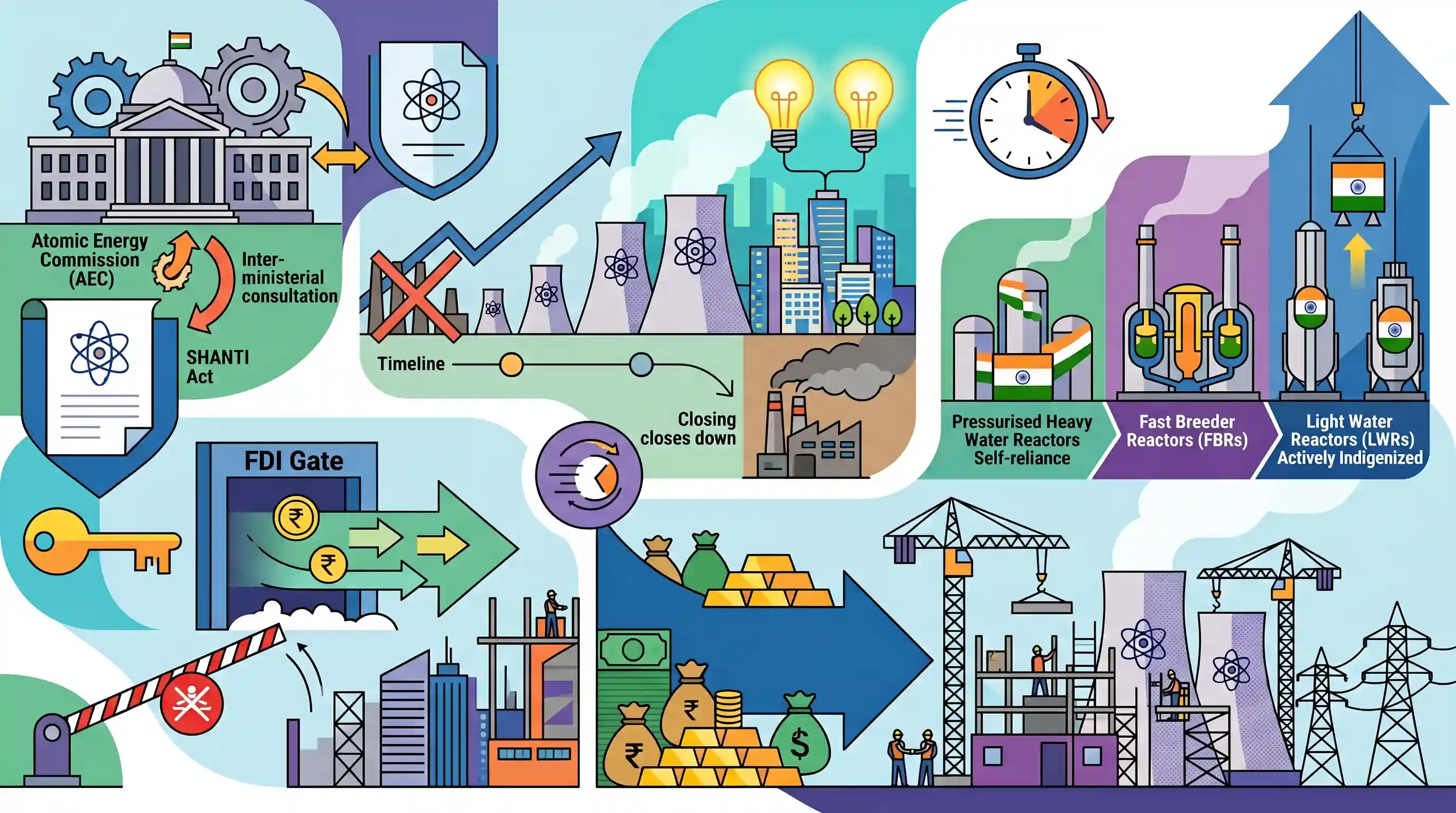
Highlights a major policy paradigm shift in India's highly regulated nuclear sector by opening it to private and foreign investment. It connects India's net-zero and energy security goals with necessary legislative reforms (SHANTI Act) and the evolution of the three-stage nuclear program (PHWRs, FBRs, LWRs).
Summary
The Atomic Energy Commission (AEC) has cleared a draft policy allowing Foreign Direct Investment (FDI) in India's nuclear power sector and forwarded it for inter-ministerial consultations. This move is propelled by the proposed SHANTI (Safe Holistic Assured Nuclear-energy for Transformation of India) Act, which seeks to amend the Atomic Energy Act of 1962 to dilute strict civil nuclear liability clauses, thereby enabling private and foreign capital. The policy shift aims to fast-track nuclear capacity addition, targeting 100 GW by 2047 from the current 8.1 GW to provide a reliable baseload alternative to coal. Achieving this will require massive investments estimated at ₹20 lakh crore and a reduction in project approval timelines. Technologically, while India is self-reliant in Pressurised Heavy Water Reactors (PHWRs) and has advanced its Fast Breeder Reactor (FBR) program, indigenizing Light Water Reactors (LWRs) remains the next frontier.
Key Points
- The Atomic Energy Commission (AEC) has approved a draft FDI policy for the nuclear energy sector, advancing it for inter-ministerial consultation.
- The proposed SHANTI Act seeks to amend the Atomic Energy Act of 1962, easing civil nuclear liability rules to attract private sector participation and foreign direct investment (FDI).
- India aims to expand its nuclear power capacity from 8.1 GW to 100 GW by 2047, which requires an estimated investment of ₹20 lakh crore.
- Technological progress: India has mastered Pressurised Heavy Water Reactors (PHWRs) and achieved criticality in a Fast Breeder Reactor (FBR). The next objective is indigenizing Light Water Reactor (LWR) technology.
- The Central Electricity Authority (CEA) views nuclear energy as a critical baseload alternative to coal to ensure grid stability and facilitate the energy transition.
- Project approval timelines need to be compressed from the current 13 years to 8-9 years to meet long-term capacity addition targets.
Important Terms
SHANTI Act

A landmark legislation (2025) that consolidated India's nuclear laws, repealing the Atomic Energy Act (1962) and Civil Liability Act (2010) to enable private sector participation and foreign investment in nuclear power.
UPSC context
GS Paper II (Legislation) and GS Paper III (Energy Security); tests understanding of policy shifts from state monopoly to liberalization.
Atomic Energy Commission (AEC)
India's apex policy-making body for atomic energy, established in 1958; it functions directly under the Prime Minister and is responsible for formulating nuclear research and power policies.
UPSC context
GS Paper II (Institutional Framework); crucial for understanding the top-down governance of India's strategic sectors.
Civil Liability for Nuclear Damage Act, 2010
The 2010 law that established a no-fault liability regime for nuclear accidents; its controversial Section 17(b) on supplier liability was a major deterrent for foreign investors until the SHANTI Act.
UPSC context
GS Paper III (Energy/Environment); tests knowledge of international conventions (CSC) and legal hurdles in nuclear diplomacy and FDI.
Atomic Energy Act, 1962
The foundational 1962 legislation that reserved atomic energy exclusively for the Central Government and prohibited private ownership or patents in nuclear technology until its recent repeal/amendment.
UPSC context
GS Paper II (Governance); essential historical context for the evolution of India's "Sovereign" nuclear control.
Bhabha Atomic Research Centre (BARC)
India’s premier nuclear research facility located in Trombay, Mumbai; it serves as the research and development backbone for the country’s entire nuclear fuel cycle and reactor technologies.
UPSC context
GS Paper III (Science & Technology); frequently tested for its role in the Three-Stage Nuclear Power Program and indigenous technology.
Department of Atomic Energy (DAE)
The administrative department under the Prime Minister's Office responsible for implementing nuclear power projects, managing fuel resources, and overseeing research institutions and public sector undertakings like NPCIL.
UPSC context
GS Paper II (Government Structures); tests knowledge of the executive branch's management of strategic energy and research.
Prelims Trap
The SHANTI Act deregulates the atomic sector, allowing 100% Foreign Direct Investment under the automatic route.
Nuclear energy remains strategically restricted. The proposed SHANTI Act dismantles the complete state monopoly but envisions FDI capped at 49%, not 100%, to maintain domestic control.
Static Concepts Connected
How do PHWR, LWR, and FBR technologies differ?
- PHWR: Uses heavy water (D2O) as moderator/coolant and unenriched natural uranium as fuel. It is the mainstay of India's current fleet.
- LWR: Uses ordinary light water as moderator/coolant but strictly requires enriched uranium fuel. This is the next indigenization frontier for India.
- FBR: Generates more fissile material than it consumes. It uses liquid sodium as a coolant and does not require a moderator.
Why does the Civil Liability for Nuclear Damage Act (2010) deter foreign vendors?
- Supplier Liability: Section 17(b) of the Act gives the operator a right of recourse to sue the equipment supplier if a defect causes a nuclear incident.
- Global Deviation: This deviates from international conventions (like the CSC) which channel absolute and exclusive liability strictly to the plant operator.
- Investment Block: Foreign vendors fear unlimited liability. The SHANTI Act push specifically targets diluting these strict clauses to unlock foreign capital.
Cross-Topic Patterns
FDI trends in Strategic Sectors
Following the recent opening of the Space sector to FDI, the SHANTI Act marks a parallel policy trend of dismantling state monopolies in strategic domains to fund capital-intensive expansion.
Baseload Power + Net-Zero 2070
As intermittent solar and wind scale up, the CEA identifies nuclear as the crucial non-fossil 'baseload' to replace coal, directly linking nuclear liability reforms to India's Net-Zero 2070 targets.

Expect a 2026 multi-statement question contrasting India's 'supplier liability' (CLNDA 2010) with global 'operator-only' liability norms.
Linked PYQs · 3
Linked PYQs · 3
- 2011PrelimsGS1
The function of heavy water in a nuclear reactor is to
- 2017MainsGS3
Give an account of the growth and development of nuclear science and technology in India. What is the advantage of fast breeder reactor programme in India?
- 2016MainsGS3
Justify the need for FDI for the development of the Indian economy. Why there is gap between MOUs signed and actual FDIs? Suggest remedial steps to be taken for increasing actual FDIs in India.
