Intersection of Religious Authority and State Politics
Source:Indian Express ↗
Why It Matters
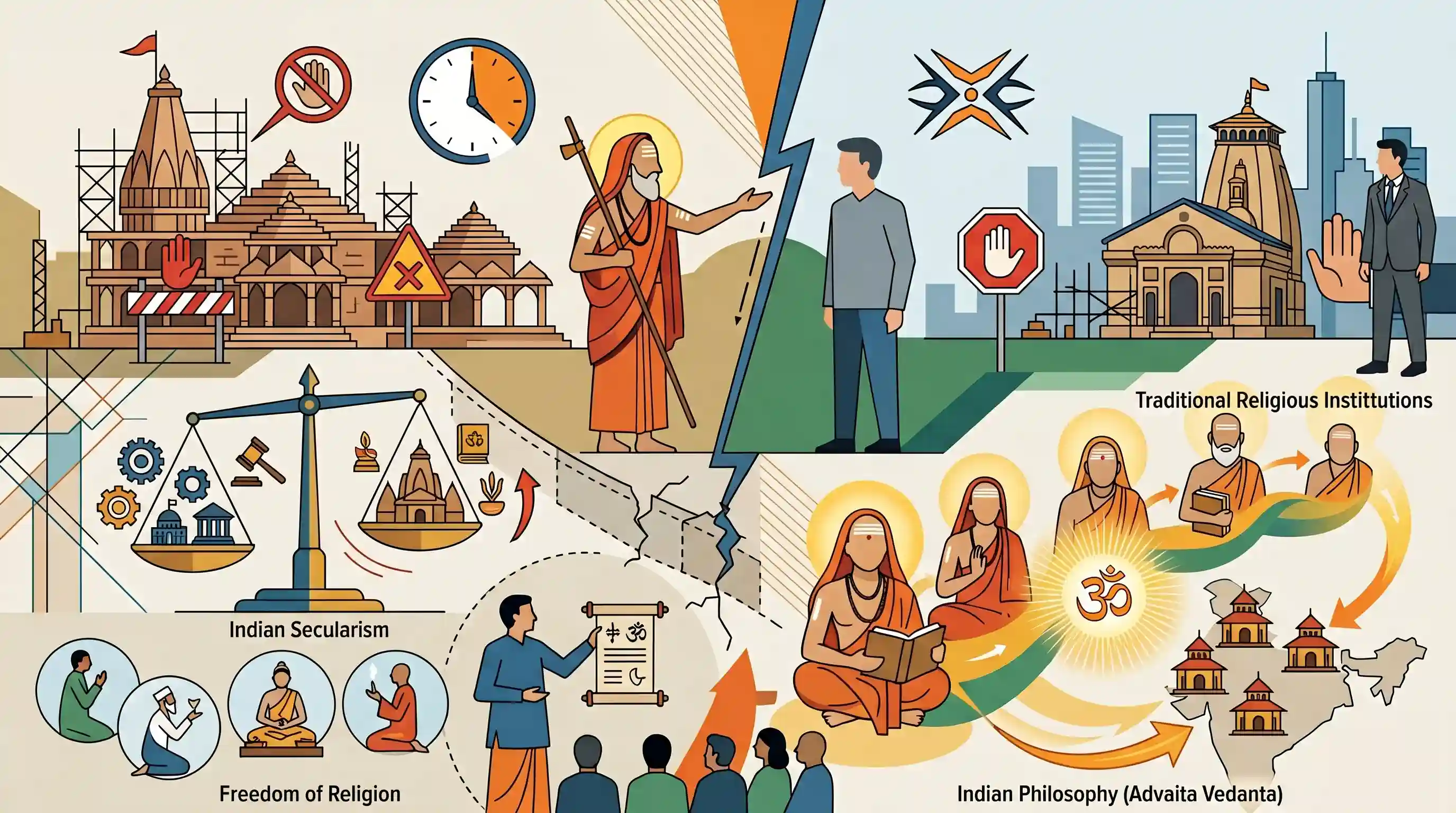
The controversy is deeply relevant for UPSC aspirants as it touches upon two major syllabus areas: GS2 (Secularism, separation of powers, and the state's role in religious administration) and GS1 (Art & Culture, specifically the history and philosophical significance of the Shankaracharya institution and Advaita Vedanta). It provides a real-world case study on the boundaries between religious authority and political leadership in India.
Summary
The article discusses the ongoing conflicts between Swami Avimukteshwaranand Saraswati—who claims the title of Shankaracharya of Jyotir Math—and the BJP-led governments at the state and Centre. The tensions have centered around various issues where religious orthodoxy meets political action, including his boycott of the Ayodhya Ram Temple consecration due to incomplete construction, and his vocal opposition to the Kedarnath replica temple project in Delhi. The disputes underline the complexities of Indian secularism, the separation of state and religion, and the enduring influence of the traditional Shankaracharya institutions founded by Adi Shankaracharya.
Key Points
- Swami Avimukteshwaranand Saraswati, the claimant to the Jyotir Math Shankaracharya title, has frequently clashed with the ruling BJP governments over religious and administrative matters.
- The seer previously boycotted the Pran Pratishtha (consecration) ceremony of the Ram Mandir in Ayodhya, arguing that it violated scriptures to inaugurate an incomplete temple.
- Recent rows include his opposition to the construction of a Kedarnath replica temple in Delhi and allegations regarding missing gold from the original Kedarnath shrine.
- The tussle highlights the broader intersection of religious authority and political power, bringing into focus the constitutional principles of Indian secularism and state interference in religious affairs.
- The institution of the Shankaracharya, tracing its origins to the 8th-century philosopher Adi Shankaracharya and his Advaita Vedanta philosophy, remains a highly influential religious authority in Hinduism.
Important Terms
Jyotir Math

One of the four cardinal monasteries (mathas) established by Adi Shankaracharya, located in Joshimath, Uttarakhand. It is the northern seat (Uttaramnaya) and traditionally holds authority over the Atharva Veda.
UPSC context
GS Paper I (Art & Culture) and II (Polity). Tests knowledge of monastic geography and state-religion interactions.
Shankaracharya
The religious title for the heads of the four cardinal monasteries founded by Adi Shankara. They are considered the highest spiritual authorities in the Advaita Vedanta tradition.
UPSC context
GS Paper I (Religious Personalities) and GS II (Freedom of Religion). Relevant for traditional authority vs. modern legal succession.
Supreme Court of India
The highest judicial authority in India. In religious rows, it serves as the final arbiter for legal succession, institutional management, and the protection of constitutional rights under Articles 25-28.
UPSC context
GS Paper II (Judiciary). Tests judicial intervention in religious affairs and constitutional limits of state power.
Advaita Vedanta
A non-dualist school of Indian philosophy systematized by Adi Shankara. It teaches that the individual soul (Atman) and the ultimate reality (Brahman) are one, and the world is Maya (illusion).
UPSC context
GS Paper I (Indian Philosophy). Essential for understanding the theological framework of the four cardinal Mathas.
Indian Secularism
A "positive" model of secularism based on "principled distance," where the state respects all religions equally (Sarva Dharma Sambhava) but intervenes for social reform, morality, and public order.
UPSC context
GS Paper II (Constitutional Comparison). Tests understanding of India's unique state-religion relationship versus the Western "strict separation" model.
Bharatiya Janata Party (BJP)
One of India's major political parties, advocating for Hindutva (cultural nationalism). Its governments at the state and Centre are often key stakeholders in religious infrastructure and civilizational revival projects.
UPSC context
GS Paper II (Polity/Governance). Relevant for the intersection of political ideology and the administration of religious sites.
Prelims Trap
"The Indian Constitution mandates a strict wall of separation, prohibiting state interference in religious institutions."
Unlike the US, India follows 'principled distance'. The state can and does intervene in secular/economic activities of religious institutions and for social reform.
Static Concepts Connected
What are the core teachings and institutions established by Adi Shankaracharya?
- Advaita Vedanta: Consolidated the doctrine of Non-Dualism, asserting that Atman (individual soul) and Brahman (ultimate reality) are identical, and the phenomenal world is Maya (illusion).
- Four Mathas: Established four Amnaya Mathas to preserve Vedic traditions: Jyotir Math (North), Dwarka (West), Puri (East), and Sringeri (South).
- Literary Contributions: Authored profound commentaries (Bhashyas) on the Upanishads, the Brahma Sutras, and the Bhagavad Gita.
How does the Constitution balance religious freedom with state regulation?
- Essential Religious Practices (ERP): Formulated in the 1954 Shirur Mutt case, it restricts constitutional protection under Articles 25/26 to only those practices fundamental to a religion.
- Article 26 Limits: Denominations can manage 'matters of religion', but the state retains power to regulate secular, economic, and administrative activities of these institutions.
- Social Reform (Art 25): The state can intervene in religious practices to enact social welfare and reform (e.g., throwing open Hindu religious institutions to all classes).
Cross-Topic Patterns
State Infrastructure vs. Religious Denomination Rights
State-led redevelopment of sacred sites (like the Kashi Vishwanath and Mahakal corridors) frequently tests the limits of Article 26, balancing state infrastructure goals against traditional religious orthodoxy.
Advaita vs. Vishishtadvaita in Prelims
The contemporary political prominence of the Mathas revives focus on ancient Indian philosophies. UPSC often contrasts Adi Shankaracharya's Advaita (Non-dualism) with Ramanuja's Vishishtadvaita (Qualified non-dualism).

Expect a hybrid Prelims question pairing Adi Shankaracharya's Advaita Vedanta/Mathas with the limits of Article 26 (Shirur Mutt doctrine).
Linked PYQs · 2
Linked PYQs · 2
- 2024MainsGS2
Discuss India as a secular state and compare with the secular principles of the US constitution.
- 2022PrelimsGS1
The world's second tallest statue in sitting pose of Ramanuja was inaugurated by the Prime Minister of India at Hyderabad recently. Which one of the following statements correctly represents the teachings of Ramanuja?
