Shangri La Dialogue and Regional Security Architecture
Source:The Hindu ↗
Why It Matters
The article illustrates India's assertive strategic shift in dealing with cross-border terrorism and highlights the changing dynamics of the India-Pakistan rivalry, where traditional military engagements are increasingly shaped by emerging technologies like drones and AI, as well as robust diplomatic campaigns on global forums.
Summary
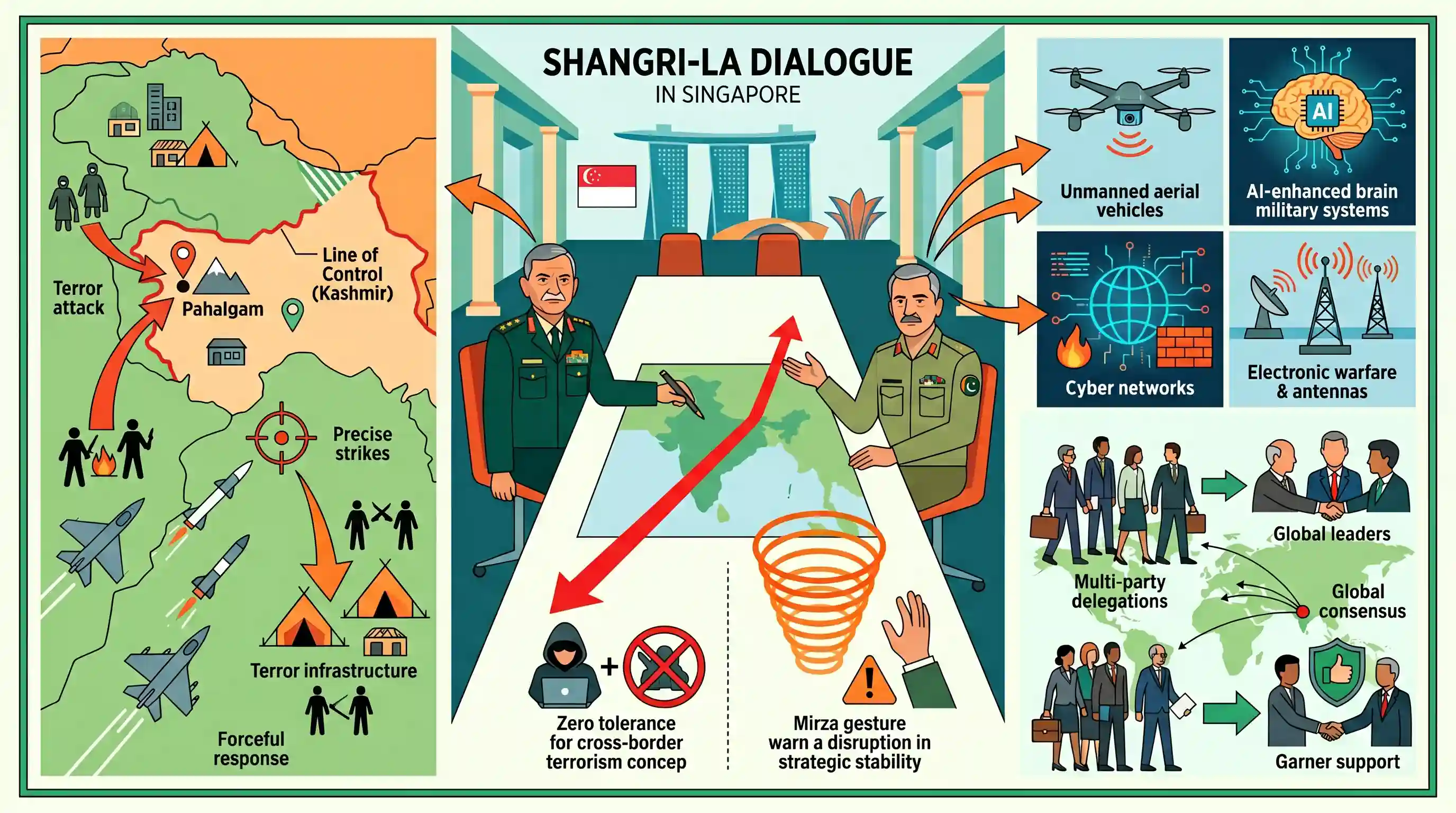
At the 2025 Shangri-La Dialogue in Singapore, top military officials from India and Pakistan outlined their strategic postures following a brief military conflict in May. The confrontation was triggered by a terror attack in Pahalgam, prompting India to launch 'Operation Sindoor' against terror infrastructure in Pakistan and PoK. India's CDS Gen. Anil Chauhan emphasized that India has drawn a 'new red line of intolerance' against cross-border terrorism, signaling a definitive end to the proxy war. Conversely, Pakistan's Gen. Sahir Shamshad Mirza cautioned that rapid escalation in future conflicts could severely disrupt strategic stability. The dialogue also highlighted the evolving nature of India-Pakistan hostilities, emphasizing the critical role of modern warfare technologies such as drones, AI, cyber capabilities, and electronic warfare. Alongside military posturing, India effectively deployed multi-party diplomatic delegations to secure international support for its anti-terrorism stance.
Key Points
- Top military officials from India and Pakistan addressed the Shangri-La Dialogue in Singapore amid tensions following a recent brief military confrontation.
- The conflict was sparked by a terror attack in Pahalgam, which led to India\'s retaliatory strikes on terror infrastructure under 'Operation Sindoor'.
- India\'s Chief of Defence Staff Gen. Anil Chauhan asserted that India has drawn a 'new red line of intolerance' to end the decades-long proxy war of terror.
- Pakistan\'s Gen. Sahir Shamshad Mirza warned that a future conflict targeting cities could rapidly destabilize strategic stability before international intervention.
- Both sides heavily utilized drones during the conflict, which underscored the rising importance of AI, cyber, electronic warfare, and precision firepower in modern warfare.
- India launched an unprecedented diplomatic effort by sending multi-party delegations globally to build consensus on its anti-terror narrative.
Important Terms
Shangri-La Dialogue

Asia's premier annual inter-governmental security forum held in Singapore. Organized by the International Institute for Strategic Studies (IISS), it facilitates high-level dialogue among defense ministers and military chiefs on regional security.
UPSC context
GS Paper 2: International Relations. Relevant for Asia-Pacific security architecture and India's 'Act East' policy engagements.
Operation Sindoor
An Indian military operation launched on May 7, 2025, involving precision strikes against terror infrastructure in Pakistan and PoK. It followed the Pahalgam terror attack and established a 'new red line' of intolerance.
UPSC context
GS Paper 3: Security Challenges and Management in Border Areas. Tests knowledge of counter-terrorism doctrines and military deterrence.
Strategic Stability
A state in international relations where nuclear-armed neighbors lack incentives to initiate a first strike. It relies on credible deterrence, arms control, and effective crisis-management mechanisms to prevent escalation.
UPSC context
GS Paper 2/3: International Relations/Security. Important for nuclear policy, deterrence theory, and conflict resolution in South Asia.
Chief of Defence Staff (CDS)
The professional head of the Indian Armed Forces and principal military adviser to the government. The post aims to foster inter-service synergy and oversee the transition to Integrated Theatre Commands.
UPSC context
GS Paper 3: Security. Key to defense reforms, modernization, and higher defense management in India.
Cross-border Terrorism
Terrorist acts originating from one country but executed in another, often as part of a proxy war. It involves external support for militants to destabilize a target nation's sovereignty.
UPSC context
GS Paper 3: Internal Security. A critical challenge for Indian national security and a major point of bilateral friction.
Prelims Trap
"The Shangri-La Dialogue is an official inter-governmental forum hosted by ASEAN."
While it features track-one defense ministers, it is organized by the International Institute for Strategic Studies (IISS), an independent think tank, not an official ASEAN body.
Static Concepts Connected
What is the significance of Article 51 of the UN Charter in cross-border strikes?
- Inherent Right: Recognizes the inherent right of individual or collective self-defense if an armed attack occurs against a UN Member state.
- State Practice: Increasingly invoked by states to justify retaliatory strikes against non-state actors (terrorists) when the host state is unwilling or unable to act.
- UNSC Notification: Measures taken by members in the exercise of this right of self-defense must be immediately reported to the UN Security Council.
How do India and Pakistan's deterrence doctrines structurally contrast?
- India's Doctrine: Built on "No First Use" (NFU) and "Credible Minimum Deterrence," threatening massive retaliation only if attacked with weapons of mass destruction.
- Pakistan's Doctrine: Relies on "Full Spectrum Deterrence" without an NFU policy, implicitly threatening the use of tactical nuclear weapons against conventional forces.
- Sub-conventional War: India uses limited conventional retaliation (like Operation Sindoor) to operate below the nuclear threshold, challenging Pakistan's reliance on its nuclear umbrella to shield proxy wars.
Cross-Topic Patterns
AI and shifting nuclear deterrence thresholds
The use of kamikaze drones and precision strikes shows how niche conventional military tech is blurring the lines of traditional nuclear deterrence and altering regional strategic stability.
Bipartisan consensus as a foreign policy tool
India's dispatch of bipartisan delegations mirrors the 1994 Parliament Resolution on J&K, demonstrating how domestic political consensus is strategically leveraged to legitimize foreign policy and military actions globally.

Expect a 2026 Mains question linking Article 51 self-defense, cross-border strikes, and how AI/loitering munitions alter deterrence.
Linked PYQs · 4
Linked PYQs · 4
- 2024MainsGS3
India has a long and troubled border with China and Pakistan fraught with contentious issues. Examine the conflicting issues and security challenges along the border. Also give out the development being undertaken in these areas under the Border Area Development Programme (BADP) and Border Infrastructure and Management (BIM) Scheme.
- 2023MainsGS3
The use of unmanned aerial vehicles (UAVs) by our adversaries across the borders to ferry arms/ammunitions, drugs, etc., is a serious threat to the internal security. Comment on the measures being taken to tackle this threat.
- 2021MainsGS3
Keeping in view India's internal security, analyse the impact of cross-border cyber attacks. Also discuss defensive measures against these sophisticated attacks.
- 2020MainsGS2
Quadrilateral Security Dialogue (Quad)' is transforming itself into a trade bloc from a military alliance, in present times - Discuss.
