Shamonda Virus Detection in Humans and One Health Surveillance Risks
Source:The Hindu ↗
આ શા માટે મહત્વનું છે
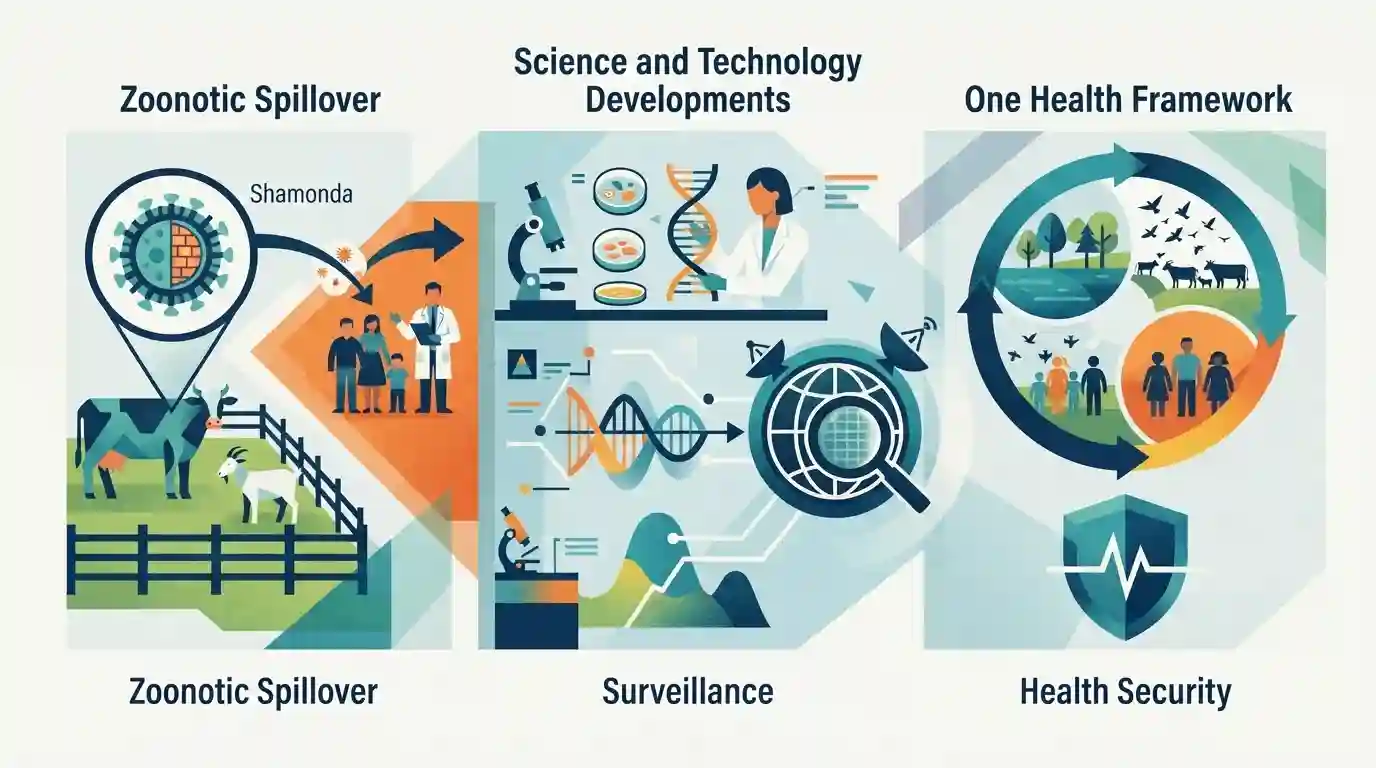
The first-ever human detection of a livestock pathogen like the Shamonda virus emphasizes the growing risks of zoonotic spillover and reinforces the relevance of global disease surveillance and the One Health approach in public health policy.
સારાંશ
The article discusses the initial detection of the Shamonda virus in humans, a pathogen typically restricted to livestock such as ruminants. This cross-species spillover emphasizes the evolving risks of zoonotic infections and the critical need for comprehensive disease surveillance under the One Health framework.
મુખ્ય મુદ્દા
- The Shamonda virus, traditionally known as a livestock pathogen affecting ruminants like cattle and sheep, has been detected in a human for the first time.
- This discovery highlights the growing concern of zoonotic spillover events, where pathogens jump from animals to humans.
- Emergence of such livestock-associated viruses in humans underscores the importance of 'One Health' approach integrating human, animal, and environmental health surveillance.
મહત્વપૂર્ણ શબ્દો
Shamonda virus

An arbovirus belonging to the Simbu serogroup and Orthobunyavirus genus, primarily infecting ruminants and livestock via midge vectors, which recently saw its first documented human infection.
UPSC context
UPSC CSE GS Paper III (Science & Tech / Health Security): Tests knowledge of emerging zoonotic diseases and cross-species pathogen spillovers.
One Health framework
An integrated, unifying approach that aims to sustainably balance and optimize the health of people, animals, and ecosystems, crucial for monitoring zoonotic pathogen spillovers.
UPSC context
UPSC CSE GS Paper II & III: Important for public health governance, disease surveillance, and managing animal-to-human disease transmission risks.
Zoonotic infections
Infectious diseases that can be naturally transmitted between animals and humans, highlighting the expanding interface between human populations and livestock or wildlife reservoirs.
UPSC context
UPSC CSE GS Paper III (Health): Frequently tested under emerging health threats, epidemic preparedness, and pandemic prevention strategies.
World Health Organization
A specialized agency of the United Nations responsible for international public health, leading global disease surveillance, standard setting, and outbreak response under frameworks like One Health.
UPSC context
UPSC CSE GS Paper II (International Organizations): Tests roles, mandates, and global health governance during emerging pathogen outbreaks.
પ્રિલિમ્સ ટ્રેપ
Shamonda virus is a human-to-human pathogen transmitted exclusively by mosquitoes.
Aspirants often assume newly human-detected zoonotic viruses are strictly human-to-human pathogens or mosquito-borne, missing that vector groups like Culicoides midges transmit livestock viruses.
સંલગ્ન સ્થિર ખ્યાલો
What are the key vector-borne zoonotic viral groups and their primary transmission vectors tested in UPSC?
- Orthobunyavirus Vector: Orthobunyaviruses (like Shamonda, Oropouche) are typically transmitted by biting midges (Culicoides) and mosquitoes, primarily affecting ruminants before potential spillover.
- One Health Framework: The One Health framework integrates human clinical surveillance, veterinary disease tracking, and environmental monitoring to preempt zoonotic cross-species jumps.
આંતર-વિષય પેટર્ન
Zoonotic Spillover + One Health Mission
Zoonotic spillover of livestock pathogens into humans tests the operationalization of India's National One Health Mission across animal husbandry and public health ministries.

Zoonotic vector-borne pathogens (like Shamonda virus or Oropouche) will likely feature in prelims matching vector-host-pathogen pairs.
સંલગ્ન PYQ · 1
સંલગ્ન PYQ · 1
- 2021PrelimsGS1
The term 'ACE2' is talked about in the context of
