Shamonda Virus Detection in Humans and Zoonotic Risks
Source:The Hindu ↗
Why It Matters
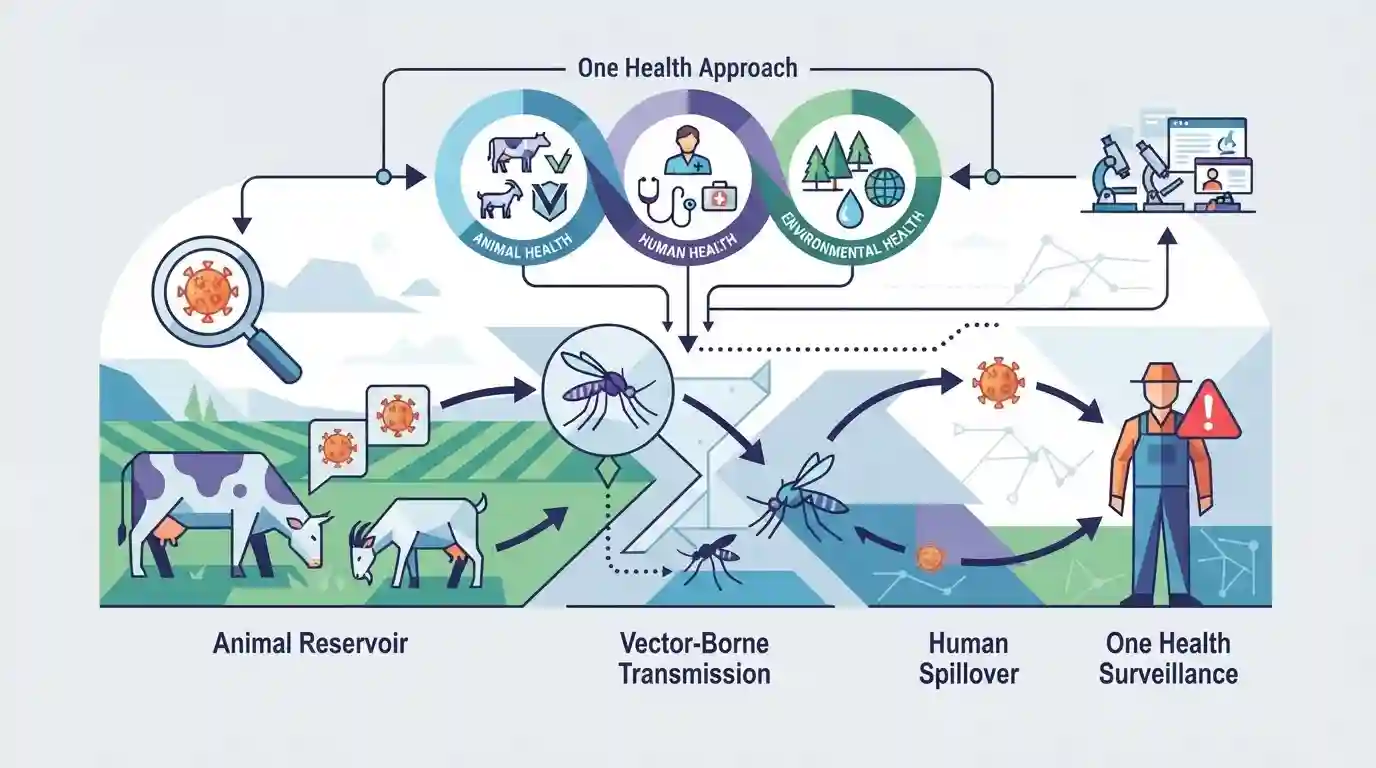
The first-ever detection of a livestock pathogen like Shamonda virus in humans emphasizes the threat of zoonotic spillovers, highlighting the relevance of 'One Health' surveillance and multi-sectoral health policy planning in preventing potential disease outbreaks.
Summary
The article discusses the initial detection of the Shamonda virus—a pathogen typically affecting livestock like cattle and goats—in humans for the first time. This event sheds light on zoonotic spillover dynamics, vector-borne transmission risks, and the critical need for a 'One Health' surveillance framework to detect novel pathogens before they trigger broader public health crises.
Key Points
- The Shamonda virus, traditionally known as a livestock pathogen primarily affecting cattle, sheep, and goats through insect vectors, has been detected in humans for the first time.
- This discovery highlights the growing concern of zoonotic spillover—where pathogens jump from animals to humans, often exacerbated by environmental changes and close livestock-human interfaces.
- It underscores the importance of the 'One Health' approach, which integrates human health, animal health, and environmental monitoring to preemptively track and contain novel viral threats.
Important Terms
Shamonda virus

An orthobunyavirus primarily affecting livestock like cattle and goats through biting midges, which recently made history by being detected in humans for the first time, sparking global health monitoring.
UPSC context
UPSC GS Paper-III (Science and Technology - Health & Diseases): Important for understanding emerging zoonotic diseases, vector-borne transmission, and public health surveillance.
One Health Approach
A collaborative, multisectoral framework recognizing that human, animal, and environmental health are deeply interconnected and essential for preventing novel infectious disease threats at their source.
UPSC context
UPSC GS Paper-II/III (Governance, Health & Environment): Crucial for managing zoonotic spillovers, pandemic preparedness, and integrated disease monitoring systems like the National One Health Mission.
Zoonotic Spillover
The transmission of a pathogen from vertebrate animals to humans, a process increasingly driven by ecological disruption, habitat loss, and intensified livestock interactions.
UPSC context
UPSC GS Paper-III (Biodiversity, Environment, and Health): Relevant for examining the root causes of novel epidemics and cross-species pathogen transmission risks.
Vector-Borne Transmission
Insects such as mosquitoes, ticks, and biting midges that transmit pathogens and parasites from one animal or human to another, driving vector-borne pathogen spread.
UPSC context
UPSC GS Paper-III (Health and Disease Control): Relevant for public health interventions, vector control programs, and climate change-induced shifts in disease vectors.
Prelims Trap
Shamonda virus is a novel wildlife-derived respiratory pathogen that spreads directly between humans without insect vectors.
Aspirants often assume new human pathogens are exclusively novel respiratory viruses or originate directly from wildlife, missing vector-borne livestock viruses jumping via midges.
Static Concepts Connected
What are the core pillars and objectives of the 'One Health' approach in India?
- Integrated Framework: Collaborative approach linking human health, animal health, and environmental sectors at sub-national, national, and global levels.
- Zoonotic Focus: Recognizes that over 60% of emerging infectious diseases are zoonotic, originating from animals or shared ecosystems.
- Indian Policy: Instituted via mechanisms like the National One Health Mission and specialized research consortia to prevent future pandemics.
Cross-Topic Patterns
Zoonotic Spillover + Climate Change Impacts
Vector-borne diseases like Shamonda are heavily influenced by climate shifts, expanding the geographical range of biting midges and increasing agricultural disease vulnerability.
One Health Framework + Public Policy
Integrating veterinary and human public health surveillance is essential to prevent agricultural economic losses and human epidemics simultaneously.

Zoonotic spillover pathogens like Shamonda virus + One Health framework will feature in prelims matching or multi-statement MCQs.
Linked PYQs · 3
Linked PYQs · 3
- 2021PrelimsGS1
The term 'ACE2' is talked about in the context of
- 2023PrelimsGS1
'Wolbachia method' is sometimes talked about with reference to which one of the following?
- 2021PrelimsGS1
Consider the following statements : 1. Adenoviruses have single-stranded DNA genomes whereas retroviruses have double-stranded DNA genomes. 2. Common cold is sometime caused by an adenovirus whereas AIDS is caused by a retrovirus. Which of the statements given above is/are correct?
