Supreme Court Slams State Administration Over Jojari River Pollution
Source:cobrapost ↗
Why It Matters
Demonstrates the growing judicial scrutiny over environmental governance in India and highlights specific ecological threats (river pollution by industries) in the arid region of Rajasthan, relevant for state geography and environment syllabus.
Summary
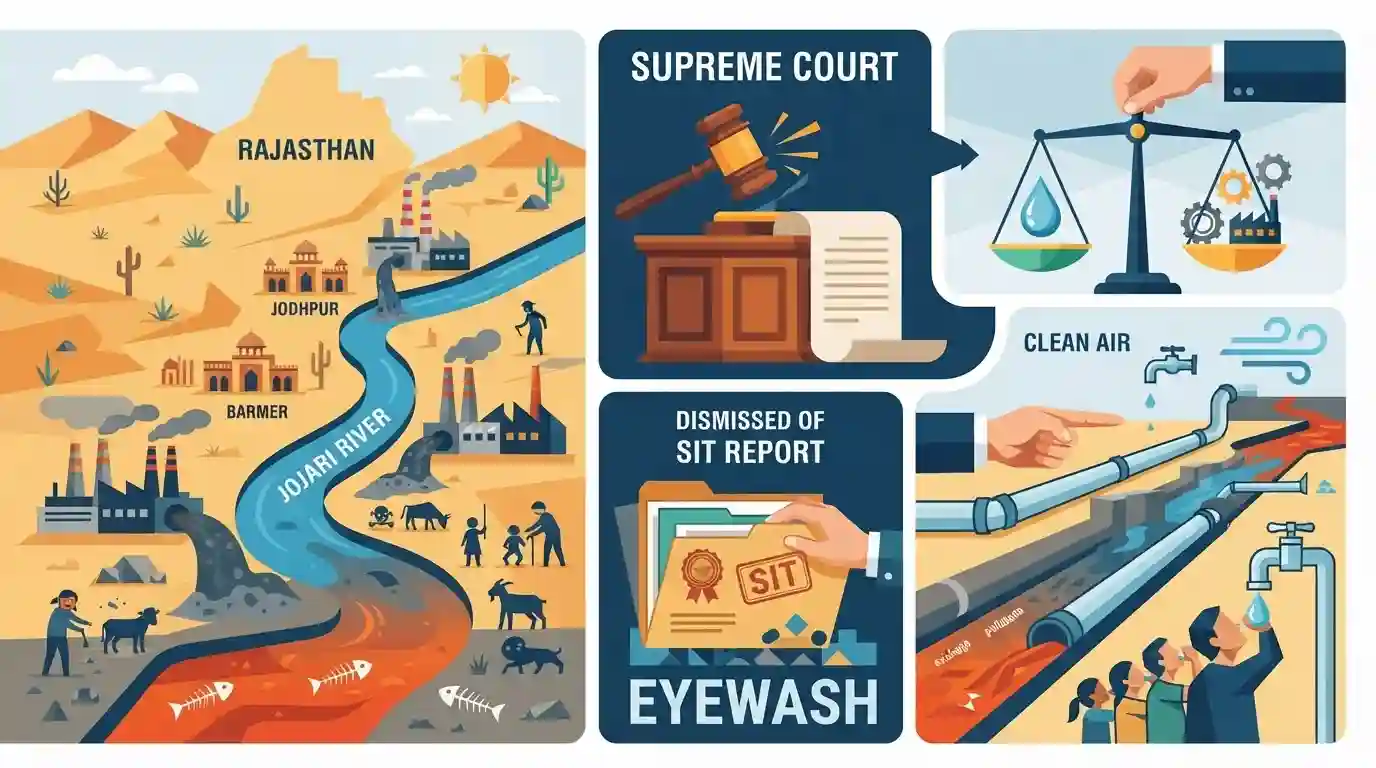
The Supreme Court of India strongly reprimanded the Rajasthan state government for its failure to control severe pollution in the Jojari River, a vital water source for arid districts like Jodhpur and Barmer. Citing an NGT-appointed expert committee report that found highly acidic water in the river, the Court termed the state's negligence as "shameful" and a violation of citizens' fundamental right to clean air and water under Article 21. The bench dismissed the state's Special Investigation Team (SIT) report as a mere "eyewash" attempting to shield polluters—primarily local textile dyeing and printing industries. The court underscored the necessity for immediate and stringent action to ensure water quality and protect the health of lakhs of dependent citizens.
Key Points
- The Supreme Court severely criticized the Rajasthan government for failing to prevent industrial pollution in the Jojari River, a critical water source for Jodhpur and Barmer districts.
- An expert committee appointed by the NGT reported that the river contains highly acidic water due to the direct discharge of untreated industrial effluents, primarily from textile dyeing and printing units.
- The SC bench comprising Justices Vikram Nath, Sandeep Mehta, and R Mahadevan invoked Article 21, stating that denying citizens basic amenities like clean air and water is shameful.
- The Court rejected the report submitted by a state-formed Special Investigation Team (SIT), calling it an 'eyewash' intended to protect the perpetrators rather than address the ecological damage.
Important Terms
Article 21 (Constitution of India)

A fundamental right stating no person shall be deprived of life or personal liberty except by law. The Supreme Court expansively interprets this to include the right to a clean, pollution-free environment and safe drinking water.
UPSC context
Essential for GS Paper 2 (Polity). Tests judicial interpretation of Fundamental Rights and the intersection of environment and human rights.
National Green Tribunal (NGT)
A specialized statutory body established in 2010 to expedite cases involving environmental protection, forest conservation, and the enforcement of environmental legal rights, ensuring compliance with the right to a healthy environment.
UPSC context
Core GS Paper 3 (Environment) and GS Paper 2 (Statutory Bodies) topic. Tests knowledge of environmental dispute resolution mechanisms.
Jojari River
An ephemeral right-bank tributary of the Luni River in Rajasthan. Unlike Luni's other tributaries, it does not originate in the Aravalli Range but from the Nagaur plains, flowing through Jodhpur before joining the Luni.
UPSC context
Highly relevant for GS Paper 1 (Geography) and Prelims mapping. Tests knowledge of the Luni river basin and desert drainage.
Supreme Court of India
The apex judicial authority in India. It acts as the guardian of Fundamental Rights, frequently utilizing suo motu cognizance and judicial activism to mandate executive action against severe environmental degradation and public health hazards.
UPSC context
Crucial for GS Paper 2 (Polity). Assesses understanding of judicial activism, public interest litigation, and checks on the executive branch.
Rajasthan State Pollution Control Board
A statutory authority formed in 1975 under the Water Act (1974) and later the Air Act (1981). It is responsible for enforcing environmental regulations, monitoring pollution, and ensuring industrial compliance across Rajasthan.
UPSC context
Important for GS Paper 3 (Environment). Tests the roles, powers, and practical limitations of state environmental regulatory agencies.
Special Investigation Team (SIT)
A specialized task force appointed by the government or higher courts to investigate complex, high-profile cases, such as systemic environmental violations, when standard investigative or administrative mechanisms are deemed insufficient.
UPSC context
Relevant to GS Paper 2 (Governance & Judiciary). Highlights alternative investigative mechanisms and judicial oversight over administrative failures.
Prelims Trap
"All tributaries of the Luni river originate from the Aravalli mountain range."
Jojari is unique. It is the only major tributary of the Luni that originates in the plains (Nagaur) rather than the Aravalli hills, and joins from the right bank.
Static Concepts Connected
What are the unique characteristics of the Luni River drainage system?
- Inland Drainage: It is an ephemeral, inland drainage river that flows through the Thar desert and terminates in the Rann of Kutch.
- Salinity Profile: Known as 'Lavanavari' (salt river), its water remains fresh up to Balotra (Rajasthan) and becomes highly saline downstream.
- Tributaries: Key tributaries include Sukri, Bandi, Jawai, and Jojari. Jojari is the sole major right-bank tributary.
How is the right to a clean environment protected under the Constitution?
- Article 21: SC ruled in Subhash Kumar v. State of Bihar (1991) that the right to life includes the right to enjoyment of pollution-free water and air.
- DPSP & Duties: Article 48A directs the State to protect/improve the environment; Article 51A(g) makes it a fundamental duty of every citizen.
Cross-Topic Patterns
Textile Effluents & Zero Liquid Discharge
The severe pollution in Jojari stems from textile dyeing. UPSC often links specific industrial pollutants (like azo dyes and heavy metals) with river pollution profiles and Zero Liquid Discharge (ZLD) mandates.
NGT Fact-Finding vs. Constitutional Courts
Highlights the institutional dynamic where NGT's expert fact-finding relies on the overarching enforcement power of the Supreme Court under Article 32/21 to override state-level investigative bodies like SITs.

Expect a prelims map question on Luni tributaries (Jojari, Sukri, Jawai) or a polity statement linking Article 21 to NGT's jurisdiction.
Linked PYQs · 4
Linked PYQs · 4
- 2024RPSC_PRELIMSGS1
Which of the following is correct regarding Rajasthan Bharatpur – Rajasthan Berger? A. Luni Basin and Southwest Rajasthan Border are part of Rajasthan Berger. B. Ghagghar Plain covers mainly the North Rajasthan. C. Rajasthan Plain does have salty lakes and inland drainage. D. Bhilwara district is a part of all the above things of Rajasthan. Select the correct answer using the codes given below:
- 2025RPSC_PRELIMSGS1
Consider the following statements: A. Luni Basin and Shekhawati region are sub-regions of Bhangar in Rajasthan. B. The Ghaggar plain is mostly spread in Hanumangarh and Ganganagar districts. C. Nagaur Uplands have saline lakes and internal drainage. D. The Aravalli ranges are rich in all types of minerals. Select the correct answer from the code given below: Code:
- 2018RPSC_PRELIMSGS1
Which of the following environmental pollutants are responsible for acid rain?
- 2025RPSC_PRELIMSGS1
Match List-I with List-II and select the correct answer from the code given below: List-I (District) – List -II (River) A. Udaipur i. Sabai and Ruparil B. Bundi ii. Gambhiri and Parwati C. Bharatpur iii. Som and Jakham D. Alwar iv. Kural Code: A, B, C, D
