Union Home Minister Sets Deadline for Left Wing Extremism Eradication
Source:The Hindu ↗
Why It Matters
LWE remains one of the most formidable internal security challenges in India. The article highlights the government\'s definitive timeline (March 2026) for its eradication and outlines the multi-dimensional strategy (security, development, financial chokeholds) which are highly relevant for GS Paper 3 questions on internal security threats and their management.
Summary
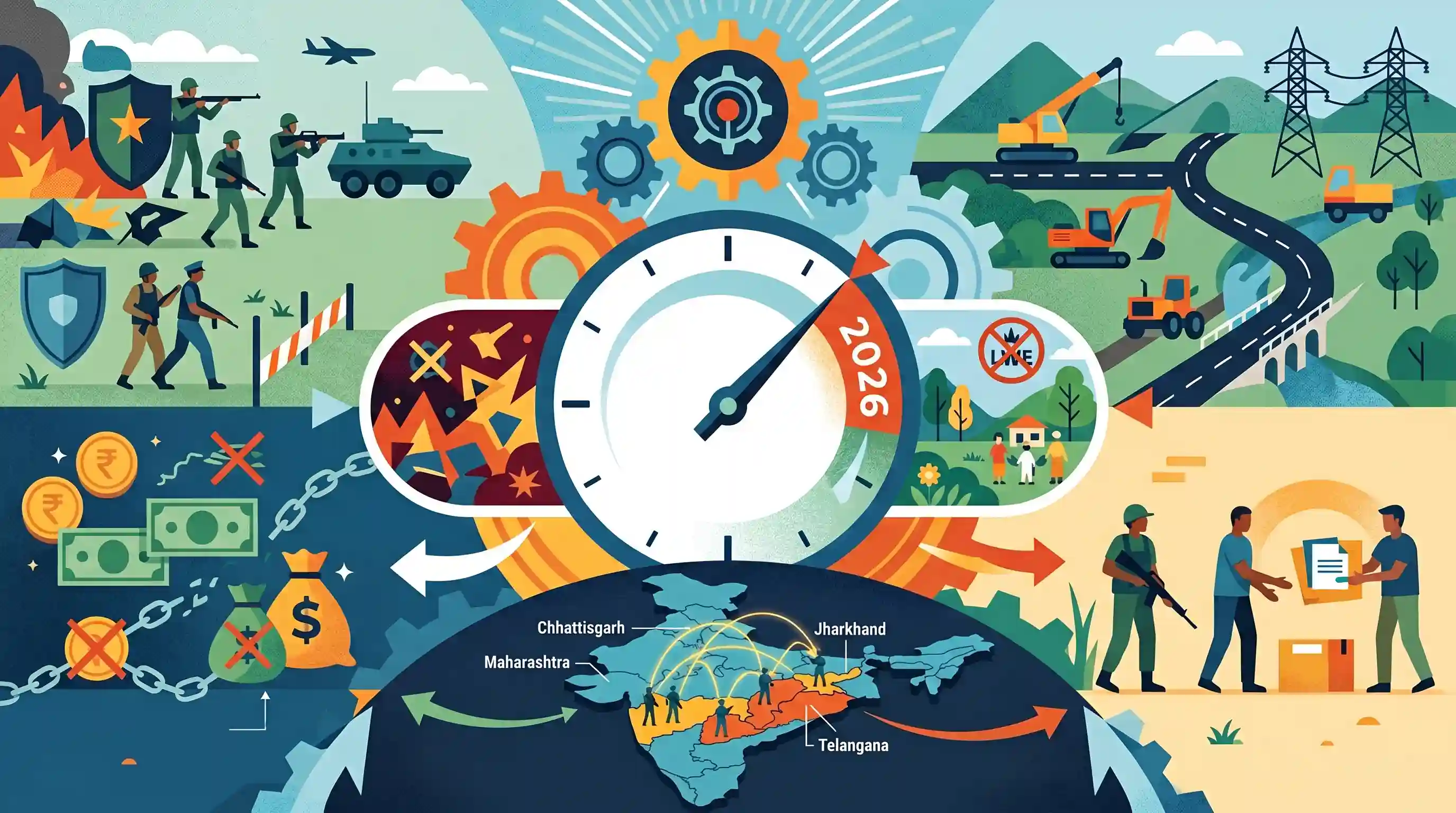
Union Home Minister Amit Shah chaired a high-level security review meeting in Raipur, establishing a clear March 31, 2026 deadline for the total elimination of Left-Wing Extremism (LWE) in India. The strategy to defeat the Maoist insurgency involves robust security operations, accelerated infrastructure development, strangling Naxal financial networks, and encouraging militants to surrender. The meeting underscored the necessity of strict coordination between central intelligence and security agencies, along with the state police forces of Chhattisgarh, Odisha, Maharashtra, Jharkhand, and Telangana, to ensure insurgents cannot cross state borders to evade capture.
Key Points
- Union Home Minister Amit Shah chaired a high-level security meeting in Raipur, setting a March 31, 2026 deadline to eradicate Left-Wing Extremism (LWE) from India.
- The government\'s successful approach relies on a \'double-engine\' strategy focusing on security, infrastructure development, attacking Naxal financial networks, and implementing effective surrender policies.
- Seamless coordination between Central agencies (CRPF, BSF, ITBP, NIA, IB) and State police forces across LWE-affected states is crucial to prevent Maoists from fleeing across borders.
- Recent successes include the surrender of 12 Maoists in Bijapur, Chhattisgarh, who carried a combined bounty of ₹46 lakh.
Important Terms
Left-Wing Extremism (LWE)

Violent armed insurgency, also known as Naxalism, rooted in Maoist ideology. It seeks to overthrow the Indian state through revolution, primarily in the central and eastern "Red Corridor" states.
UPSC context
GS Paper 3 (Internal Security); tests understanding of non-state actors and ideological challenges to national integrity.
Ministry of Home Affairs (MHA)
The nodal Union ministry responsible for internal security. It coordinates counter-LWE strategy, deploys central forces, and monitors development schemes in affected districts through its LWE Division.
UPSC context
GS Paper 2/3 (Governance/Security); tests understanding of central-state administrative coordination in security management.
Intelligence Bureau (IB)
India’s premier internal intelligence agency. It collects domestic intelligence on counter-insurgency and internal security, providing actionable inputs to state police and central security forces.
UPSC context
GS Paper 3 (Internal Security); tests knowledge of the institutional framework for intelligence and domestic security.
National Investigation Agency (NIA)
India’s federal counter-terrorism agency. In the LWE context, it investigates terror-funding networks and seizes Maoist assets to "financially choke" the insurgency.
UPSC context
GS Paper 3 (Security); focuses on the legal and investigative tools used to dismantle insurgent financial networks.
Central Armed Police Forces (CAPF)
Collective term for seven security forces under MHA, including the CRPF, BSF, and ITBP. They provide operational support and are the primary combatants in counter-Naxal operations.
UPSC context
GS Paper 3 (Internal Security); covers the role of various security forces and their coordination with state police.
Surrender and Rehabilitation Policy
A multi-pronged strategy to encourage militants to abjure violence. It provides financial aid, vocational training, and legal assistance to facilitate their reintegration into mainstream society.
UPSC context
GS Paper 3 (Internal Security); tests knowledge of soft-power strategies for conflict resolution.
Prelims Trap
CAPFs deployed in LWE-affected states operate under the direct operational command of the Union Home Ministry.
While deployed by the Centre, CAPFs act 'in aid to civil power' and function under the operational command of the respective State Police/DGP.
Static Concepts Connected
What is the SAMADHAN doctrine for fighting LWE?
- S-A-M-A: Smart Leadership, Aggressive Strategy, Motivation & Training, and Actionable Intelligence.
- D-H-A-N: Dashboard Based KPIs, Harnessing Technology, Action plan for each theatre, and No access to financing.
How does the Union Government financially support State anti-LWE operations?
- Security Related Expenditure (SRE): Reimburses states for operational needs, ex-gratia payments to victims, and training of state police forces.
- Special Infrastructure Scheme (SIS): Provides funds for the construction of fortified police stations and the capacity building of state special forces.
- Civic Action Plan (CAP): Direct financial grants to deployed CAPFs to conduct local welfare activities, bridging the trust deficit with tribals.
Cross-Topic Patterns
PMLA application in LWE financing
Choking Naxal financial networks relies heavily on the NIA and ED seizing assets under the Prevention of Money Laundering Act, bridging kinetic counter-insurgency with federal economic intelligence.
Aspirational Districts & LWE
The infrastructure development pillar of the anti-Naxal strategy converges with the Aspirational Districts Programme, explicitly targeting socio-economic deficits in LWE-affected regions to dry up extremist recruitment pools.

Expect a GS3 Mains question evaluating the SAMADHAN doctrine's success against the persistent challenge of inter-state LWE border fluidities.
Linked PYQs · 4
Linked PYQs · 4
- 2018MainsGS3
Left Wing Extremism (LWE) is showing a downward trend, but still affects many parts of the country. Briefly explain the Government of India's approach to counter the challenges posed by LWE.
- 2022MainsGS3
Naxalism is a social, economic and developmental issue manifesting as a violent internal security threat. In this context, discuss the emerging issues and suggest a multilayered strategy to tackle the menace of Naxalism.
- 2025MainsGS3
The Government of India recently stated that Left Wing Extremism (LWE) will be eliminated by 2026. What do you understand by LWE and how are the people affected by it? What measures have been taken by the government to eliminate LWE?
- 2023MainsGS3
What are the internal security challenges being faced by India? Give out the role of Central Intelligence and Investigative Agencies tasked to counter such threats.
