SEZ manufacturing units granted concessional domestic tariff sales
Source:Indian Express ↗
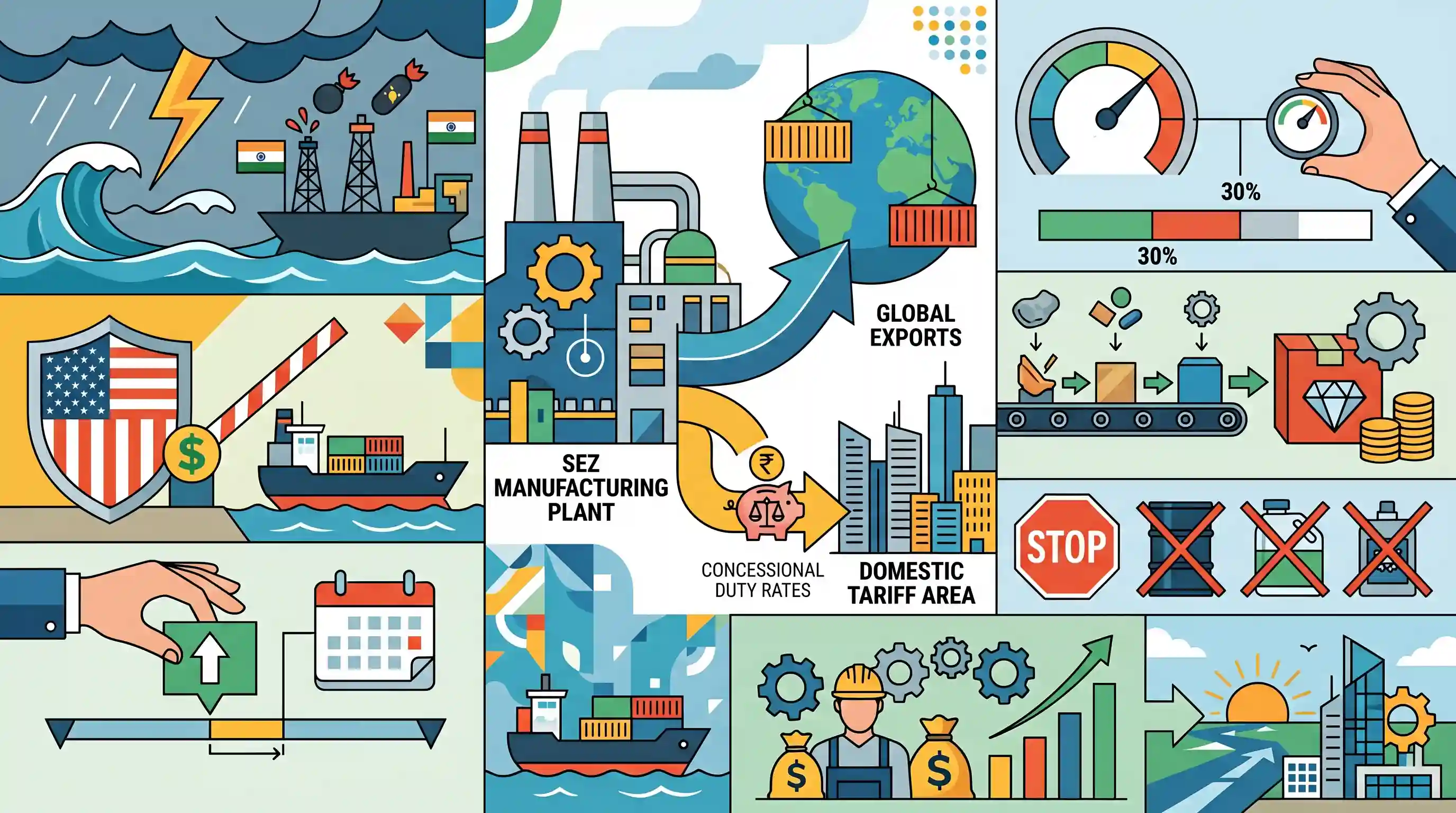
Why It Matters
SEZs are a critical part of India's industrial and export strategy but have faced declining performance and unit closures. This policy intervention demonstrates how domestic fiscal policies are calibrated to respond to global geopolitical tensions and trade protectionism (like US tariffs). It provides an excellent case study for GS-3 answers on the challenges of the manufacturing sector, the balance between export promotion and protecting domestic industries, and the impact of global events on the Indian economy.
Summary
The Indian government has implemented a one-time relief measure allowing Special Economic Zone (SEZ) manufacturing units to sell a portion of their goods in the Domestic Tariff Area (DTA) at concessional duty rates. Valid from April 2026 to March 2027, the policy aims to buffer SEZ operations against global trade disruptions stemming from the West Asia conflict and US tariffs. The concessions come with strict conditions, including a 30% cap on domestic sales relative to past export highs and a minimum 20% value addition requirement. While the relief provides operational flexibility and protects jobs, sensitive sectors and most petroleum products are excluded to safeguard domestic industries. Experts view the measure as a modest but necessary step while broader, long-term SEZ reforms are being formulated.
Key Points
- The Indian government has introduced a one-time relief measure allowing SEZ units to sell eligible goods in the Domestic Tariff Area (DTA) at concessional duty rates from April 2026 to March 2027.
- The move is designed to shield manufacturers from global demand shocks caused by the West Asia conflict and recent US tariffs, offering a stabilizing buffer.
- To qualify, SEZ units must achieve a minimum 20% value addition, and DTA sales are capped at 30% of their highest annual export value from the past three years.
- Sensitive sectors and most petroleum products (except limited refinery products like petroleum coke) are excluded to protect domestic industries.
- The relief comes as over 460 SEZ units have closed in the last five years, emphasizing the ongoing need for broader structural reforms and export promotion alignment.
Important Terms
Special Economic Zones (SEZs)

Designated duty-free enclaves with liberal economic laws aimed at boosting exports, investment, and employment. They are governed by the SEZ Act, 2005, and treated as foreign territories for trade purposes.
UPSC context
GS Paper 3 (Economy/Industrial Policy); tests export-led growth models, regulatory frameworks, and their impact on employment and infrastructure.
Central Board of Indirect Taxes and Customs (CBIC)
A statutory body under the Ministry of Finance responsible for administering indirect taxes, including customs, GST, and excise. It implements trade-related tax concessions and ensures enforcement against smuggling.
UPSC context
GS Paper 2 (Statutory Bodies) and GS Paper 3 (Taxation); tests knowledge of tax administration and fiscal interventions in trade.
Ministry of Commerce and Industry
The nodal ministry for establishing and managing SEZs in India. It oversees the Board of Approval (BoA), which is the apex decision-making body for zone-related clearances.
UPSC context
GS Paper 2 (Governance); critical for understanding administrative structures for commerce, trade promotion, and the Ease of Doing Business.
Global Trade Research Initiative (GTRI)
A New Delhi-based think tank providing evidence-based analysis on global trade, climate change, and technology. It informs policy on Free Trade Agreements (FTAs) and domestic industrial resilience.
UPSC context
GS Paper 3 (Trade/External Sector); relevant for analyzing trade deficits, FTAs, and protecting manufacturing from global economic shocks.
Ministry of Finance
The apex ministry responsible for India's fiscal policy, Union Budget, and revenue collection. It manages the Central Board of Indirect Taxes and Customs (CBIC) to implement duty reliefs.
UPSC context
GS Paper 3 (Budgeting); tests understanding of fiscal policy, government spending, and tax incentives to stimulate economic growth.
Confederation of Indian Industry (CII)
A non-government, industry-led organization that facilitates dialogue between the Indian government and the private sector. It provides policy recommendations to enhance industrial competitiveness and growth.
UPSC context
GS Paper 3 (Industry); significant for the role of industry associations in policy advocacy and public-private partnerships.
Prelims Trap
"Goods sold by an SEZ unit to the Domestic Tariff Area (DTA) are treated as domestic sales and exempt from customs duties."
By default, goods supplied from an SEZ to the DTA are legally treated as imports and attract regular customs duties, not domestic taxes.
Static Concepts Connected
How does the SEZ Act regulate trade with the Domestic Tariff Area (DTA)?
- Foreign Territory: SEZs are legally deemed as foreign territory for the purposes of trade operations, duties, and tariffs.
- DTA Definition: The DTA encompasses the whole of India's geographical area excluding the designated SEZs.
- Import Treatment: Any supply of goods from an SEZ to the DTA is treated as a regular import into India and is subject to standard customs duties.
- Positive NFE: SEZ units must achieve positive Net Foreign Exchange (NFE) earnings cumulatively over a 5-year period.
Why do SEZ concessions and FTAs mandate minimum 'Value Addition' norms?
- Preventing Round-Tripping: It ensures goods aren't merely imported from third countries and re-routed without actual manufacturing, preventing circumvention of import duties.
- Economic Linkage: It mandates that a specific percentage (e.g., 20%) of the final product's value is created locally through labor, processing, or domestic raw materials.
Cross-Topic Patterns
SEZ overhaul & WTO Compliance
This stop-gap relief highlights the ongoing delay in the broader DESH (Development of Enterprise and Service Hubs) Bill, which aims to make Indian SEZs WTO-compliant by removing direct export-linked incentives.
Geopolitics dictating industrial policy
The SEZ DTA concession illustrates how external geopolitical shocks (Red Sea crisis, US tariffs) directly force temporary tweaks in India's domestic industrial policy to prevent factory closures and job losses.

Expect a multi-statement Prelims question on SEZ vs DTA regulations, focusing on the legal treatment of DTA sales as regular imports.
Linked PYQs · 3
Linked PYQs · 3
- 2015MainsGS3
There is a clear acknowledgement that Special Economic Zones (SEZs) are a tool of industrial development, manufacturing and exports. Recognizing this potential, the whole instrumentality of SEZs requires augmentation. Discuss the issues plaguing the success of SEZs with respect to taxation, governing laws and administration.
- 2018MainsGS3
How would the recent phenomena of protectionism and currency manipulations in world trade affect macroeconomic stability of India?
- 2025MainsGS3
What are the challenges before the Indian economy when the world is moving away from free trade and multilateralism to protectionism and bilateralism? How can these challenges be met?
