ICMR Survey on Severe Anaemia Prevalence and Public Health Policy
Source:The Hindu ↗
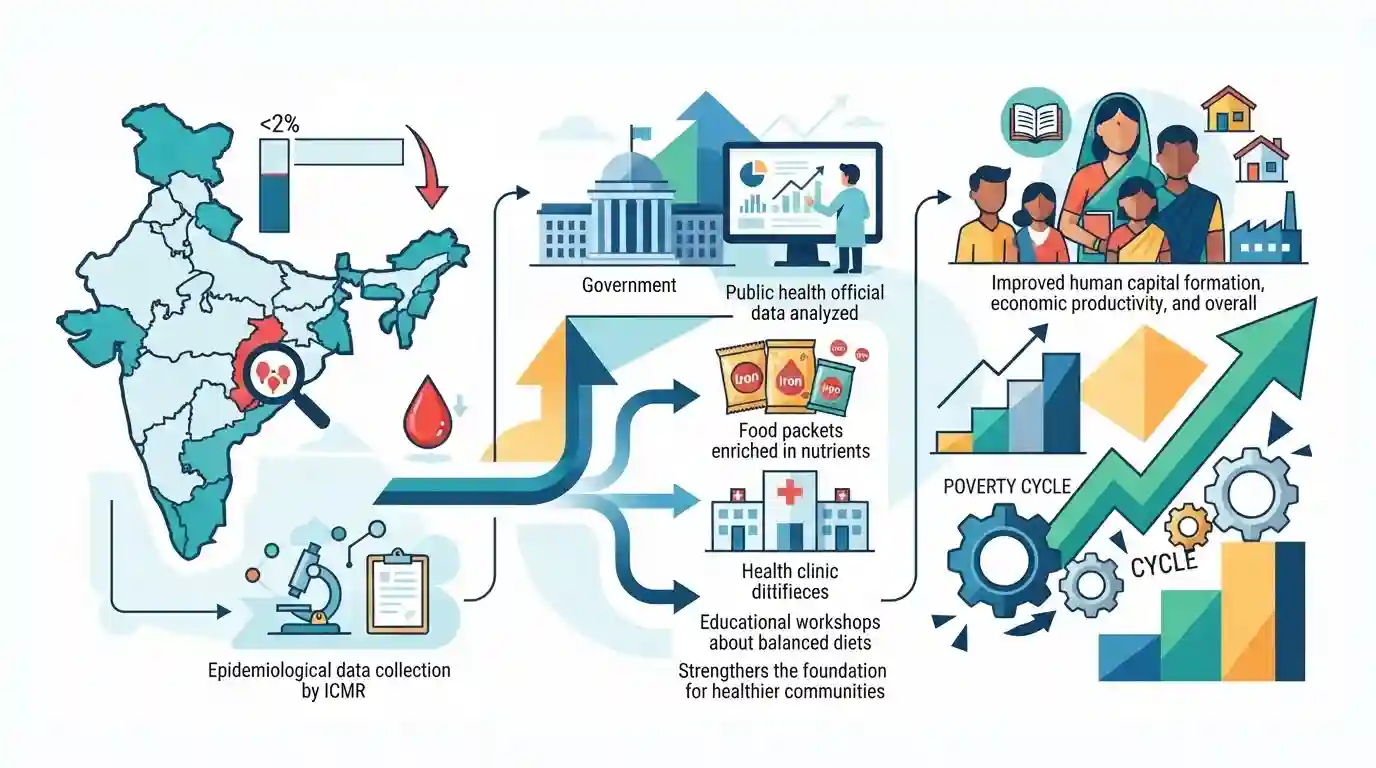
Why It Matters
Accurate data on the prevalence of severe conditions like anaemia is vital for designing effective public health strategies, tracking schemes like Anaemia Mukt Bharat, and improving human capital.
Summary
An Indian Council of Medical Research (ICMR) survey highlights that severe anaemia affects less than 2% of the Indian population. This finding provides crucial epidemiological data to evaluate national public health initiatives, address nutritional deficiencies, and break the vicious cycle of poverty and malnutrition affecting human capital formation in India.
Key Points
- An ICMR survey reveals that severe anaemia affects less than 2% of the Indian population, providing fresh insights into the country's public health landscape.
- The findings contrast with broader nutritional metrics and offer localized data for re-evaluating national health interventions like Anaemia Mukt Bharat.
- Accurate epidemiological data is crucial for designing targeted policies to combat malnutrition and enhance human capital formation.
Important Terms
Anaemia Mukt Bharat

A nationwide public health campaign launched in 2018 by the Ministry of Health and Family Welfare to reduce anaemia prevalence across vulnerable groups via iron-folic acid supplementation, deworming, and institutional mechanisms.
UPSC context
UPSC Prelims/Mains (GS Paper II - Health & Social Justice): Important government health interventions and strategies targeting nutritional deficiencies.
National Nutrition Mission (Poshan Abhiyaan)
India's apex flagship program launched in 2018 to improve nutritional outcomes for children, pregnant women, and lactating mothers by reducing stunting, undernutrition, and anaemia through technology, convergence, and community mobilization.
UPSC context
UPSC Prelims/Mains (GS Paper II - Government Policies & Interventions): Evaluating key developmental initiatives tackling malnutrition and human capital.
Indian Council of Medical Research (ICMR)
India's apex body for the formulation, coordination, and promotion of biomedical research, functioning under the Department of Health Research, Ministry of Health and Family Welfare.
UPSC context
UPSC Prelims/Mains (GS Paper II/III - Health & Science/Tech): Questions on premier scientific research institutions and epidemiological data generation in India.
Static Concepts Connected
What is the mandate and constitutional status of the Indian Council of Medical Research (ICMR)?
- Apex Body: Apex body in India for the formulation, coordination, and promotion of biomedical research, functioning under the Ministry of Health and Family Welfare.
- Historical Origin: Traces its origin back to 1911 as the Indian Research Fund Association (IRFA), making it one of the oldest medical research bodies globally.
Cross-Topic Patterns
Epidemiological Data & Multidimensional Poverty
Clinical gold-standard diagnostics like automated venous blood analysis in large-scale surveys directly impact national human capital indices and multidimensional poverty measurements.

ICMR survey data + Anaemia Mukt Bharat lifecycle strategy will likely feature in a multi-statement Prelims question on public health.
Linked PYQs · 3
Linked PYQs · 3
- 2023PrelimsGS1
Consider the following statements in the context of interventions being undertaken under Anaemia Mukt Bharat Strategy: 1. It provides prophylactic calcium supplementation for pre-school children, adolescents and pregnant women. 2. It runs a campaign for delayed cord clamping at the time of child-birth. 3. It provides for periodic deworming to children and adolescents. 4. It addresses non-nutritional causes of anaemia in endemic pockets with special focus on malaria, hemoglobinopathies and fluorosis. How many of the statements given above are correct?
- 2017PrelimsGS1
Which of the following are the objectives of 'National Nutrition Mission'? 1. To create awareness relating to malnutrition among pregnant women and lactating mothers. 2. To reduce the incidence of anaemia among young children, adolescent girls and women. 3. To promote the consumption of millets, coarse cereals and unpolished rice. 4. To promote the consumption of poultry eggs. Select the correct answer using the code given below:
- 2024MainsGS2
Poverty and malnutrition create a vicious cycle, adversely affecting human capital formation. What steps can be taken to break the cycle ?
