Balochistan Insurgency and Security Threats to Regional Infrastructure
Source:The Hindu ↗
Why It Matters
Understanding the dynamics of the Balochistan insurgency is crucial for assessing India-Pakistan bilateral relations, state-sponsored terrorism, and the strategic implications of the China-Pakistan Economic Corridor (CPEC) on India's security landscape.
Summary
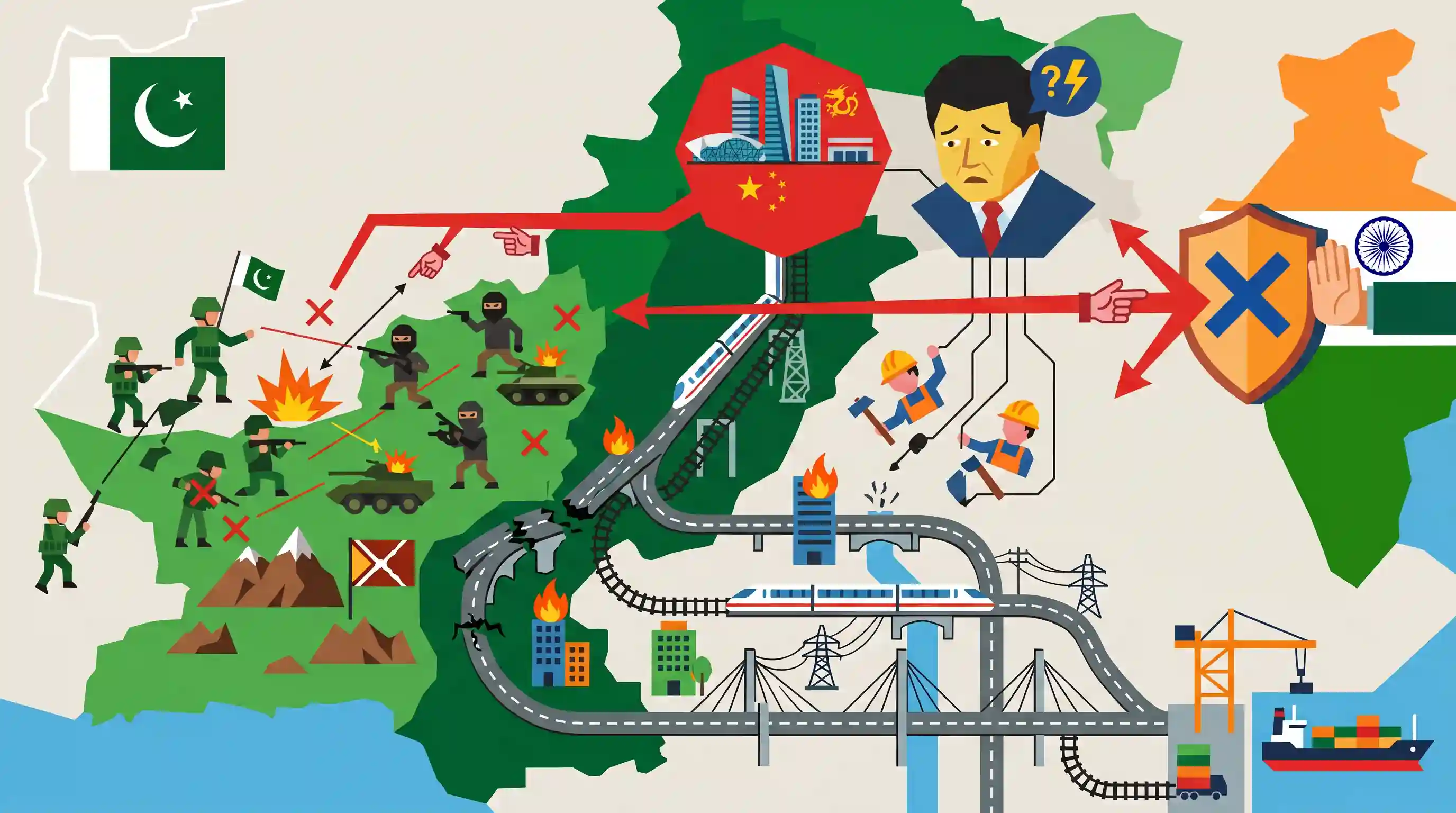
The Pakistan Army recently completed "Operation Radd-ul-Fitna-1" in restive Balochistan to counter attacks by insurgent groups like the Baloch Liberation Army (BLA). The military response resulted in hundreds of casualties. Pakistan has accused India of sponsoring these terror outfits, an allegation India has categorically rejected, describing it as a distraction from Pakistan's own internal failings. The violence in Balochistan severely disrupts key infrastructure initiatives, particularly the $65 billion China-Pakistan Economic Corridor (CPEC), raising concerns in Beijing about the security of its investments and workers. This conflict underscores the fragile security environment in India's neighborhood and the geopolitical ramifications of Chinese infrastructural expansion.
Key Points
- The Pakistan Army concluded 'Operation Radd-ul-Fitna-1' in Balochistan following a series of deadly attacks by separatist groups.
- The operation led to over 270 deaths, including insurgents, security personnel, and civilians.
- Pakistan accused India of sponsoring the terrorism in Balochistan, which India strongly denied as a tactic to deflect from internal state failures.
- The ongoing instability in Balochistan poses a direct threat to the execution of the $65 billion China-Pakistan Economic Corridor (CPEC) projects.
Important Terms
China-Pakistan Economic Corridor (CPEC)

A $62-65 billion flagship project of China's Belt and Road Initiative (BRI) connecting Gwadar Port in Pakistan to Xinjiang, China, through a network of highways, railways, and energy pipelines.
UPSC context
GS Paper II/III: Infrastructure/Neighborhood Relations. Tests knowledge of regional connectivity, Chinese 'String of Pearls' strategy, and impact on India's sovereignty (PoK).
Baloch Liberation Army (BLA)
A proscribed ethno-nationalist militant group seeking independence for Balochistan. It frequently targets Pakistani security forces and Chinese nationals/infrastructure associated with CPEC, viewing them as symbols of exploitation.
UPSC context
GS Paper III: Internal Security. Relates to cross-border terrorism, non-state actors, and security challenges in India's neighborhood.
Operation Radd-ul-Fitna-1
A 2026 large-scale counter-terrorism campaign by the Pakistan Army in Balochistan. It aimed to dismantle insurgent networks (like BLA/BRG) and sleeper cells, often accompanied by official allegations of Indian sponsorship.
UPSC context
GS Paper II: India and its Neighborhood. Tests understanding of Pakistan's internal stability and the geopolitical implications of its 'foreign hand' narratives.
Gwadar Port
A strategic deep-water port in Balochistan, Pakistan, serving as the southern terminal of CPEC. It provides China a shortcut to the Arabian Sea, bypassing the Malacca Strait.
UPSC context
GS Paper II: International Relations. Crucial for understanding maritime strategy, China's presence in the Indian Ocean, and India's counter-initiatives like Chabahar.
Baloch Republican Guards (BRG)
A Baloch separatist militant group and member of the BRAS (Baloch Raaji Aajoi Sangar) alliance. It specializes in targeting critical infrastructure, such as gas pipelines and the Jaffar Express railway.
UPSC context
GS Paper III: Internal Security. Highlights the role of splinter insurgent groups in disrupting regional economic corridors and internal stability.
Prelims Trap
Gwadar port, the terminus of CPEC, is strategically located in the Sindh province of Pakistan.
Gwadar is located in Balochistan, not Sindh. UPSC frequently swaps provincial geographies to test map precision regarding the CPEC terminus and Arabian Sea ports.
Static Concepts Connected
Why does India officially oppose the China-Pakistan Economic Corridor (CPEC)?
- Sovereignty violation: CPEC traverses Gilgit-Baltistan in Pakistan-occupied Kashmir (PoK). India opposes the project because it directly violates and ignores India's territorial sovereignty.
- String of Pearls: The development and operation of Gwadar port gives the Chinese PLA Navy a potential dual-use strategic foothold in the western Indian Ocean.
- Opaque financing: India formally rejects the broader Belt and Road Initiative (BRI), citing opaque financing, ecological damage, and unsustainable debt burdens on host nations.
What is China's 'Malacca Dilemma' and how does CPEC attempt to solve it?
- Chokepoint vulnerability: The vast majority of China's energy imports transit the narrow Strait of Malacca, a maritime chokepoint vulnerable to blockade by rival navies during a conflict.
- Overland bypass: CPEC links the Arabian Sea (Gwadar) directly to Xinjiang via pipelines and highways, allowing Chinese energy imports to bypass Southeast Asian maritime routes entirely.
Cross-Topic Patterns
Gwadar vs. Chabahar port dynamics
Balochistan's Gwadar port (China-backed) sits roughly 170km from Iran's Chabahar port (India-backed). This geographic proximity links CPEC's internal security woes directly to India's Central Asian connectivity strategies.
Resource Nationalism and Sub-national Insurgency
The BLA's attacks on Chinese investments highlight the 'resource curse' paradigm, where marginalized locals in mineral-rich regions violently resist central state exploitation and opaque transnational projects.

CPEC's precise route through Gilgit-Baltistan and the geographic proximity of Gwadar to Chabahar will likely form a paired map question.
Linked PYQs · 3
Linked PYQs · 3
- 2015MainsGS2
Terrorist activities and mutual distrust have clouded India-Pakistan relations. To what extent the use of soft power like sports and cultural exchanges could help generate goodwill between the two countries? Discuss with suitable examples.
- 2016MainsGS2
Increasing cross-border terrorist attacks in India and growing interference in the internal affairs of several member-states by Pakistan are not conducive for the future of SAARC (South Asian Association for Regional Cooperation)." Explain with suitable examples.
- 2011MainsGS2
Critically examine the security and strategic implications of the so-called 'string of pearls' theory for India.
