South Western Railway sustainability and decarbonization initiatives
Source:The Hindu ↗
Why It Matters
Indian Railways is one of the world's largest rail networks, and its operations have a massive environmental footprint. The transition toward 100% electrification, solar energy generation, and freight optimization directly aligns with India's Nationally Determined Contributions (NDCs) and the ambitious target of achieving net-zero emissions by 2070. Understanding these large-scale institutional adaptations provides practical case studies for sustainable development and infrastructure answers in UPSC Mains GS3.
Summary
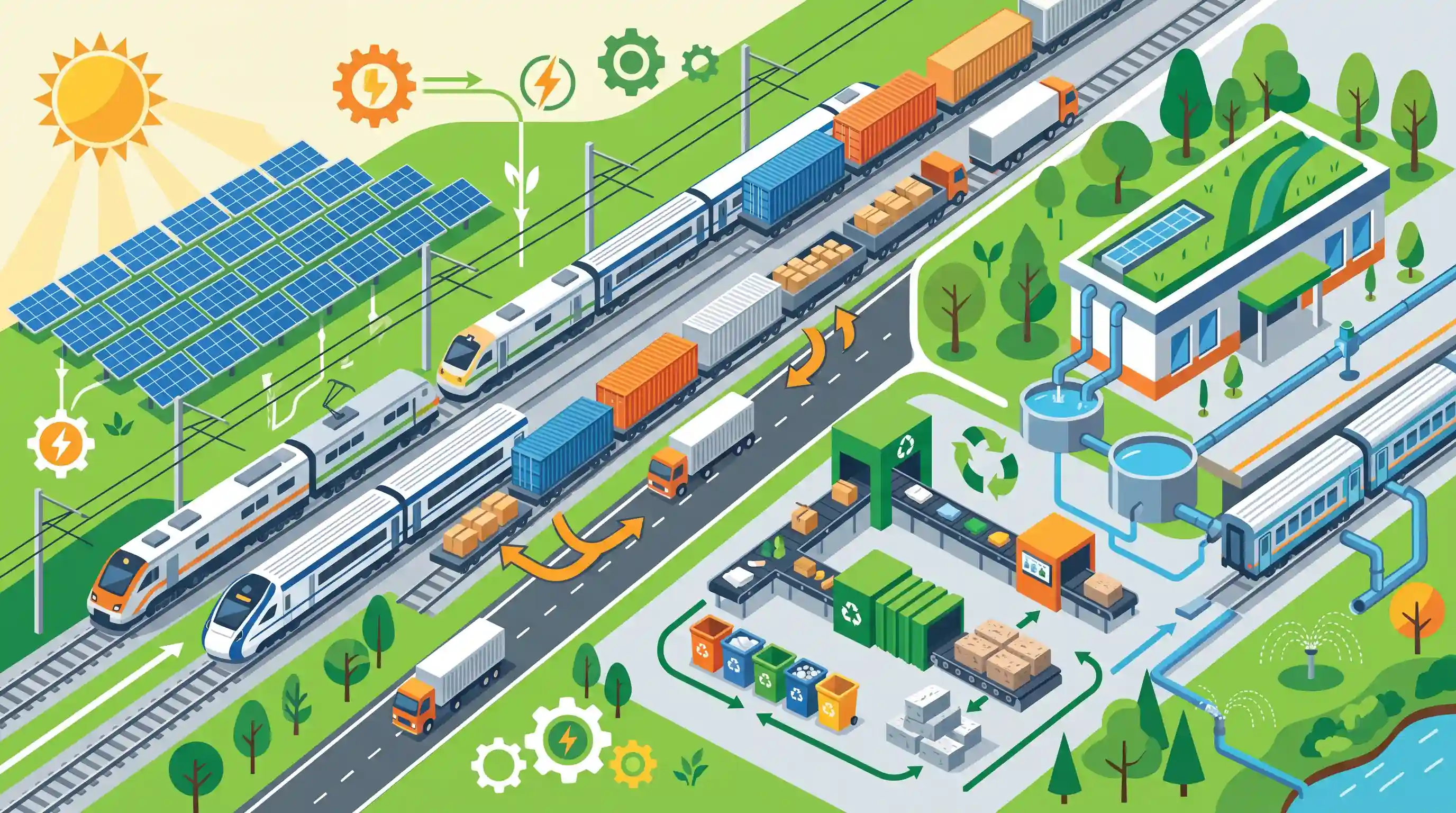
The South Western Railway (SWR) has launched a series of comprehensive sustainability and environmental protection initiatives to promote eco-friendly transport and reduce carbon footprints. Emphasized during World Environment Day, these measures encompass full route electrification, extensive solar energy adoption, optimized freight movement to reduce road transport dependence, and strict zero-waste and water recycling protocols. Such initiatives demonstrate the critical role of Indian Railways in achieving national decarbonization and renewable energy targets.
Key Points
- The South Western Railway (SWR) has prioritized green infrastructure through 100% route electrification and large-scale solar panel installations across stations, service buildings, and level crossing gates.
- Freight optimization strategies are actively encouraging the shift of bulk commodities from road networks to rail transport, significantly cutting down transport-related greenhouse gas emissions.
- To mark World Environment Day, SWR undertook a plantation drive with 750 saplings under the theme "Inspired by Nature for Climate for Our Future."
- Comprehensive eco-friendly initiatives include zero-waste practices, rigorous solid waste management, water recycling facilities, and a strict campaign against single-use plastics across SWR facilities.
Important Terms
Indian Railways (IR)

The world's fourth-largest rail network, currently undergoing a 'Green Railways' transformation to align with India's national climate goals and reduce logistics costs.
UPSC context
GS Paper III: Infrastructure (Railways). Focuses on connectivity, logistics, and the sector's role in national economic and environmental targets.
Net Zero Carbon Emitter by 2030
An ambitious target set by the Ministry of Railways to eliminate net carbon emissions by 2030 through 100% electrification and large-scale renewable energy adoption.
UPSC context
GS Paper III: Environment & Conservation. Tests knowledge of India's Nationally Determined Contributions (NDCs) and sectoral climate mitigation strategies.
Route Electrification
The transition from diesel-powered to electric traction; Indian Railways has electrified approximately 99.2% of its Broad Gauge network as of late 2025.
UPSC context
GS Paper III: Infrastructure. Relevant for discussions on energy security, operational efficiency, and reducing fossil fuel dependence in transport.
South Western Railway (SWR)
One of 19 railway zones, headquartered in Hubballi, Karnataka; it is a leader in regional sustainability initiatives like water self-sufficiency and high solar energy adoption.
UPSC context
GS Paper III: Infrastructure/Geography. Useful for specific case studies on regional implementation of national railway policies and sustainability.
Green Railway Station Rating
A certification system developed by the Environment Directorate and IGBC to evaluate and recognize sustainability in railway station design, operations, and passenger amenities.
UPSC context
GS Paper III: Sustainable Infrastructure. Tests understanding of green building standards and urban planning in public transport systems.
Renewable Energy Integration
The strategy of utilizing solar and wind plants (traction and non-traction) to meet railway power demands, aiming for 20 GW of solar capacity by 2030.
UPSC context
GS Paper III: Economy/Energy. Concerns the shift from coal-based power to clean energy to achieve national decarbonization targets.
Prelims Trap
Indian Railways has aligned its Net Zero carbon emission target with India's national Panchamrit goal of 2070.
Aspirants often confuse India's national Net Zero target (2070) with Indian Railways' ambitious, sector-specific deadline of 2030.
Static Concepts Connected
What are the core objectives of the National Rail Plan for India?
- Freight Share: Increase the railway freight modal share from ~27% currently to 45% by 2030 to reduce road transport emissions.
- Capacity Creation: Develop railway capacity ahead of demand by 2030 to seamlessly cater to projected traffic growth up to 2050.
How will Indian Railways achieve 'Net Zero Carbon Emitter' status by 2030?
- Full Electrification: 100% electrification of the broad-gauge network to completely eliminate direct diesel consumption in train traction.
- Renewable Sourcing: Establishing massive captive solar power plants on vacant railway lands to meet traction energy requirements cleanly.
- Energy Efficiency: Implementing Head-On-Generation (HOG) technology in coaches and 100% LED lighting to drastically reduce auxiliary power consumption.
Cross-Topic Patterns
Modal Shift & National Logistics Policy
Railway decarbonization directly impacts the National Logistics Policy's goal of reducing overall logistics costs by lowering fossil fuel reliance and improving bulk freight efficiency.
Land Monetization & Solar Grids
Indian Railways' push for 30GW solar capacity bridges GS-3 asset monetization (via vacant land utilization) with the national renewable energy transition.

Expect a prelims statement mixing up India's 2070 national Net Zero target with Indian Railways' much earlier 2030 goal.
Linked PYQs · 3
Linked PYQs · 3
- 2023MainsGS3
The adoption of electric vehicles is rapidly growing worldwide. How do electric vehicles contribute to reducing carbon emissions and what are the key benefits they offer compared to traditional combustion engine vehicles?
- 2018MainsGS3
What are the impediments in disposing the huge quantities of discarded solid wastes which are continuously being generated? How do we remove safely the toxic wastes that have been accumulating in our habitable environment?
- 2022MainsGS3
Do you think India will meet 50 percent of its energy needs from renewable energy by 2030 ? Justify your answer. How will the shift of subsidies from fossil fuels to renewables help achieve the above objective ? Explain.
