Louisiana Mardi Gras Parade Shooting Highlights US Gun Crisis
Source:Indian Express ↗
Why It Matters
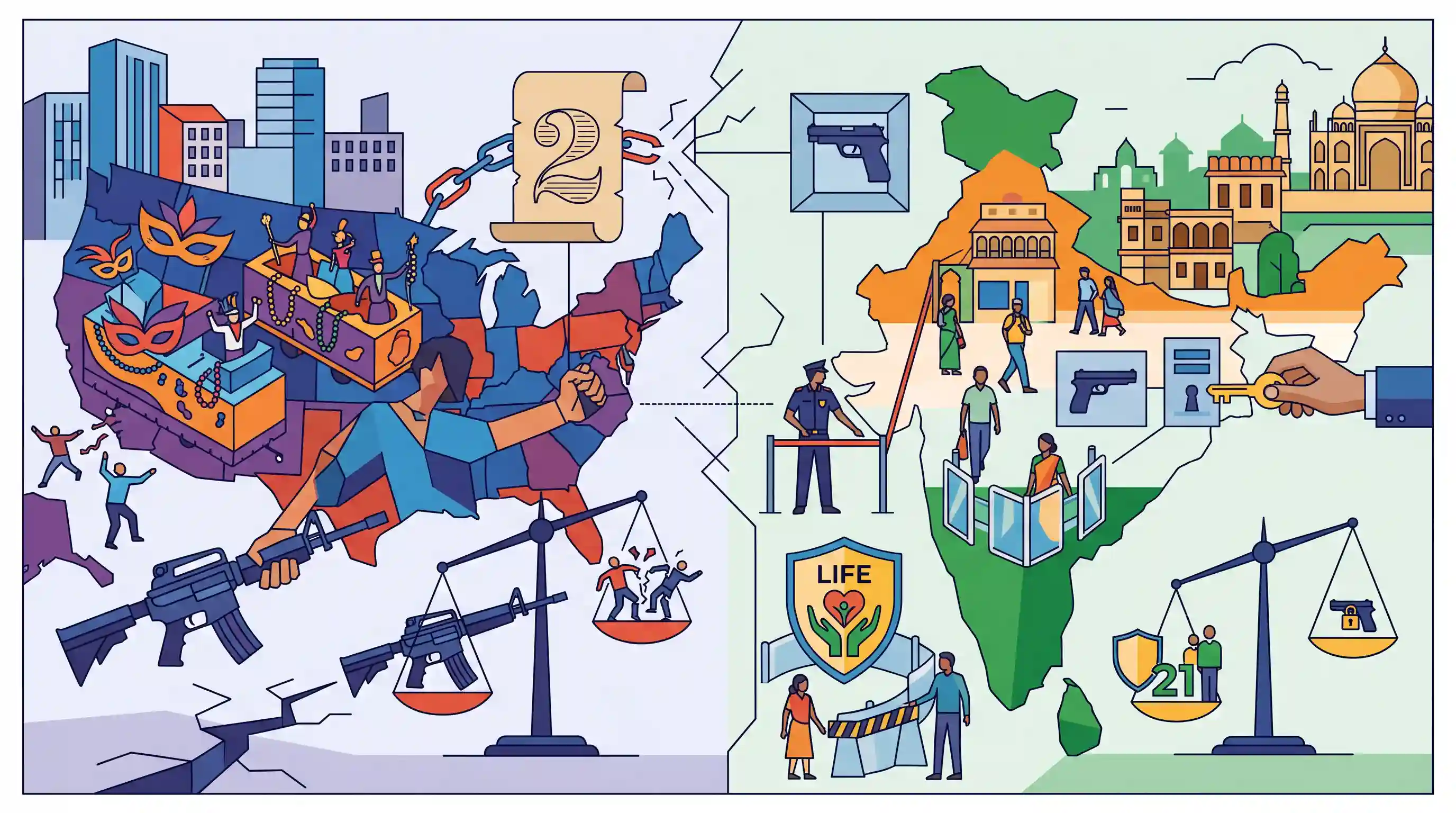
Useful for comparative constitutional studies (US Second Amendment vs. Indian Constitution) and discussing public safety, gun control legislation, and the State's duty to protect the Right to Life.
Summary
The article reports a tragic mass shooting at a Mardi Gras parade in Louisiana, USA, which left several people, including a child, injured. This incident underscores the persistent challenge of gun violence and public security in the United States, deeply tied to the constitutional debate over the Second Amendment. From a UPSC perspective, it offers a comparative lens to examine India's strict gun control regime under the Arms Act, 1959, which prioritizes public safety and the constitutional Right to Life (Article 21) over an individual right to bear arms.
Key Points
- A mass shooting occurred during a Mardi Gras parade in Louisiana, USA, causing multiple casualties, including a child.
- The incident highlights the ongoing public safety crisis surrounding gun violence and mass shootings in the United States.
- It triggers debates on the US Second Amendment (right to bear arms) versus the need for stricter gun control legislation.
- In contrast to the US, India regulates firearms strictly through the Arms Act, 1959, and does not provide a fundamental right to bear arms, prioritizing the broader Right to Life (Article 21).
Important Terms
Second Amendment (US Constitution)

A 1791 US Bill of Rights provision protecting the "right to keep and bear arms." Recent jurisprudence affirms this as an individual right for self-defense, though it remains a subject of intense political debate.
UPSC context
GS Paper II: Comparative Constitution. Tests understanding of differing global approaches to individual liberties vs. state regulation of firearms.
Arms Act, 1959 (India)
The primary Indian legislation regulating the manufacture, sale, and possession of firearms. It establishes that gun ownership is a strictly licensed privilege, not a fundamental right, prioritizing public safety.
UPSC context
GS Paper II/III: Governance and Internal Security. Tests knowledge of statutory frameworks for maintaining public order and controlling lethal weapons.
Article 21 (Indian Constitution)
Fundamental right guaranteeing that no person shall be deprived of life or personal liberty except according to procedure established by law. It is the bedrock of individual safety in India.
UPSC context
GS Paper II: Fundamental Rights. Tests the interpretative link between state-mandated gun control and the collective "Right to Life."
Comparative Constitution
A core GS II topic involving the study of similarities and differences between world constitutions. This case contrasts the US "Right to Bear Arms" with India's "Right to Life."
UPSC context
GS Paper II: Syllabus topic. Evaluates the ability to analyze India’s constitutional vision against other democratic models like the USA.
Public Order
Refers to the maintenance of public peace and safety. In India, it is a ground for restricting fundamental rights and is a State subject under the Seventh Schedule.
UPSC context
GS Paper II/III: Governance and Security. Essential for understanding the state’s power to limit individual freedoms to prevent mass violence.
Reasonable Restrictions
Constitutional limits on Fundamental Rights (e.g., Article 19) allowing the State to balance individual liberty with collective interests like security, public order, and morality.
UPSC context
GS Paper II: Fundamental Rights. Tests the understanding that Indian rights are not absolute and can be curtailed for public safety.
Prelims Trap
The right to bear arms is implicitly protected under Article 21 for self-defense.
Indian courts consistently hold that bearing arms is strictly a statutory privilege under the Arms Act, 1959, not a fundamental right.
Static Concepts Connected
How does the 7th Schedule divide jurisdiction over arms and public order?
- Union List: Arms, firearms, ammunition, and explosives are exclusively governed by the Centre under Entry 5 of List I.
- State List: Public order and Police are exclusively managed by the states under Entries 1 and 2 of List II.
What are the key provisions of the Arms (Amendment) Act, 2019?
- Ownership Limit: Reduced the maximum number of firearms an individual can legally possess from three to two.
- License Validity: Increased the validity period of a firearm license from 3 years to 5 years.
- Celebratory Gunfire: Introduced specific and stringent penalties for celebratory firing that endangers human life or personal safety.
Cross-Topic Patterns
Comparative Constitution (GS2)
Contrasting the US Second Amendment with India's Arms Act is a classic GS2 theme, illustrating how different constitutional frameworks balance individual liberty against collective public safety.
Internal Security & Arms Smuggling (GS3)
India's strict domestic gun control laws contrast sharply with the GS3 challenge of illegal small arms proliferation, largely driven by cross-border smuggling networks and porous borders.

A Prelims question linking the 7th Schedule (Arms as a Union Subject vs. Public Order as State Subject) and Article 21 is highly probable.
Linked PYQs · 2
Linked PYQs · 2
- 2023MainsGS2
“The Constitution of India is a living instrument with capabilities of enormous dynamism. It is a constitution made for a progressive society.” Illustrate with special reference to the expanding horizons of the right to life and personal liberty.
- 2017MainsGS3
Mob violence is emerging as a serious law and order problem in India. By giving suitable examples, analyze the causes and consequences of such violence.
