Joint Security Operations Target Left Wing Extremism in Bastar Forests
Source:The Hindu ↗
Why It Matters
Left Wing Extremism (Naxalism) is explicitly mentioned in the GS3 syllabus as a major internal security threat. The article sheds light on the multi-agency kinetic approach (state police and central forces) taken to dismantle Maoist networks in their traditional strongholds. Additionally, the location (Indravati National Park) is a high-yield geographical fact for Prelims.
Summary
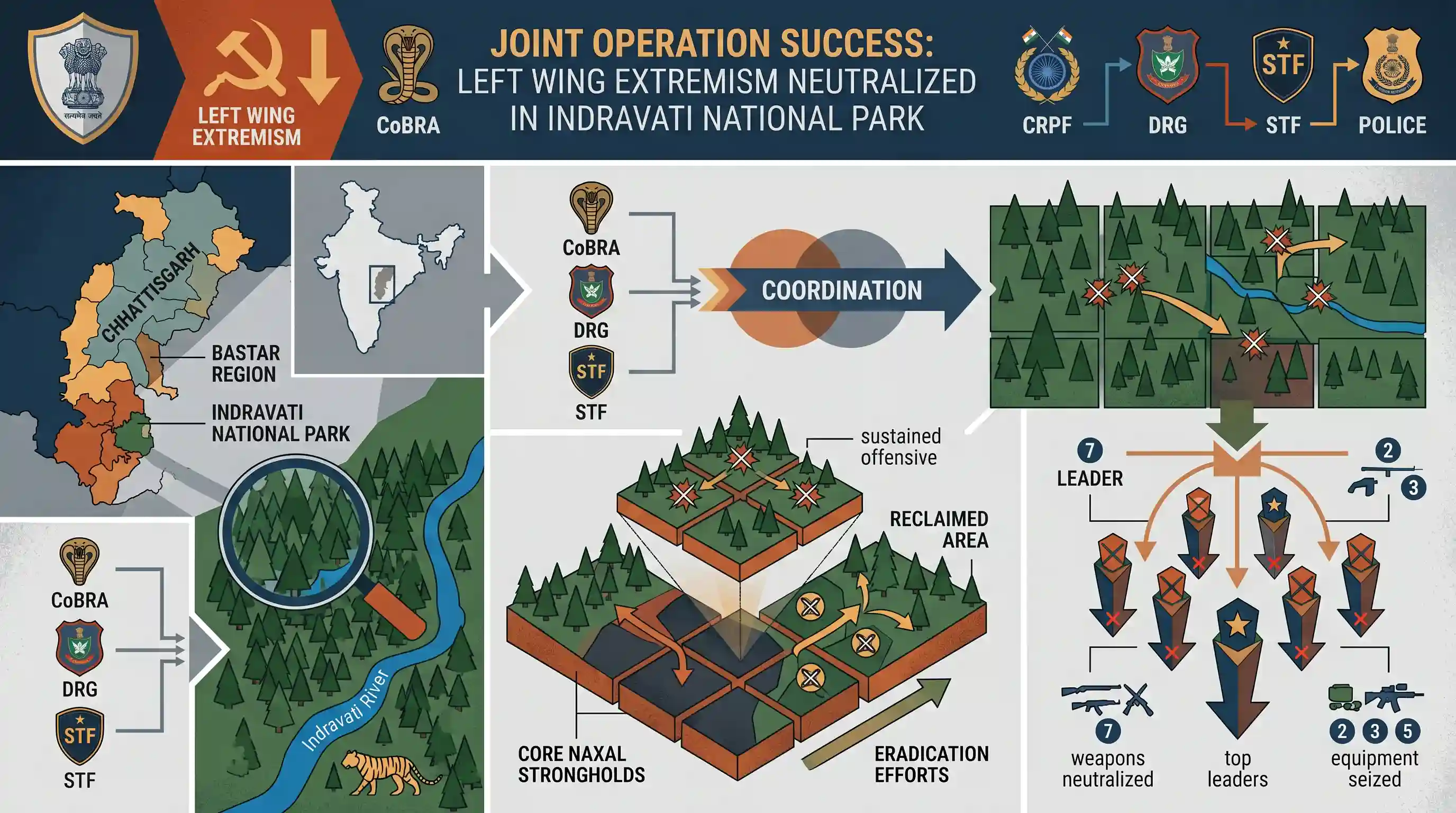
Security forces in Chhattisgarh successfully neutralized seven Maoists, including top leaders, during an intense encounter in the dense forests of Indravati National Park. The joint operation involved state police units like the District Reserve Guard (DRG) and the Special Task Force (STF), alongside the CRPF's elite CoBRA unit. The sustained offensive in the Bastar region reflects ongoing efforts to eradicate Left Wing Extremism (LWE) and reclaim core Naxal strongholds.
Key Points
- Seven Maoists, including senior commanders, were killed in an encounter with security forces in the Indravati National Park area in Chhattisgarh's Bijapur district.
- The joint operation was carried out by the Special Task Force (STF), the District Reserve Guard (DRG), and the CRPF's specialized CoBRA unit.
- The encounter highlights intensified, targeted anti-Naxal operations in the highly forested tri-junction area of Bijapur, Narayanpur, and Dantewada.
- This adds to a significant number of Maoist casualties in Chhattisgarh this year, reflecting a robust tactical offensive strategy against Left Wing Extremism (LWE).
Important Terms
Central Reserve Police Force (CRPF)

India's premier Central Armed Police Force (CAPF) under the Ministry of Home Affairs, tasked with internal security, counter-insurgency, and maintaining law and order, particularly in Naxal-affected regions.
UPSC context
GS Paper III: Internal Security. Tests understanding of the mandate and operational role of various security forces.
Commando Battalion for Resolute Action (CoBRA)
A specialized elite wing of the CRPF trained in guerrilla tactics and jungle warfare specifically for counter-insurgency operations against Maoist groups in difficult terrain.
UPSC context
GS Paper III: Security Forces and Agencies. Focuses on specialized commando units and unconventional warfare strategies.
District Reserve Guard (DRG)
A specialized unit of the Chhattisgarh Police recruited from local tribal youth and surrendered Maoists, utilizing their terrain knowledge and local intelligence for anti-Naxal operations.
UPSC context
GS Paper III: Internal Security (LWE). Highlights the "son of the soil" approach in counter-insurgency operations.
Special Task Force (STF)
State-level specialized police units (e.g., in Chhattisgarh) focused on intelligence-led operations, counter-insurgency, and neutralizing high-ranking extremist leaders in coordination with central forces.
UPSC context
GS Paper III: Internal Security. Relevant for state-central coordination in addressing non-state actor threats.
Left Wing Extremism (LWE)
An armed insurgency in India, primarily led by Maoist groups, aiming to overthrow the democratic state through "protracted people's war" and mass mobilization.
UPSC context
GS Paper III: Internal Security. A critical topic concerning the single largest internal security challenge in India.
Indravati National Park
A critical tiger reserve and national park in Chhattisgarh's Bijapur district, frequently cited in security contexts as a dense forest stronghold for Maoist cadres.
UPSC context
GS Paper I/III: Geography & Internal Security. Tests knowledge of environmental geography intersecting with conflict zones.
Prelims Trap
Indravati River, flowing through the Bastar region of Chhattisgarh, is a major tributary of the Mahanadi River.
False. Indravati is a crucial tributary of the Godavari, not the Mahanadi. UPSC frequently exploits this confusion since Mahanadi is Chhattisgarh's primary river system.
Static Concepts Connected
What are the key ecological features of Indravati National Park?
- Location & Drainage: Situated in Chhattisgarh’s Bijapur district, it is bounded by the Indravati River (a Godavari tributary) to the north.
- Flagship species: It serves as one of the last remaining major habitats for the endangered wild water buffalo (Bubalus arnee) in Central India.
- Vegetation: Features tropical mixed deciduous forests with prominent teak and sal tree associations.
What is the SAMADHAN doctrine for Left Wing Extremism?
- Operational tactics: A Ministry of Home Affairs framework focusing on Smart Leadership, Actionable Intelligence, and Aggressive Strategy to counter Naxalites.
- Technology focus: Relies on Harnessing Technology (UAVs, trackers) and Dashboard-based KPIs for tracking operational performance.
- Economic blockade: Aims to choke insurgent networks by ensuring 'No access to financing' and cutting off logistical supply chains.
Cross-Topic Patterns
LWE clearance + Aspirational Districts
Security operations in Bastar are immediately followed by road connectivity and mobile tower installations, showcasing the 'Clear, Hold, Build' framework linking internal security directly to socio-economic development.
Protected areas as insurgent sanctuaries
Dense canopy cover in tri-junction reserves like Indravati provides tactical cover for Naxals, forcing CAPFs to deploy specialized jungle warfare units (CoBRA) to counter geographic advantages.

Mapping LWE-affected districts (Bastar region) against key geographic features like rivers and tiger reserves is highly probable for 2026.
Linked PYQs · 2
Linked PYQs · 2
- 2022MainsGS3
Naxalism is a social, economic and developmental issue manifesting as a violent internal security threat. In this context, discuss the emerging issues and suggest a multilayered strategy to tackle the menace of Naxalism.
- 2023MainsGS3
What are the internal security challenges being faced by India? Give out the role of Central Intelligence and Investigative Agencies tasked to counter such threats.
