Meghalaya rat hole mining ban violations and disaster enforcement gaps
Source:The Hindu ↗
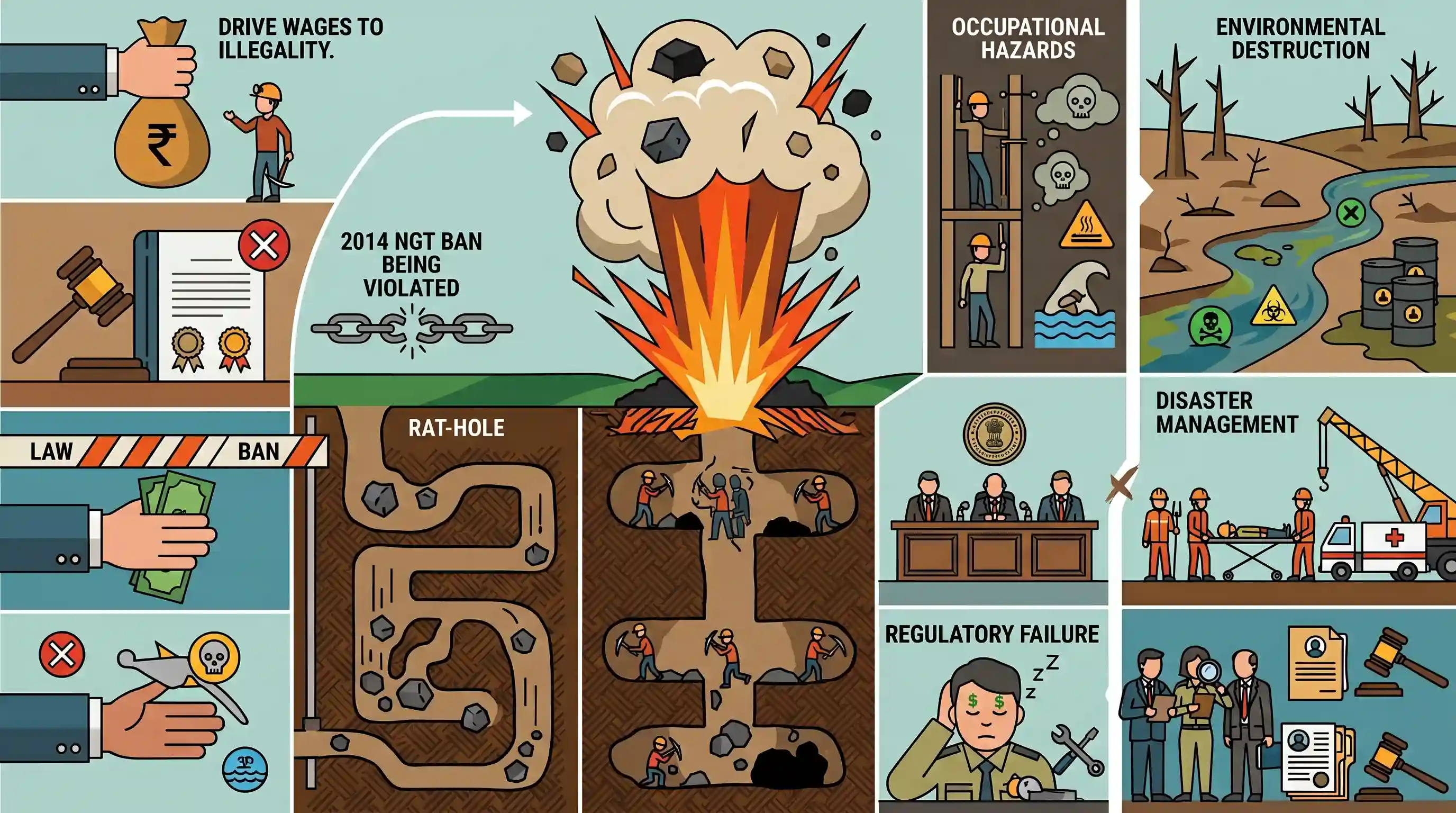
Why It Matters
The continued operation of illegal rat-hole mines despite explicit NGT and Supreme Court bans exposes significant governance deficits, regulatory enforcement failures, and grave environmental and human rights concerns in resource-rich regions.
Summary
At least 18 miners were killed following an explosion in an illegal "rat-hole" coal mine in Meghalaya's East Jaintia Hills district. Despite a 2014 National Green Tribunal (NGT) ban—subsequently upheld by the Supreme Court—illegal mining operations persist, driven by high wages and systemic regulatory failures. The Meghalaya government has ordered an investigation, registering cases under multiple laws including the Mines and Minerals (Development and Regulation) Act. The tragedy highlights severe occupational safety issues and persistent environmental non-compliance, despite the existence of oversight panels like the Justice B.P. Katakey Committee.
Key Points
- An explosion in an illegal rat-hole coal mine in Meghalaya's East Jaintia Hills district killed at least 18 miners.
- The National Green Tribunal (NGT) banned the hazardous practice of rat-hole mining in 2014, a decision later upheld by the Supreme Court.
- Despite the ban and oversight efforts by the Justice B.P. Katakey Committee, illegal mining persists due to lucrative daily wages and alleged backing by influential figures.
- An FIR has been registered under the Bharatiya Nyaya Sanhita, the Mines and Minerals (Development and Regulation) Act, and the Explosives Substances Act.
Important Terms
Rat-hole mining

A primitive and hazardous coal extraction method involving narrow horizontal tunnels (3-4 feet high). It is primarily practiced in Meghalaya and was banned by the NGT in 2014 for safety/environmental risks.
UPSC context
GS I (Resources) & GS III (Environment). Tests awareness of illegal resource extraction, labor exploitation, and environmental degradation in Northeast India.
National Green Tribunal (NGT)
A specialized statutory body established under the NGT Act (2010) for the effective and expeditious disposal of cases relating to environmental protection and conservation of forests.
UPSC context
GS II (Statutory Bodies) & GS III (Environment). Tests understanding of environmental governance and the role of specialized tribunals.
Mines and Minerals (Development and Regulation) Act, 1957
The principal legislation governing the mining sector in India. It regulates the grant of leases and empowers state governments to frame rules to prevent illegal mining and transportation.
UPSC context
GS II (Government Policies) & GS III (Resources). Essential for understanding the legal framework of mineral resource management and federal mining powers.
B.P. Katakey Committee
A judicial committee appointed by the Meghalaya High Court to oversee the implementation of the ban on rat-hole mining and recommend environmental restoration measures in the state.
UPSC context
GS III (Environment/Security). Tests knowledge of specific judicial oversight mechanisms and the challenge of enforcing environmental bans in local contexts.
National Disaster Response Force (NDRF)
A specialized force constituted under the Disaster Management Act (2005) for rapid response to natural and man-made disasters. It consists of personnel from various Central Armed Police Forces.
UPSC context
GS III (Disaster Management). Tests awareness of the institutional framework for rescue operations and disaster mitigation in India.
Explosive Substances Act, 1908
A 1908 law that criminalizes the unlawful making, possession, and use of explosive substances intended to cause injury or property destruction, prescribing stringent penalties including life imprisonment.
UPSC context
GS II (Statutory Laws) & GS III (Internal Security). Relevant for understanding the legal consequences of hazardous industrial accidents and unlawful use of explosives.
Bharatiya Nyaya Sanhita (BNS)
India’s new penal code (effective July 1, 2024), which replaced the Indian Penal Code (IPC) to modernize definitions of offenses, including those related to negligence and organized crime.
UPSC context
GS II (Polity/Laws). Tests knowledge of the recent overhaul of India's criminal justice system and current legal provisions.
Prelims Trap
"Sixth Schedule tribal landowners are exempt from the central MMDR Act."
While tribals own the minerals in Meghalaya, the Supreme Court explicitly ruled in 2019 that all extraction must comply with the MMDR Act and environmental laws.
Static Concepts Connected
How do mineral rights function in Meghalaya under the Sixth Schedule?
- Private Ownership: Unlike most of India where the state owns minerals, land and subsurface minerals in Meghalaya are owned by private individuals or tribal communities.
- Statutory Override: The Supreme Court clarified that private ownership does not exempt miners from obtaining mandatory leases and clearances under the MMDR Act, 1957.
What is Acid Mine Drainage (AMD) associated with rat-hole mining?
- Chemical Process: Sulfide minerals (like pyrite) exposed in coal seams react with oxygen and water to form highly corrosive sulfuric acid.
- Ecological Impact: Highly acidic water leaches heavy metals, turning local rivers like the Lukha and Myntdu orange and rendering them toxic to aquatic life.
Cross-Topic Patterns
Sixth Schedule vs. Environmental Regulation
The clash between indigenous community land rights under the Sixth Schedule and statutory environmental frameworks (NGT, EPA) is a recurring governance theme in UPSC.
River Toxicity and Acid Mine Drainage
Unscientific coal extraction directly causes Acid Mine Drainage (AMD), heavily polluting rivers. UPSC often links specific mining practices to resultant water pollutants and river ecology.

Expect a Prelims statement linking Sixth Schedule mineral ownership with MMDR Act compliance, alongside NGT jurisdiction.
Linked PYQs · 3
Linked PYQs · 3
- 2025MainsGS3
Mineral resources are fundamental to the country's economy and these are exploited by mining. Why is mining considered an environmental hazard? Explain the remedial measures required to reduce the environmental hazard due to mining.
- 2019MainsGS3
Coastal sand mining, whether legal or illegal, poses one of the biggest threats to our environment. Analyze the impact of sand mining along the Indian coasts, citing specific examples.
- 2018PrelimsGS1
How is the National Green Tribunal (NGT) different from the Central Pollution Control Board (CPCB)? 1. The NGT has been established by an Act whereas the CPCB has been created by an executive order of the Government. 2. The NGT provides environmental justice and helps reduce the burden of litigation in the higher courts whereas the CPCB promotes cleanliness of streams and wells, and aims to improve the quality of air in the country. Which of the statements given above is/are correct?
