Meghalaya rat-hole mine blast exposes environmental governance gaps
Source:The Hindu ↗
Why It Matters
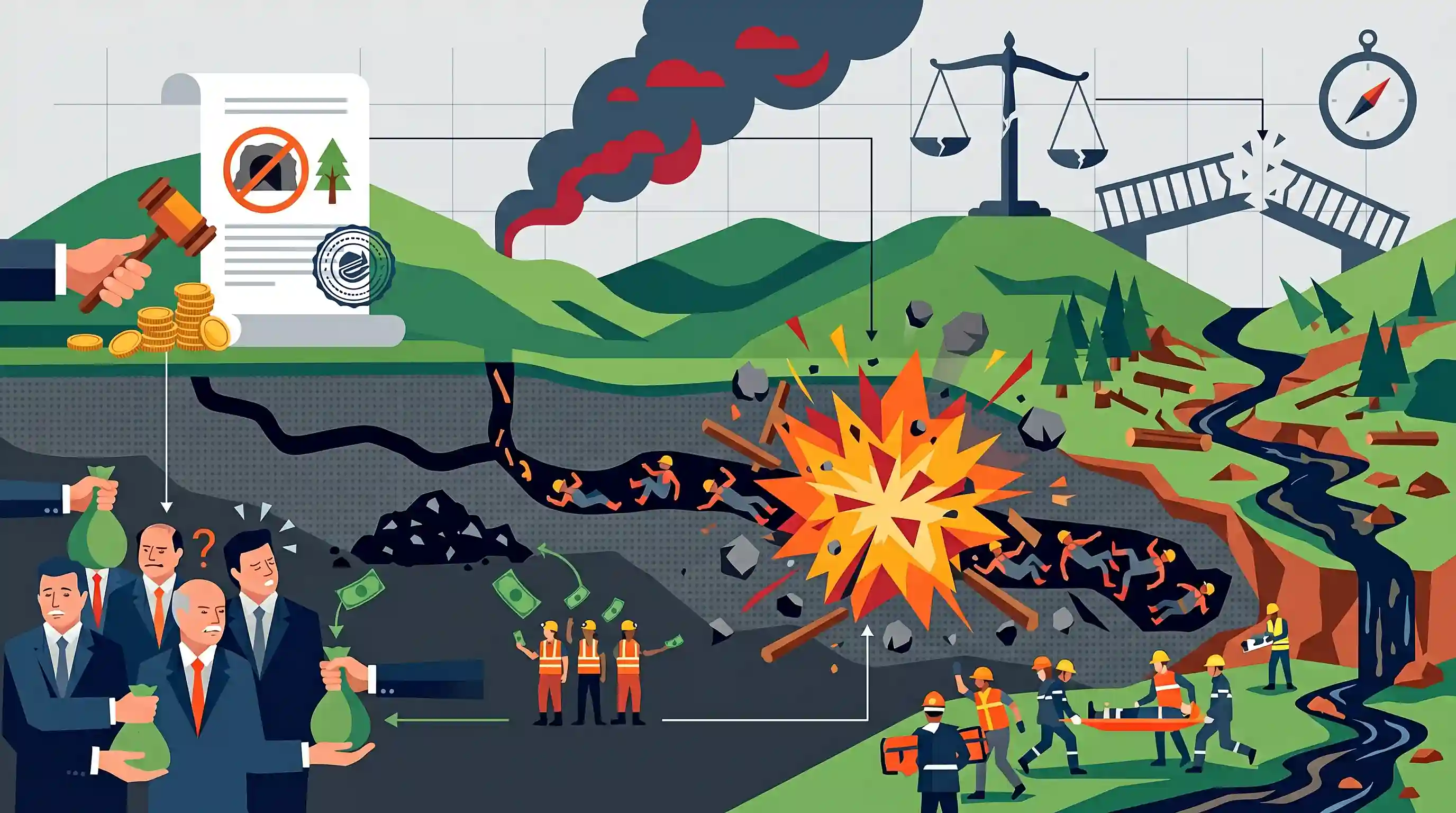
The incident serves as a critical case study on the gap between environmental legislation (NGT bans) and ground-level enforcement. It highlights the socio-economic complexities driving illegal mining and the ecological vulnerability of the Northeast, making it highly relevant for questions on environmental governance, disaster management, and the sustainable exploitation of resources in Mains GS2 and GS3.
Summary
An explosion at an illegal rat-hole coal mine in Meghalaya’s East Jaintia Hills district claimed the lives of at least 18 miners, highlighting the unabated continuation of this hazardous practice despite a 2014 ban by the National Green Tribunal (NGT). Rat-hole mining, which involves digging narrow tunnels for manual extraction of coal, persists due to lucrative daily wages and alleged political-administrative complicity, posing severe safety and environmental risks. Authorities have registered FIRs under relevant legislation, including the MMDR Act and the Explosives Substances Act. The tragedy underscores substantial governance deficits in enforcing environmental jurisprudence, managing resource extraction, and ensuring occupational safety in ecologically sensitive regions like the Northeast.
Key Points
- An explosion in an illegal rat-hole coal mine in Meghalaya's East Jaintia Hills resulted in the deaths of at least 18 miners.
- The tragedy highlights the persistent continuation of rat-hole mining, a hazardous practice officially banned by the National Green Tribunal (NGT) in 2014 and upheld by the Supreme Court.
- Activists attribute the unabated illegal mining to a nexus between mining mafias and authorities, alongside socioeconomic factors like lucrative daily wages (₹2,000) for impoverished workers.
- FIRs have been registered under multiple laws, including the Mines and Minerals (Development and Regulation) Act and the Explosives Substances Act.
- The incident brings attention back to the findings of the B.P. Katakey Committee, formed to oversee environmental restoration and investigate illegal coal extraction in the region.
Important Terms
Rat-hole Mining

Manual coal extraction involving narrow horizontal tunnels for a single person. Banned by the NGT in 2014 due to frequent fatalities and severe environmental degradation in Meghalaya.
UPSC context
GS1 (Resource Geography), GS3 (Environment and Disaster Management); tests understanding of hazardous extraction practices and regulatory failures.
National Green Tribunal (NGT)
A specialized statutory body established under the NGT Act 2010 for the expeditious disposal of cases related to environmental protection and conservation of forests.
UPSC context
GS2 (Statutory Bodies), GS3 (Environmental Jurisprudence); tests knowledge of quasi-judicial mechanisms for environmental enforcement.
Mines and Minerals (Development and Regulation) Act
The primary legal framework regulating the Indian mining sector, governing the grant of mineral concessions and prescribing penalties for illegal mining and environmental non-compliance.
UPSC context
GS2 (Governance), GS3 (Economy/Resources); essential for questions on mineral resource management and federal mining regulations.
B.P. Katakey Committee
A committee appointed by the High Court of Meghalaya to recommend measures for curbing illegal coal mining and overseeing the implementation of NGT/Supreme Court orders.
UPSC context
GS2 (Judicial Oversight), GS3 (Internal Security); relevant to regional governance issues and judicial intervention in ecological hotspots.
Explosive Substances Act, 1908
A 1908 legislation prescribing stringent punishments for causing explosions likely to endanger life or property, often invoked in cases of industrial accidents and terrorism.
UPSC context
GS2 (Legal Framework), GS3 (Internal Security); tests awareness of laws governing hazardous substances and public safety.
Bharatiya Nyaya Sanhita (BNS)
The primary criminal code of India that replaced the Indian Penal Code (IPC) in 2024, consolidating and defining various criminal offenses and their punishments.
UPSC context
GS2 (Indian Polity/Legal Reform); critical for understanding the updated criminal justice system and its application in modern cases.
Prelims Trap
Tribal areas in Meghalaya are exempt from central mining laws like the MMDR Act due to Sixth Schedule autonomy.
The Supreme Court (2019) explicitly ruled that while tribals own the land and minerals, all extraction must strictly comply with the central MMDR Act.
Static Concepts Connected
How does mineral ownership work in Sixth Schedule areas like Meghalaya?
- Private Ownership: Tribal customary laws grant local communities and individuals private ownership over both land and subsurface minerals, unlike the rest of India.
- Regulatory Override: Despite local ownership, the Supreme Court mandates that resource extraction cannot bypass the central MMDR Act, 1957, or national environmental norms.
What is Acid Mine Drainage (AMD)?
- Chemical Process: Occurs when sulfur-bearing coal is exposed to water and oxygen during mining, creating a reaction that produces highly toxic sulfuric acid.
- Ecological Impact: It severely pollutes local water bodies, rendering rivers like Meghalaya's Lukha and Myntdu highly acidic and completely devoid of aquatic life.
Cross-Topic Patterns
Sixth Schedule vs. Environmental Law
The conflict between tribal community ownership of subsurface minerals and national environmental regulation (NGT bans, MMDR Act) is a high-yield Polity-Environment intersection.
Topography dictates mining methods
Meghalaya's exceptionally thin coal seams (<2m) make standard open-cast mining economically unviable, geographically driving the shift toward hazardous, informal rat-hole tunnels.

Expect a multi-statement question linking Sixth Schedule mineral ownership rights with MMDR Act compliance and NGT bans in Meghalaya.
Linked PYQs · 4
Linked PYQs · 4
- 2025MainsGS3
Mineral resources are fundamental to the country's economy and these are exploited by mining. Why is mining considered an environmental hazard? Explain the remedial measures required to reduce the environmental hazard due to mining.
- 2017MainsGS1
In spite of adverse environmental impact, coal mining is still inevitable for development." Discuss.
- 2022MainsGS2
“The most significant achievement of modern law in India is the constitutionalization of environmental problems by the Supreme Court.” Discuss this statement with the help of relevant case laws.
- 2019MainsGS3
Coastal sand mining, whether legal or illegal, poses one of the biggest threats to our environment. Analyze the impact of sand mining along the Indian coasts, citing specific examples.
