Meghalaya Rat-Hole Mining and Regulatory Failure Challenges
Source:The Hindu ↗
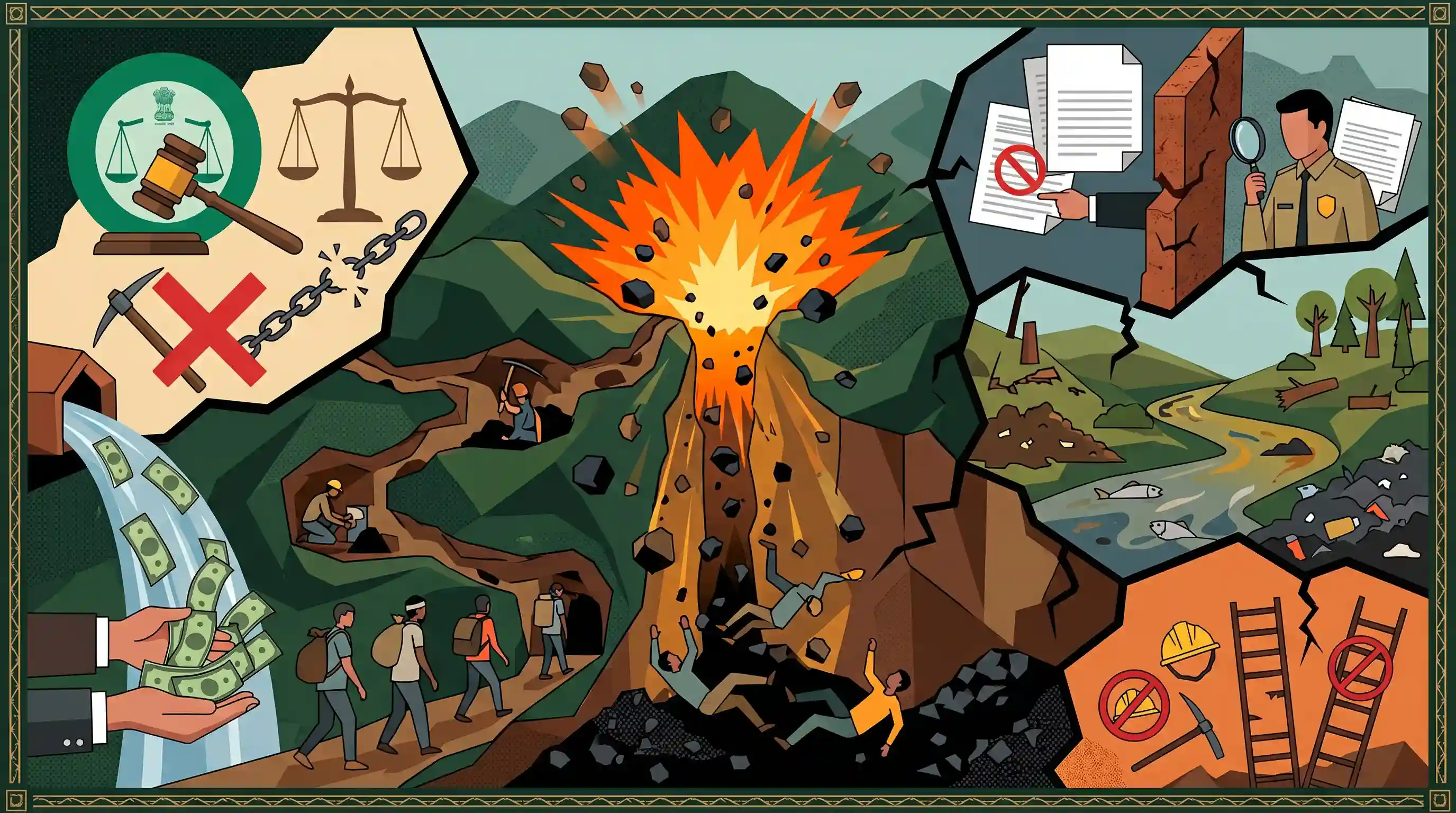
Why It Matters
Provides a clear case study on the challenge of enforcing environmental and occupational safety regulations (NGT bans) against lucrative, localized illegal economies. Relevant for questions on the environmental hazards of mining, regulatory failures, and the socio-economic drivers of illegal resource extraction.
Summary
An explosion at an illegal rat-hole coal mine in Meghalaya's East Jaintia Hills district claimed at least 18 lives, exposing the persistent failure to enforce the 2014 National Green Tribunal (NGT) ban on this hazardous practice. Despite Supreme Court validation of the ban and critical reports from the High Court-appointed Justice B.P. Katakey Committee regarding the state's inaction, illegal mining thrives due to lucrative daily wages that attract migrant laborers. The tragedy highlights significant gaps in environmental governance, occupational safety, and the enforcement of judicial mandates in resource-rich regions.
Key Points
- An explosion at an illegal rat-hole coal mine in Meghalaya's East Jaintia Hills district resulted in the death of at least 18 workers.
- The tragedy exposes the continued operation of hazardous rat-hole mining despite a 2014 ban by the National Green Tribunal (NGT), later upheld by the Supreme Court.
- High daily wages (up to ₹2,000) continue to attract migrant laborers to these unsafe, illegal mines despite the extreme occupational risks.
- The Justice B.P. Katakey Committee, appointed by the High Court of Meghalaya, has previously highlighted the state government's failure to halt illegal mining and coal transportation.
Important Terms
Rat-hole Mining

A primitive, hazardous coal extraction method involving digging narrow, horizontal tunnels (3-4 feet high). It is notorious for worker entrapment, child labor, and severe environmental degradation.
UPSC context
GS III (Environment/Disaster Management). Tests knowledge of illegal mining, internal security, and ecological impacts in Northeast India.
National Green Tribunal (NGT)
A specialized statutory body established under the NGT Act 2010 for the effective and expeditious disposal of cases relating to environmental protection and forest conservation.
UPSC context
GS II (Statutory/Quasi-judicial Bodies). Essential for understanding environmental justice and institutional mandates in India.
Justice B.P. Katakey Committee
A judicial committee appointed by the Meghalaya High Court to monitor illegal mining, oversee coal inventory, and recommend enforcement measures against the violation of mining bans.
UPSC context
GS III (Environmental Governance). Illustrates the role of judicial oversight in addressing executive failures in environmental protection.
Environmental Governance
The framework of laws, policies, and institutions that regulate human-environment interactions. In Meghalaya, it involves balancing tribal land rights with national environmental mandates.
UPSC context
GS II (Governance) and GS III (Environment). Focuses on the implementation of sustainable development and regulatory enforcement.
Acid Mine Drainage (AMD)
The outflow of highly acidic water, often containing heavy metals, from coal or metal mines. It severely degrades water quality and aquatic biodiversity in Meghalaya's rivers.
UPSC context
GS III (Environment). A specific pollution impact used to test technical understanding of mining-related ecological damage.
Sixth Schedule
Constitutional provision granting autonomy to tribal areas in the Northeast through Autonomous District Councils (ADCs), which often complicates the enforcement of central mining laws.
UPSC context
GS II (Polity). Crucial for understanding the conflict between tribal autonomy, land ownership, and central regulatory frameworks.
Prelims Trap
Tribal landowners in Meghalaya's Sixth Schedule areas have absolute mineral extraction rights exempt from the MMDR Act.
The Supreme Court (2019) affirmed tribal ownership of land and minerals but explicitly ruled that extraction remains strictly subject to central regulations like the MMDR Act.
Static Concepts Connected
What are the geological and environmental traits of Tertiary coal in North-East India?
- Formation age: Formed during the Eocene epoch (Tertiary period), making it geologically younger than India's primary Gondwana coal reserves.
- Chemical properties: Characterized by high moisture and an exceptionally high sulphur content, which limits its metallurgical utility.
- Environmental fallout: High sulphur leads to severe Acid Mine Drainage upon exposure to air and water, turning local rivers highly acidic.
How are mineral rights regulated in Meghalaya's Sixth Schedule areas?
- Private ownership: Uniquely, land and sub-soil minerals in Meghalaya are owned by private individuals or indigenous communities, not the State.
- Regulatory compliance: A 2019 Supreme Court ruling clarified that despite private ownership, any mining activity must fully comply with the central MMDR Act, 1957.
- NGT jurisdiction: The National Green Tribunal holds jurisdiction to ban unscientific practices like rat-hole mining if they violate the Environment (Protection) Act.
Cross-Topic Patterns
Sixth Schedule vs. Central Environmental Laws
Explores the tension between constitutional tribal land ownership under the Sixth Schedule and the mandatory enforcement of central statutes like the MMDR Act and Environment (Protection) Act.
Acid Mine Drainage & Dead Rivers
The high sulphur content in Meghalaya's coal directly connects to the severe pollution and "dead" status of local water bodies like the Kopili River, bridging resource geography with ecology.

Expect a 2026 multi-statement Prelims question linking Meghalaya's high-sulphur Tertiary coal with Sixth Schedule mineral ownership limits.
Linked PYQs · 3
Linked PYQs · 3
- 2025MainsGS3
Mineral resources are fundamental to the country's economy and these are exploited by mining. Why is mining considered an environmental hazard? Explain the remedial measures required to reduce the environmental hazard due to mining.
- 2017MainsGS1
In spite of adverse environmental impact, coal mining is still inevitable for development." Discuss.
- 2018PrelimsGS1
How is the National Green Tribunal (NGT) different from the Central Pollution Control Board (CPCB)? 1. The NGT has been established by an Act whereas the CPCB has been created by an executive order of the Government. 2. The NGT provides environmental justice and helps reduce the burden of litigation in the higher courts whereas the CPCB promotes cleanliness of streams and wells, and aims to improve the quality of air in the country. Which of the statements given above is/are correct?
