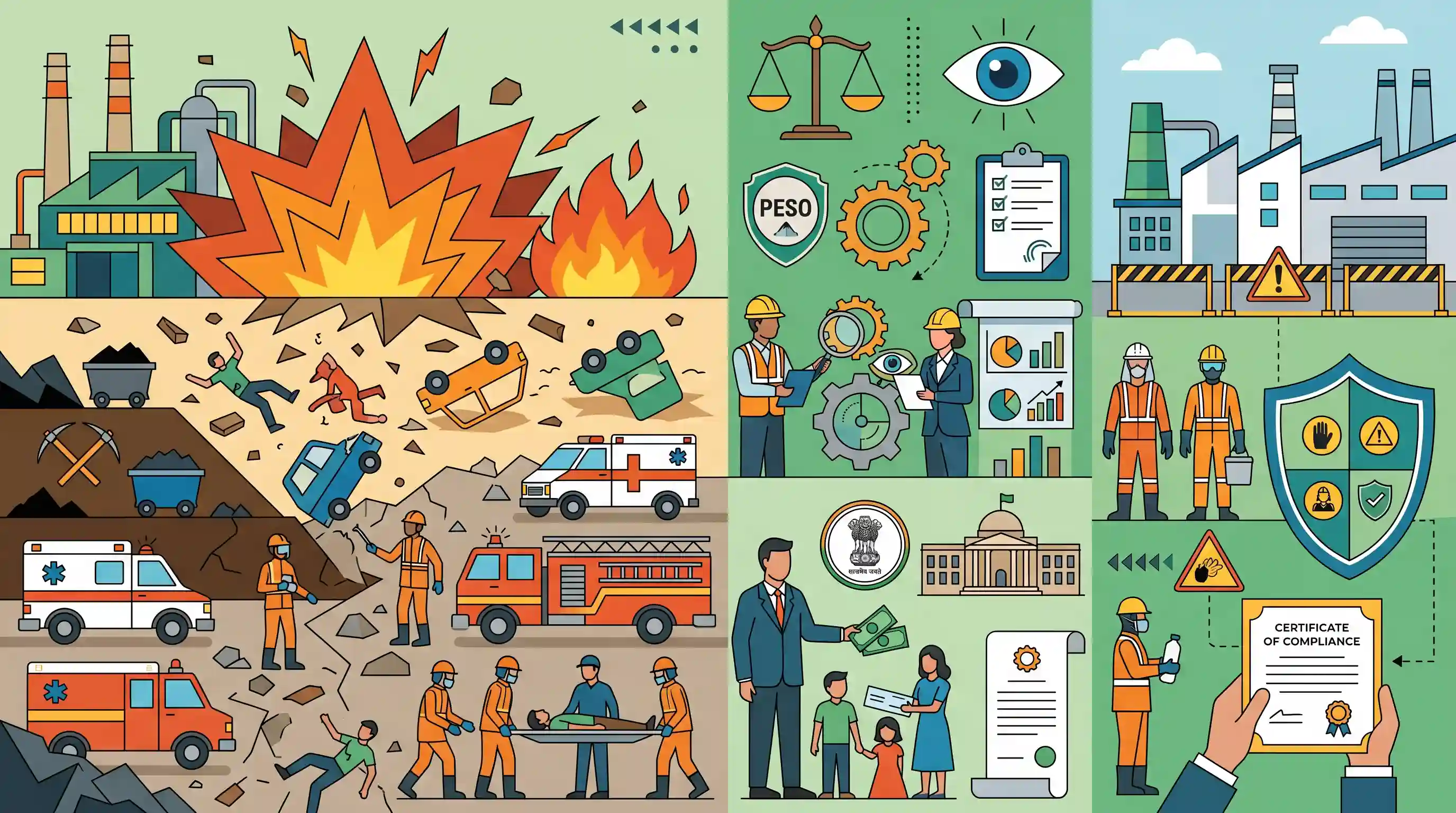
Industrial disaster and explosion at Nagpur explosives factory
Source:The Hindu ↗
Why It Matters
Industrial disasters highlight critical gaps in occupational safety frameworks, regulatory compliance, and disaster resilience. For UPSC candidates, understanding the roles of specialized agencies like PESO and DISH, alongside rapid response forces like NDRF/SDRF, is essential for analyzing industrial safety protocols and disaster management strategies under GS Paper 3.
Summary
A major explosion at an explosives manufacturing factory in Nagpur, Maharashtra, claimed at least 18 lives and left several injured. The facility, operated by SBL Energy Limited, manufactured explosives for coal mining. Authorities, including the NDRF, SDRF, and specialized safety agencies like PESO and DISH, have launched rescue operations and investigations to determine the cause of the disaster. The State government has announced compensation for victims' families and ordered a comprehensive inquiry. The incident brings to light the critical need for stringent industrial safety audits and robust occupational hazard mitigation in hazardous manufacturing units.
Key Points
- A massive explosion at SBL Energy Limited, an explosives manufacturing factory in Nagpur, killed at least 18 people and injured several others.
- The exact cause of the blast remains unknown; the factory was involved in manufacturing coal-blasting explosives.
- Teams from the NDRF, SDRF, PESO, and DISH were deployed for rescue operations and to investigate the incident.
- The Maharashtra government announced an ex gratia of ₹5 lakh to the families of the deceased and has ordered a thorough probe into the blast.
Important Terms
Petroleum and Explosives Safety Organisation (PESO)

A statutory body under the Ministry of Commerce and Industry that regulates the manufacture, storage, and transport of hazardous substances like explosives, petroleum, and compressed gases.
UPSC context
GS Paper 3: Disaster Management; critical for understanding regulatory oversight in hazardous industries and the Explosives Act, 1884.
National Disaster Response Force (NDRF)
A specialized force constituted under the Disaster Management Act, 2005, for providing a professional and swift response to natural and man-made disasters across India.
UPSC context
GS Paper 3: Disaster Management; tests knowledge of India's institutional framework for emergency response and disaster relief mechanisms.
Directorate of Industrial Safety and Health (DISH)
A state-level administrative body (formerly Factory Inspectorate) responsible for enforcing the Factories Act, 1948, to ensure the safety, health, and welfare of industrial workers.
UPSC context
GS Paper 2: Governance; relevant to labor laws, executive oversight of industrial safety, and state-level regulatory enforcement.
Factories Act, 1948
The primary legislation in India governing the working conditions, safety, health, and welfare of workers in factories, often cited during industrial accident probes.
UPSC context
GS Paper 2 & 3: Social Justice and Disaster Management; fundamental for understanding worker protections and statutory compliance in manufacturing.
Explosives Act, 1884
The principal legal framework governing the manufacture, possession, use, sale, transport, and import of explosives in India, administered by PESO.
UPSC context
GS Paper 3: Internal Security and Disaster Management; key for questions on regulating hazardous materials and industrial disaster prevention.
OSHWC Code, 2020
One of the four new labor codes that consolidates 13 central labor laws to simplify and modernize safety, health, and welfare standards for workers.
UPSC context
GS Paper 2 & 3: Economic Development and Governance; relevant to labor reforms and the transition from old acts to simplified codes.
State Disaster Response Force (SDRF)
A state-level specialized unit modeled after the NDRF to handle localized disasters and provide immediate rescue and relief operations within a state's jurisdiction.
UPSC context
GS Paper 3: Disaster Management; tests understanding of the multi-tier disaster response architecture (National, State, and District levels).
Prelims Trap
PESO functions under the Ministry of Petroleum and Natural Gas or the Ministry of Home Affairs due to its mandate.
PESO actually operates under the Department for Promotion of Industry and Internal Trade (DPIIT) within the Ministry of Commerce and Industry.
Static Concepts Connected
What is the legal framework governing industrial and chemical disasters in India?
- EPA 1986: The MSIHC Rules, 1989, enacted under this Act, provide the primary framework for prescribing safety measures in chemical and industrial units.
- PLI Act 1991: Provides immediate, 'no-fault' compensation to victims affected by accidents occurring while handling hazardous substances, funded by mandatory insurance.
- Factories Act 1948: Enforced by state-level DISH bodies to mandate occupational safety, health standards, and welfare of workers within manufacturing premises.
What is the mandate and structure of PESO?
- Core Mandate: It is the nodal statutory authority regulating the manufacture, storage, transport, and handling of explosives, compressed gases, and hazardous substances.
- Statutory Backing: It derives its regulatory powers from the Explosives Act, 1884, and the Petroleum Act, 1934.
- Nodal Ministry: It functions under the DPIIT, Ministry of Commerce and Industry, not the Home or Petroleum ministries.
Cross-Topic Patterns
Absolute vs Strict Liability in Disasters
Industrial disasters frequently invoke the 'Absolute Liability' principle established by the Supreme Court (Oleum Gas Leak case), making enterprises liable without exception for inherently dangerous activities.
Industrial Safety + New Labour Codes
The Occupational Safety, Health and Working Conditions (OSHWC) Code, 2020 aims to subsume the Factories Act, shifting the regulatory focus toward proactive hazard identification in hazardous units.

Match-the-following questions linking specialized regulatory agencies like PESO or DGMS to their non-intuitive nodal ministries are likely.
Linked PYQs · 3
Linked PYQs · 3
- 2024MainsGS3
What is disaster resilience? How is it determined? Describe various elements of a resilience framework. Also mention the global targets of Sendai Framework for Disaster Risk Reduction (2015–2030).
- 2019MainsGS3
Disaster preparedness is the first step in any disaster management process. Explain how hazard zonation mapping will help disaster mitigation in the case of landslides.
- 2018MainsGS3
Describe various measures taken in India for Disaster Risk Reduction (DRR) before and after signing 'Sendai Framework for DRR (2015-2030)'. How is this framework different from Hyogo Framework for Action, 2005?
