Saudi Coalition Airstrikes Against UAE Backed Forces in Yemen
Source:The Hindu ↗
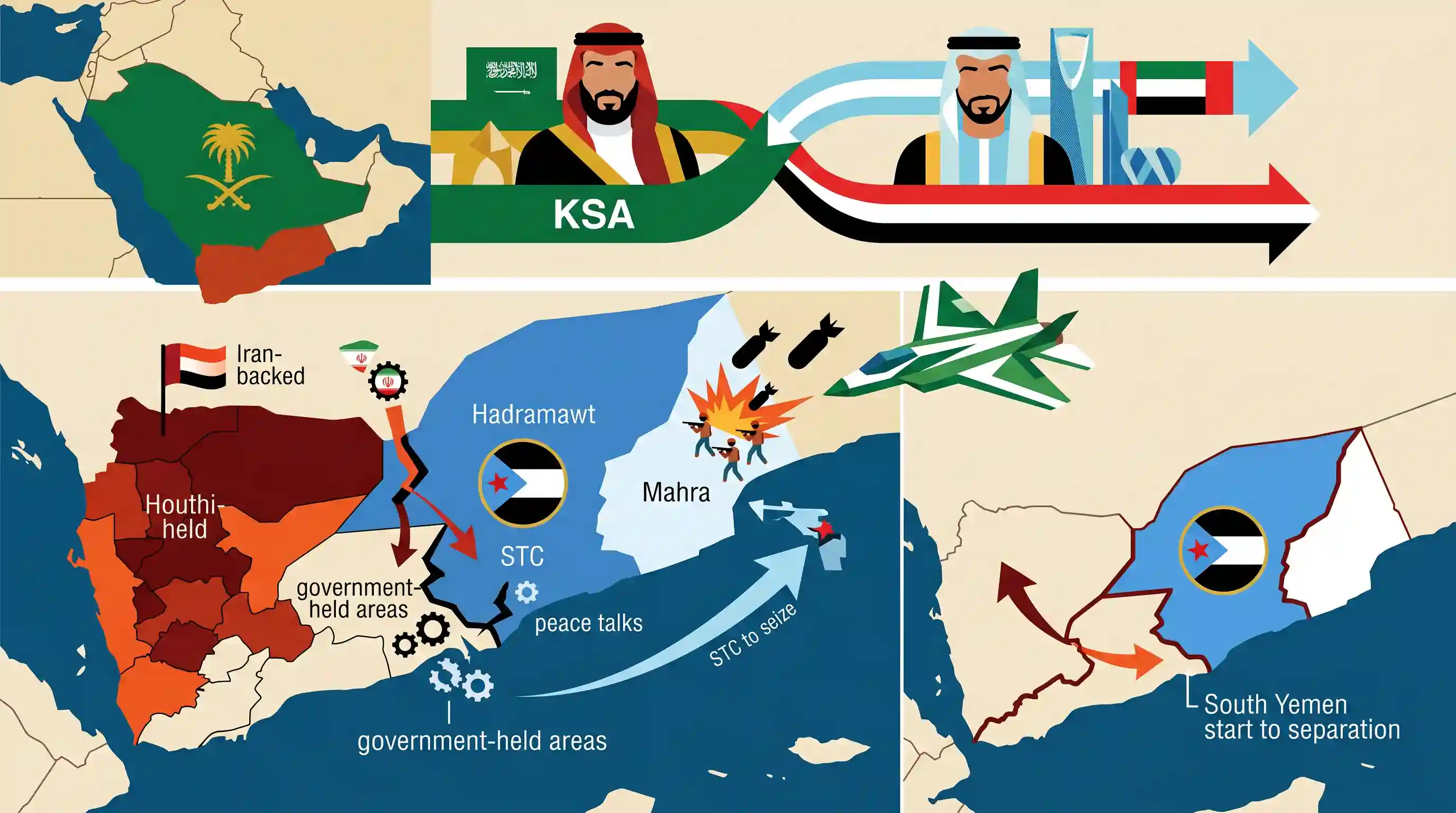
Why It Matters
The Middle East is highly crucial for India's energy security and diaspora. The escalating proxy war and fragmentation of Yemen (involving Saudi Arabia, the UAE, and Iran via the Houthis) alters the regional security architecture, impacting maritime security in the Red Sea and broader geopolitical stability. For Prelims, regions like Hadramawt and Mahra are prime candidates for 'Places in News' matching questions on global conflict zones.
Summary
Airstrikes by the Saudi-led coalition killed seven fighters of the UAE-backed Southern Transitional Council (STC) in Yemen's Hadramawt province. The clash highlights a deepening rift between Saudi Arabia and the UAE, who ostensibly formed a coalition in 2015 to fight Iran-backed Houthi rebels but currently back rival factions in government-held areas. The STC's recent seizure of the Hadramawt and Mahra provinces threatens to derail fragile peace negotiations with the Houthis and raises the prospect of South Yemen breaking away to declare independence.
Key Points
- The Saudi-led coalition conducted airstrikes against UAE-backed Southern Transitional Council (STC) forces in Yemen's Hadramawt province, killing seven fighters.
- The strikes occurred after the secessionist STC seized swathes of the Hadramawt and Mahra provinces, angering Saudi Arabia.
- Despite being nominal allies in a coalition formed in 2015 to fight Iran-backed Houthi rebels, Saudi Arabia and the UAE support rival factions in Yemen's government-held areas.
- The internal clash threatens to derail fragile, slow-moving peace negotiations with the Houthi rebels, who still control the capital Sanaa and most populated areas.
- The STC's territorial advances raise the prospect of South Yemen—an independent state from 1967 to 1990—declaring independence again.
Important Terms
Southern Transitional Council (STC)

A UAE-backed separatist movement in southern Yemen formed in 2017. It seeks to re-establish an independent South Yemeni state and frequently clashes with both Houthi rebels and Saudi-backed government forces.
UPSC context
GS Paper II: International Relations. Tests understanding of regional separatist movements and internal power struggles within Middle Eastern proxy wars.
Saudi-led Coalition
A military alliance formed in 2015 to restore Yemen's internationally recognized government. Led by Saudi Arabia, it currently faces internal friction between Saudi and UAE-backed local factions.
UPSC context
GS Paper II: West Asia Geopolitics. Focuses on regional security architectures and the evolving Saudi-UAE diplomatic relationship.
Houthi Rebels
An Iran-backed Zaydi Shia insurgent group (Ansar Allah) controlling northern Yemen, including Sana'a. They are central to the civil war and have disrupted global trade via Red Sea shipping attacks.
UPSC context
GS Paper II: International Relations. Relates to non-state actors, Iranian influence in West Asia, and threats to maritime security in the Red Sea.
Presidential Leadership Council (PLC)
The internationally recognized executive body of Yemen, established in 2022 to represent various anti-Houthi factions. It struggles to maintain unity between its Saudi-backed and UAE-backed members.
UPSC context
GS Paper II: Governance and IR. Important for understanding state-led peace processes and the fragility of transitional governments in conflict zones.
Hadramawt Province
Yemen’s largest province, strategic for its oil wealth and its border with Saudi Arabia. It has become a flashpoint for competition between the STC and Saudi-backed forces.
UPSC context
GS Paper I: Geography (Places in News). Frequent UPSC topic regarding strategic regions and resource-driven conflict zones.
Bab-el-Mandeb Strait
A critical maritime chokepoint between Yemen and the Horn of Africa. It connects the Red Sea to the Gulf of Aden, handling nearly 15% of global trade.
UPSC context
GS Paper I & II: Geography and IR. Tests knowledge of global trade chokepoints and maritime security in the Indo-Pacific/Middle East.
Prelims Trap
"The Southern Transitional Council (STC) is an Iran-backed rebel group fighting the Saudi-led coalition in Yemen."
Aspirants often assume any "rebel" group in Yemen refers to the Iran-backed Houthis. The STC is actually a UAE-backed secessionist group fighting for an independent South Yemen.
Static Concepts Connected
What is the strategic geographical significance of Yemen?
- Bab el-Mandeb Strait: Yemen controls the eastern shore of this crucial maritime choke point linking the Red Sea to the Gulf of Aden and the Indian Ocean.
- Land Borders: Shares land boundaries with Saudi Arabia to the north and Oman to the east, making its stability critical to Gulf security.
- Maritime Neighbors: Shares maritime borders with Djibouti, Eritrea, and Somalia across the Red Sea and Gulf of Aden.
What is the historical basis for the North-South divide in Yemen?
- Independent South: South Yemen (PDRY) existed as an independent, Soviet-aligned Marxist state from 1967 until 1990.
- 1990 Unification: The two states unified in 1990, but perceived political and economic marginalization of the South led to persistent secessionist movements like the STC.
Cross-Topic Patterns
Red Sea trade and maritime security
Fracturing of anti-Houthi forces prolongs Yemen's instability, directly emboldening Houthi disruptions of commercial shipping through the Bab el-Mandeb strait, which impacts India's trade routes.
Shifting GCC internal dynamics
The Saudi-UAE military clash over Yemen exposes diverging geopolitical ambitions within the Gulf Cooperation Council (GCC), challenging the narrative of a unified Arab bloc against Iran.

Match-the-pairs linking Yemen's regions (Hadramawt/Mahra) with active factions (STC/Houthis) or bordering bodies of water likely in 2026.
Linked PYQs · 4
Linked PYQs · 4
- 2023PrelimsGS1
Consider the following pairs: Area of conflict mentioned in news Country where it is located 1. Donbas : Syria 2. Kachin : Ethiopia 3. Tigray : North Yemen How many of the above pairs are correctly matched?
- 2022PrelimsGS1
The term "Levant" often heard in the news roughly corresponds to which of the following regions?
- 2015PrelimsGS1
The area known as 'Golan Heights' sometimes appears in the news in the context of the events related to
- 2025MainsGS2
"Energy security constitutes the dominant kingpin of India's foreign policy, and is linked with India's overarching influence in Middle Eastern countries.” How would you integrate energy security with India's foreign policy trajectories in the coming years?
