Chakrata Road Accident Results in Fatalities in Dehradun District
Source:etvbharat ↗
Why It Matters
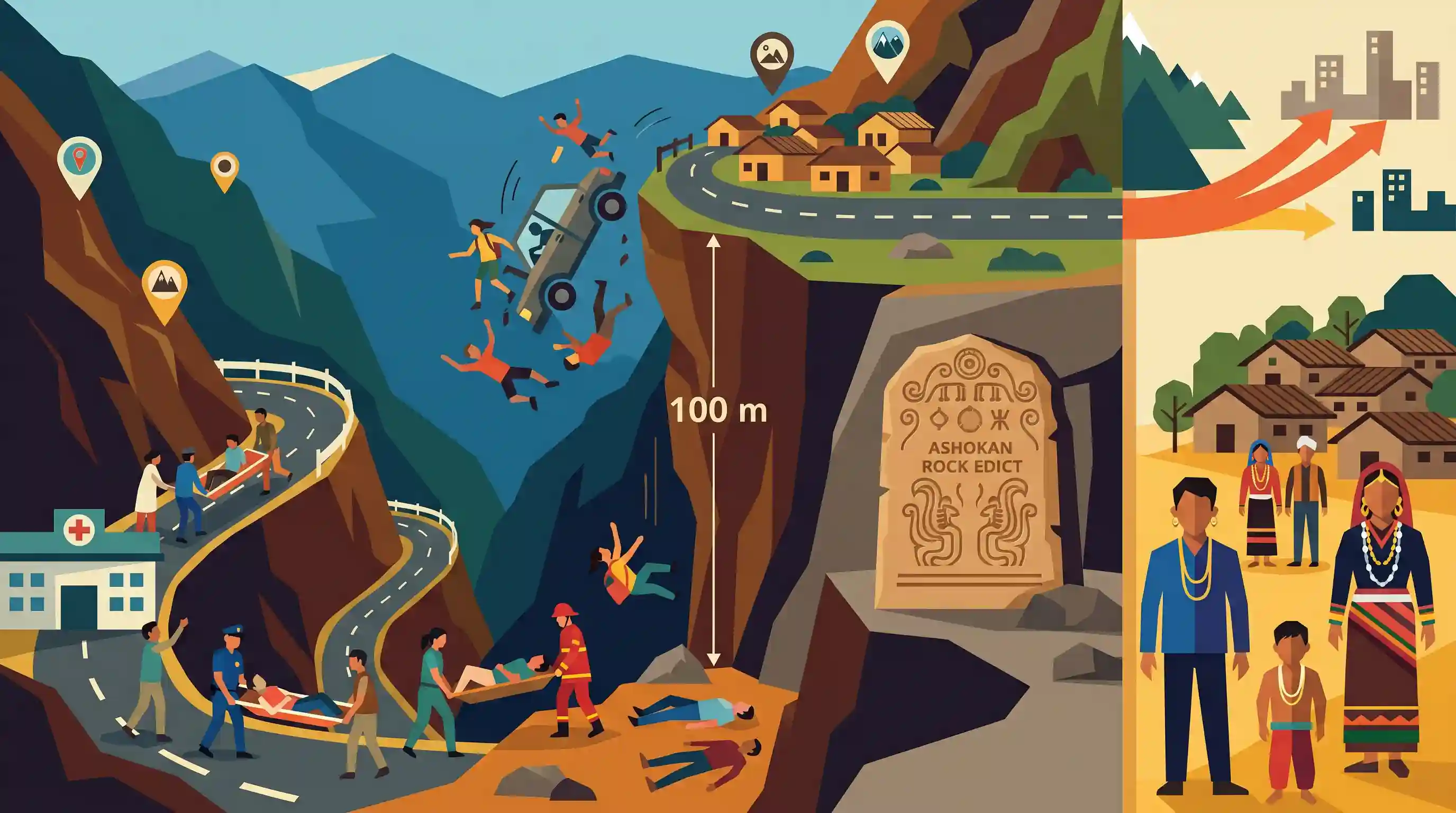
The accident location spans the historically and culturally significant Jaunsar-Bawar region. In UKPSC PCS Prelims, questions frequently arise regarding the demographics of Jaunsar-Bawar (such as the 1967 ST declaration of Jaunsaris), geographical elements like the Tons-Yamuna confluence at Kalsi (famous for Ashoka's rock edict written in Prakrit/Brahmi), and infrastructural challenges in mountainous areas.
Summary
A car carrying five tourists from Meerut and Bijnor, Uttar Pradesh, plunged 100 meters into a deep gorge near Kaletha village on the Sahiya-Kwanu road in Chakrata, Dehradun district. The accident on July 5, 2026, resulted in two fatalities and three serious injuries. A joint rescue operation by locals, Kalsi and Chakrata police, and the Dakpathar Fire Service successfully evacuated the victims to CHC Sahiya. This area of Dehradun district holds significant geographic, historical (Ashokan rock edicts at Kalsi), and cultural (Jaunsari tribal community of Jaunsar-Bawar) relevance for UKPSC Prelims.
Key Points
- On July 5, 2026, a tragic car accident occurred near Kaletha village on the Sahiya-Kwanu road in Chakrata, Dehradun district, Uttarakhand.
- A car carrying five tourists from Uttar Pradesh lost control and plunged 100 meters into a deep gorge, leading to two deaths and three serious injuries.
- A coordinated rescue operation was conducted by local residents, police from Kalsi and Chakrata, Tehsil officials, and the Dakpathar Fire Service unit.
- The injured were evacuated and initially treated at the Community Health Centre (CHC) in Sahiya, before being referred to a higher facility.
Important Terms
Kalsi Rock Edicts

A set of 14 Major Rock Edicts of Mauryan Emperor Ashoka (c. 250 BCE) located in Dehradun, Uttarakhand. Written in Brahmi script and Pali/Prakrit, it is the only major edict site in North India.
UPSC context
GS Paper I (Ancient History). Tests knowledge of Mauryan administration, Ashokan inscriptions, and the spread of Dhamma.
Jaunsari Tribe
A Scheduled Tribe native to the Jaunsar-Bawar region of Uttarakhand. They possess a distinct culture, worship Mahasu Devta, celebrate the Bissu festival, and are historically known for practicing fraternal polyandry.
UPSC context
GS Paper I (Indian Society/Anthropology) and GS II (Scheduled Tribes). Tests understanding of India's tribal diversity and distinct social customs.
Jaunsar-Bawar
A mountainous tribal valley region in Dehradun district, Uttarakhand, situated between the Tons and Yamuna rivers. It is ethnically divided into the lower Jaunsar and upper Bawar zones, home to the Jaunsari community.
UPSC context
GS Paper I (Geography of India) and UKPSC state exams. Tests knowledge of regional geographic landscapes and tribal habitats.
Special Frontier Force
A specialized paramilitary unit of India, established in 1962 following the Sino-Indian War. Operating under the Cabinet Secretariat, it is composed mainly of Tibetan refugees and is headquartered in Chakrata.
UPSC context
GS Paper III (Security Forces and Their Mandate). Tests knowledge of specialized defense units, border security, and historic conflicts.
Chakrata
A high-altitude cantonment town and sub-district in Dehradun, Uttarakhand. Established by the British in 1866, it is an access-restricted military area serving as the permanent base for the Special Frontier Force.
UPSC context
GS Paper III (Internal Security) and GS Paper I (Geography/Modern History). Tests knowledge of strategic military locations and security forces.
Prelims Trap
The Kalsi Rock Edicts were inscribed in Sanskrit using the Kharosthi script.
The Kalsi edicts are strictly in Prakrit language and Brahmi script, whereas Kharosthi was used in the northwestern frontiers like Shahbazgarhi.
Static Concepts Connected
What is the historical significance of the Kalsi Rock Edict?
- Unique Northern Edict: It is the only Major Rock Edict of Emperor Ashoka found in Northern India, containing all 14 Major Rock Edicts.
- Language and Script: It is written entirely in the Prakrit language using the Brahmi script.
- Distinct Iconography: Features an outline of an elephant inscribed with 'Gajatama' (Supreme Elephant) on its north face.
What are the geographical features of the Tons River?
- Yamuna Tributary: It is the largest perennial tributary of the Yamuna River, carrying twice the volume of the main stream at their confluence.
- Origin and Boundary: It originates from the Bandarpunch massif in Uttarakhand and forms part of the state border with Himachal Pradesh.
Cross-Topic Patterns
Mauryan Diplomacy and Hellenistic History
Ashoka's Major Rock Edict XIII links Mauryan administration to the Mediterranean, connecting ancient Indian epigraphy directly with Western classical history and early global trade networks.
Kath-Kuni Architecture and Disaster Resilience
The traditional timber-bonded masonry of Hanol temple showcases indigenous climate-resilient engineering, combining anthropological studies of the Jaunsari tribe with modern disaster-risk reduction frameworks.

A 2026 question could map Ashoka's major rock edicts to their corresponding river confluences and contemporary Greek rulers.
Linked PYQs · 2
Linked PYQs · 2
- 2025UKPSC_PRELIMSGS1
In which of the following year were the Jaunsari, Tharu, Bhotia, Buksa and Raji tribes declared Scheduled Tribes in Uttarakhand?
- 2025UKPSC_PRELIMSGS1
Consider the following statements with reference to the inscriptions of Ashoka : 1. Most of the inscriptions are in the Prakrit language and Brahmi script. 2. The inscriptions found at Mansehra and Shahbazgarhi are in the Prakrit language and Kharoshthi script. Select the correct answer from the code given below :
