Political Realignment in Bihar as Jan Suraaj Leaders Join BJP
Source:thehindu ↗
Why It Matters
The event highlights the dynamics of party switching, political realignment in Bihar, the technical scrutiny of nomination papers in state by-elections, and key figures shaping local assembly dynamics, which are frequent subjects in state public service commission exams.
Summary
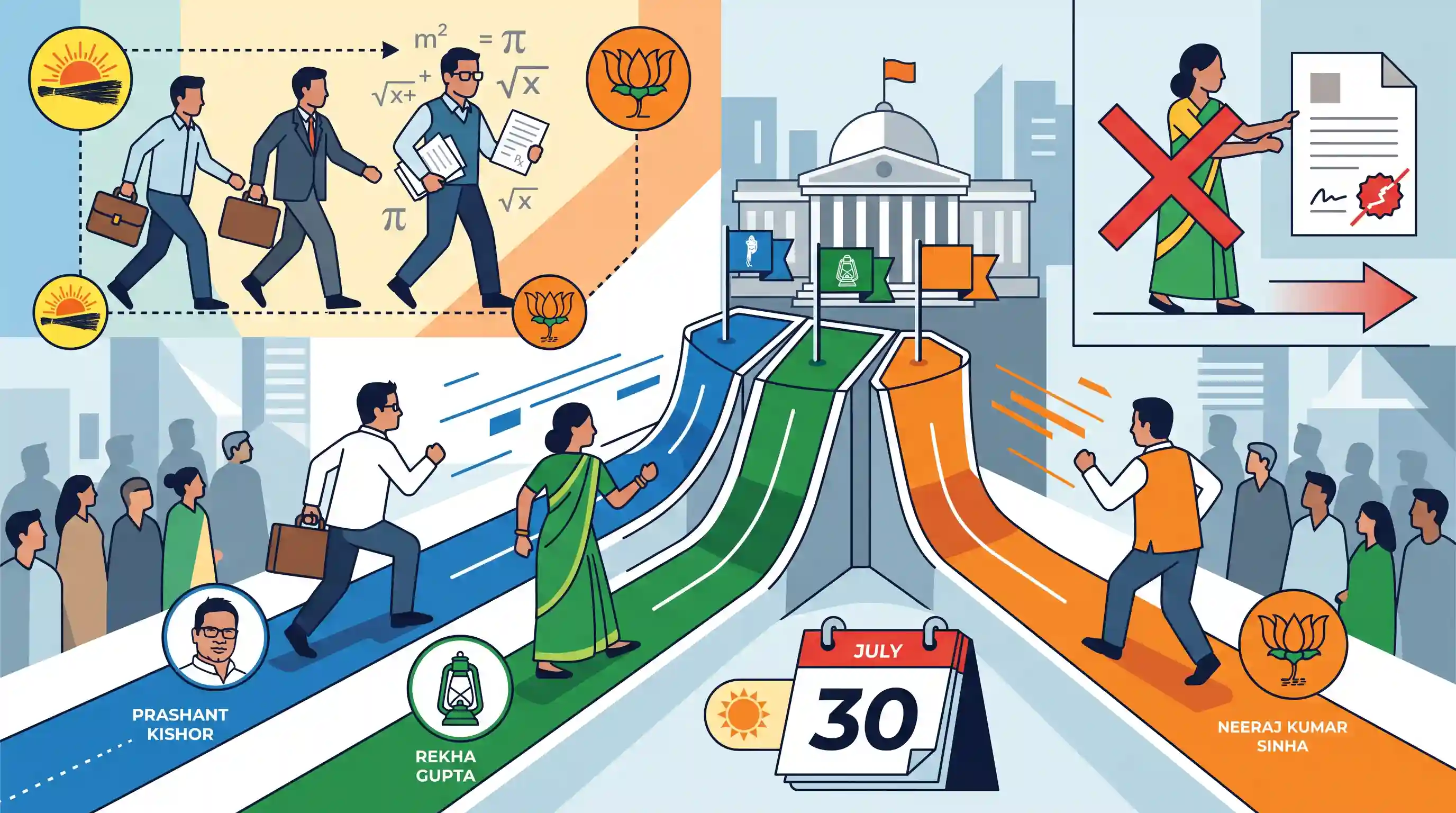
Three key Jan Suraaj leaders, including famed mathematician Prof. K.C. Sinha, defected to the BJP ahead of the upcoming Bankipur Assembly by-election scheduled for July 30, 2026. The high-stakes by-poll features a contest between JSP founder Prashant Kishor, RJD nominee Rekha Gupta, and BJP's Neeraj Kumar Sinha. Additionally, JJD candidate Veena Manvi was disqualified due to nomination defects.
Key Points
- Three prominent Jan Suraaj Party (JSP) leaders, who contested the 2025 Bihar Assembly elections from Kumhrar, Digha, and Maner, officially joined the Bharatiya Janata Party (BJP) ahead of the Bankipur Assembly by-election.
- The defectors include renowned academician and math textbook author Prof. K.C. Sinha, Ritesh Ranjan (Bittu Singh), and Sandip Kumar Singh (Gopal Singh).
- The Bankipur Assembly by-election is scheduled for July 30, 2026, featuring a critical contest between BJP nominee Neeraj Kumar Sinha, JSP founder Prashant Kishor, and RJD candidate Rekha Gupta.
- BJP nominee Neeraj Kumar Sinha was chosen after Abhishek Kumar 'Bunty' withdrew from the race due to internal family/party reasons.
- Janshakti Janata Dal (JJD) candidate Veena Manvi's nomination papers were rejected due to technical discrepancies; JJD was recently founded by RJD leader Tej Pratap Yadav.
Important Terms
Representation of the People Act, 1951

A parliamentary act in India that regulates the actual conduct of elections, qualifications, and disqualifications of candidates for Parliament and State Legislatures, corruption prevention, and election dispute resolutions.
UPSC context
GS Paper II: Elections & RPA. Tests knowledge of election regulations, candidate eligibility, and the legal framework for democratic processes.
Jan Suraaj Party (JSP)
A political party in Bihar founded by political strategist-turned-politician Prashant Kishor, focusing on grassroots campaigns, local governance, and challenging traditional political coalitions in Bihar.
UPSC context
GS Paper II: Political Parties. Tests the dynamics of newly emerging regional parties and grassroots mobilization strategies in state legislative elections.
Rashtriya Janata Dal (RJD)
A major regional political party in Bihar, India, founded by Lalu Prasad Yadav, built on socialist principles, representing secularism and social justice interests.
UPSC context
GS Paper II: Regional Parties. Tests regional political dynamics, electoral coalitions, and the role of regional interests in Indian federalism.
Bharatiya Janata Party (BJP)
A major national political party in India, practicing right-wing politics with an ideology centered on Hindutva (cultural nationalism) and rapid socio-economic development.
UPSC context
GS Paper II: Political Parties. Tests the structure of national political parties, their ideological impacts, and governance models.
Janshakti Janata Dal (JJD)
A minor state-level political party in Bihar associated with Tej Pratap Yadav, active in state elections and representing localized political factions.
UPSC context
GS Paper II: State Legislature. Illustrates factional politics, regional party fragmentation, and the entry of minor parties in state elections.
Prelims Trap
The Tenth Schedule applies to any party leader or prospective candidate who defects to another political party before an election.
The Anti-Defection Law (10th Schedule) only penalizes elected or nominated legislators. Un-elected party leaders, candidates, or ticket-seekers face no disqualification for changing parties before winning.
Static Concepts Connected
What are the statutory rules governing the conduct and timing of by-elections?
- Six-Month Mandate: Under Section 151A of the RPA 1951, the ECI must fill legislative vacancies within six months.
- Term Exception: The rule is waived if the remainder of the assembly or parliamentary term is less than one year.
- Difficulty Certification: Waived if ECI and Centre certify that holding the election within six months is extremely difficult.
On what grounds can a Returning Officer reject a candidate's nomination?
- Substantial Defect: Section 36 of RPA 1951 empowers the Returning Officer to reject papers for defects of a substantial character.
- Blank Columns: Leaving any mandatory column blank in the nomination affidavit (Form 26) constitutes ground for summary rejection.
- Oath Omission: Failure to make and subscribe the prescribed oath/affirmation before the authorized officer before the scrutiny date.
Cross-Topic Patterns
Judicial overwatch + ECI autonomy
How judicial rulings like Resurgence India (2013) legally expand the summary rejection powers of the ECI's Returning Officers, bridging the gap between Article 324 and statutory RPA provisions.
Pre-poll defections + RPA reforms
The lack of legal restrictions on pre-poll defections highlights legislative gaps in the Representation of the People Act, often cited during Law Commission recommendations on party regulation.

The exact conditions under Section 151A RPA 1951 for bypassing the six-month by-election mandate will likely be tested in 2026 prelims.
Linked PYQs · 3
Linked PYQs · 3
- 2022BPSC_PRELIMSGS1
How many seats are reserved for the SC candidates in the Bihar Legislative Assembly?
- 2020BPSC_PRELIMSGS1
Which Article in the Indian Constitution is related with the establishment of the Election Commission of India?
- 2024-EBPSC_PRELIMSGS1
Shreyasi Singh, Member of the Legislative Assembly, who has represented India in shooting in Paris Olympics 2024 was elected from which constituency in Bihar?
