Hydro tunnel floodwater surge causes casualties in Chamoli district
Source:The Hindu ↗
Why It Matters
The repeated occurrence of tunnel collapses and industrial accidents in Uttarakhand emphasizes the ecological fragility of the Himalayan region. It underscores the urgent need for stringent environmental impact assessments, real-time geological monitoring, and strict enforcement of worker safety protocols in mega-infrastructure projects.
Summary
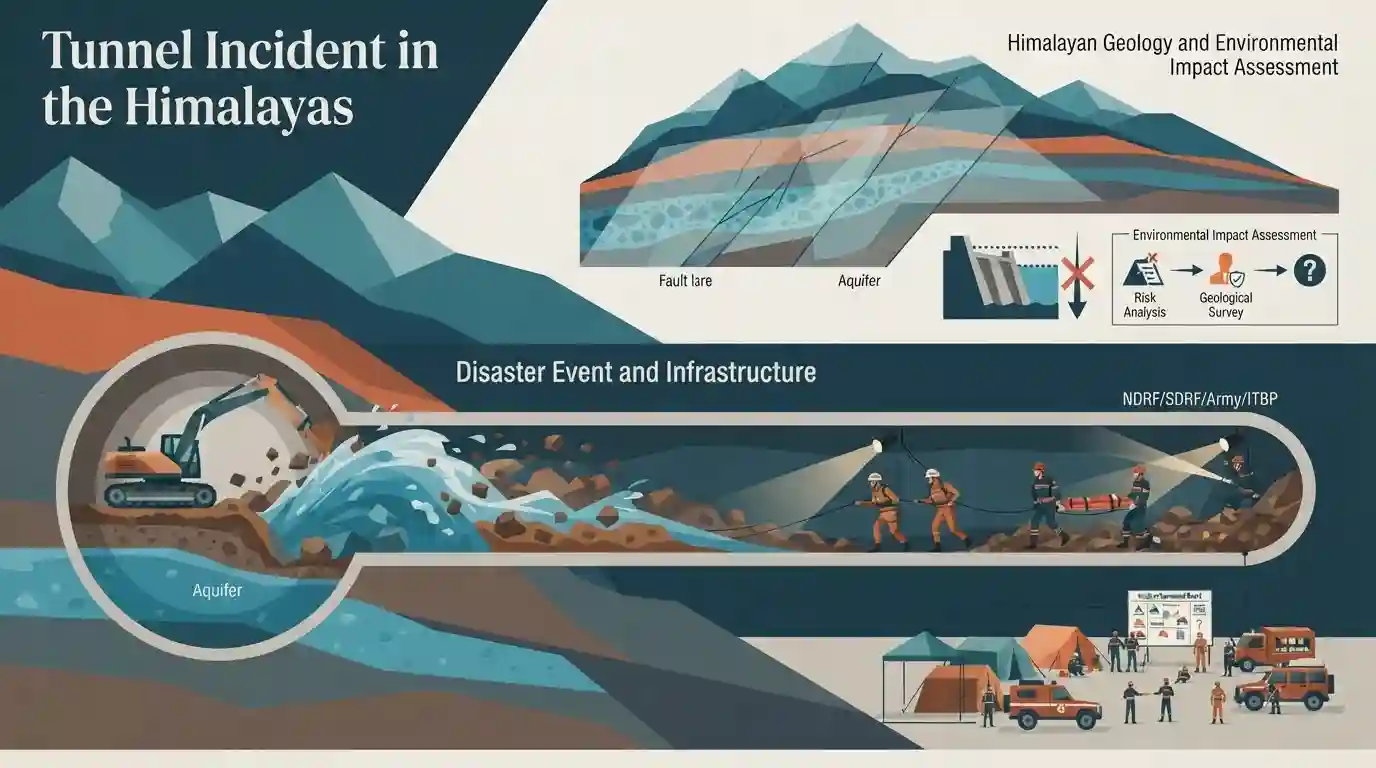
Seven workers died and several others remain missing following a massive floodwater and debris surge in an under-construction hydro tunnel in Uttarakhand's Chamoli district. The tunnel, part of a THDC India Limited project being built by Hindustan Construction Company (HCC) in Pipalkoti, experienced a sudden ingress of groundwater when an aquifer was breached during mucking operations. Multiple agencies, including the NDRF, SDRF, Army, and ITBP, have launched search and rescue missions. The incident highlights ongoing concerns about worker safety and the environmental viability of major infrastructure projects in the geologically fragile Himalayas, echoing recent disasters like the Silkyara tunnel collapse.
Key Points
- A severe floodwater and debris surge in an under-construction hydro tunnel in Chamoli district's Pipalkoti area left at least 7 workers dead and 3 missing.
- The tunnel is part of a hydroelectric project commissioned by state-owned THDC India Limited and constructed by Hindustan Construction Company (HCC).
- The accident occurred during mucking operations when workers breached a pressurized aquifer, leading to a sudden, uncontrollable ingress of mud and groundwater.
- A joint rescue operation is being spearheaded by disaster response agencies, including the SDRF, NDRF, ITBP, CISF, and the Army.
- The tragedy renews critical questions regarding worker safety, environmental impact assessments, and the sustainability of large-scale infrastructure projects in the geologically fragile Himalayan region.
Important Terms
National Disaster Response Force (NDRF)

India's specialized, central disaster response force constituted under the Disaster Management Act, 2005. Drawing personnel from various CAPFs, it provides rapid, expert assistance during severe natural and man-made disasters, supporting state administrations.
UPSC context
GS-3 (Disaster Management). Crucial for questions on India's institutional disaster response framework, statutory mandates, and multi-agency crisis coordination.
State Disaster Response Force (SDRF)
State-level specialized emergency response forces established within the Disaster Management Act framework. Funded by the State Disaster Response Fund, they act as primary responders for localized disasters, operating alongside the central NDRF.
UPSC context
GS-2 (Federalism) & GS-3 (Disaster Management). Tests knowledge of decentralized emergency frameworks, centre-state financial coordination, and localized relief efforts.
Indo-Tibetan Border Police (ITBP)
A Central Armed Police Force raised in 1962 to secure the India-China border. Specialized in mountain operations, these troops also serve as crucial first responders to high-altitude Himalayan disasters, conducting search and rescue.
UPSC context
GS-3 (Internal Security & Disaster Management). Tests understanding of border guarding forces and their overlapping roles in national security and calamity response.
THDC India Limited
A leading Mini Ratna public sector enterprise under the Ministry of Power. It develops and operates hydro, thermal, and renewable energy projects to enhance India's power capacity while navigating the ecologically sensitive Himalayan terrain.
UPSC context
GS-3 (Infrastructure/Energy). It tests knowledge of PSU roles in energy generation and the environmental challenges of Himalayan hydropower projects.
Prelims Trap
Run-of-the-river hydroelectric projects require no dams or tunneling and have zero impact on natural river ecology.
RoR projects still require small barrages and extensive underground tunneling through fragile geology, which heavily disrupts local water tables, aquifers, and river ecology.
Static Concepts Connected
What makes the Lesser Himalayas highly vulnerable to tunneling disasters?
- Tectonic boundaries: The region is bound by the Main Central Thrust (MCT) and Main Boundary Thrust (MBT), creating high tectonic stress and seismic activity.
- Shear zones: Rock formations are highly fractured and crushed, making tunnel roof collapses and unexpected geotechnical failures very common.
- Aquifer breaches: Tunneling frequently intercepts perched water tables and pressurized aquifers, leading to sudden, violent ingress of mud and groundwater.
What is the geographical sequence of the 'Panch Prayags' on the Alaknanda River?
- Vishnuprayag: The first confluence where the Alaknanda River meets the Dhauliganga River in the Chamoli district.
- Nandaprayag & Karnaprayag: Proceeding downstream, the Alaknanda meets the Nandakini at Nandaprayag, and then the Pindar River at Karnaprayag.
- Rudraprayag & Devprayag: The Alaknanda meets the Mandakini at Rudraprayag, and finally joins the Bhagirathi at Devprayag to form the Ganga.
Cross-Topic Patterns
Carrying Capacity vs. Energy Corridors
The Supreme Court's push for carrying capacity assessments in 13 Himalayan states directly clashes with the rapid expansion of run-of-the-river (RoR) energy corridors and border infrastructure.
Underground Rescue & NDMA Framework
Frequent tunnel collapses (Silkyara, Chamoli) test the Disaster Management Act 2005's framework, highlighting the overlapping mandates of SDRF, NDRF, and the armed forces during complex underground rescue operations.

Expect a 2026 multi-statement Prelims question linking Run-of-the-River project mechanics with the tectonic thrusts (MCT/MBT) of the Himalayas.
Linked PYQs · 4
Linked PYQs · 4
- 2016UKPSC_PRELIMSGS1
The biggest Hydro-Electric Project of Uttarakhand State is:
- 2024UKPSC_PRELIMSGS1
Match the hydroelectric projects with the river on which they are constructed : | Name of Project | River | |---|---| | A. Koteshwar | 1. Asan | | B. Kulhal | 2. Alaknanda | | C. Tapoban Vishnugad | 3. Bhagirathi | | D. Vishnuprayag | 4. Dhalui | A B C D
- 2025UKPSC_PRELIMSGS1
Consider the following statements and select the correct answer from the options given below : Statement 1 : Uttarakhand is highly vulnerable to climate change. Statement 2 : Climate change is causing water stress and depleting biodiversity in Uttarakhand.
- 2025UKPSC_PRELIMSGS1
Which of the following parts of Himalaya is situated between Main Boundary Thrust and Main Central Thrust ?
