Rajasthan Oxytocin Tragedy Triggers CDSCO Crackdown and WHO Inquiry
Source:the-shillong-times ↗
Why It Matters
This incident underscores critical weaknesses in the pharmaceutical regulatory framework (CDSCO) and drug safety in maternal healthcare. It is highly relevant to RAS Prelims because Oxytocin is a key biological topic (endocrine glands) and maternal welfare schemes (like JSY and PMMVY) are frequently tested.
Summary
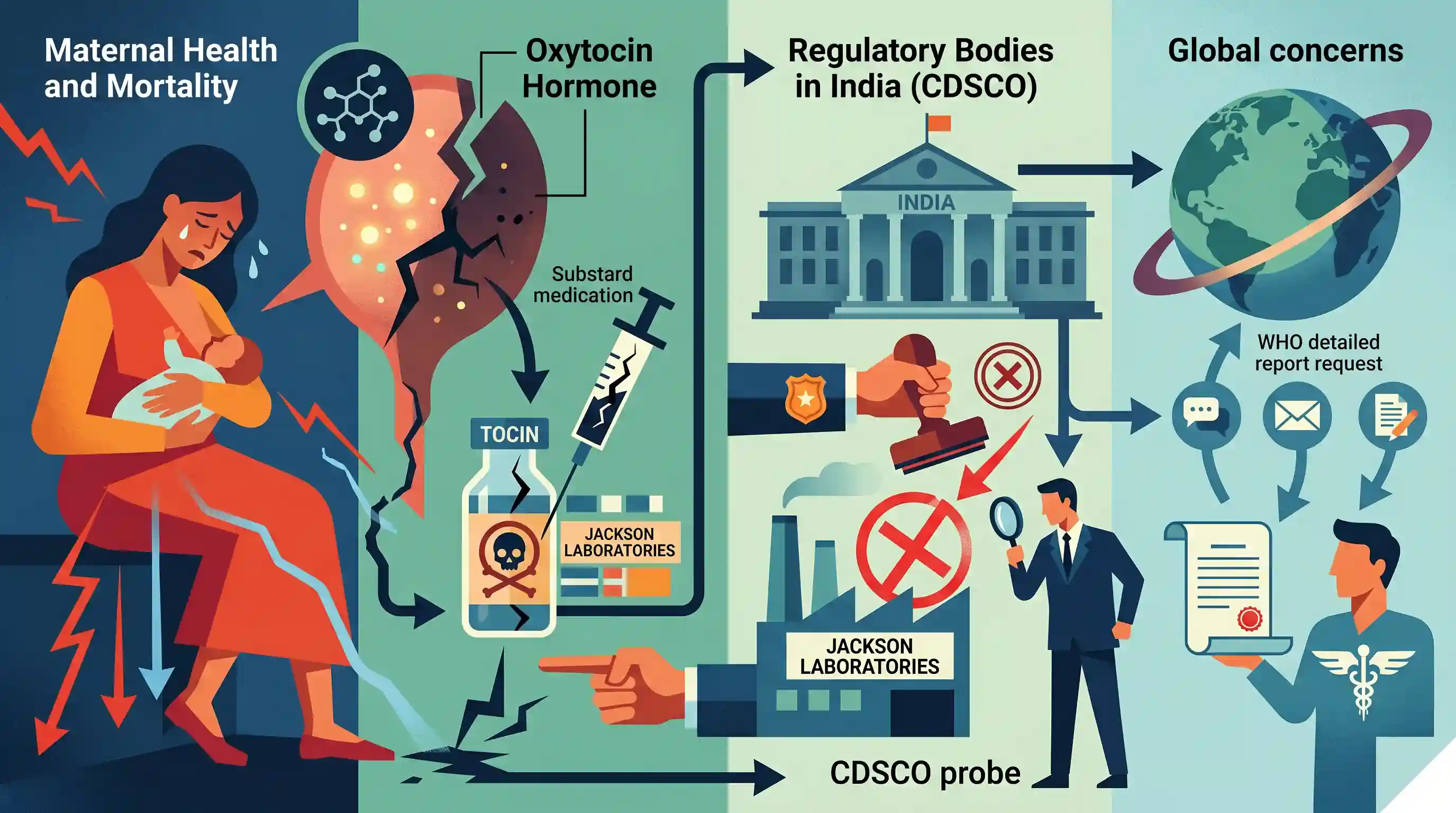
Seven maternal deaths in Rajasthan's Kota and Bikaner government hospitals were linked to substandard Oxytocin injections ('TOCIN') manufactured by Amritsar-based Jackson Laboratories. This triggered a national regulatory crackdown, resulting in the cancellation of the manufacturer's licence by the Union Health Ministry following a CDSCO probe. The WHO has requested a detailed report, underlining global concerns over the quality of Oxytocin, which is the primary drug used to prevent life-threatening postpartum hemorrhage (PPH) in mothers.
Key Points
- In May-June 2026, seven post-delivery maternal deaths occurred across government hospitals in Kota (New Medical Hospital, J.K. Lon Hospital) and Bikaner (PBM Hospital) in Rajasthan.
- The deaths were linked to sub-standard Oxytocin injections (brand name 'TOCIN') manufactured by Amritsar-based M/s Jackson Laboratories Private Limited, which failed to meet quality standards in active ingredient tests.
- Following investigations by the Central Drugs Standard Control Organisation (CDSCO) and Rajasthan Drug Control Department, the Union Health Ministry cancelled the drug manufacturing licence of Jackson Laboratories.
- The World Health Organisation (WHO) has sought a detailed report from India, highlighting global concerns over substandard maternal healthcare drugs. Oxytocin is a critical first-line drug used globally to manage and prevent postpartum hemorrhage (PPH).
- Oxytocin is a crucial peptide hormone synthesized in the hypothalamus and released by the posterior pituitary gland (neurohypophysis) that stimulates uterine contractions during childbirth and milk ejection during breastfeeding.
Important Terms
Central Drugs Standard Control Organisation (CDSCO)

India's national regulatory authority for pharmaceuticals, cosmetics, and medical devices. Operating under the Ministry of Health, it regulates drug imports, approves new medicines, and conducts clinical trials under the Drugs and Cosmetics Act, 1940.
UPSC context
GS Paper II (Regulatory Bodies, Health Sector). Tests regulatory architecture, drug safety protocols, and governance of the healthcare ecosystem.
Drugs and Cosmetics Act, 1940
The primary legislative framework in India governing the import, manufacture, distribution, and sale of drugs and cosmetics. It aims to ensure that medicines available to the public are safe, effective, and comply with state quality standards.
UPSC context
GS Paper II (Government Policies and Interventions). Tests comprehension of legal structures protecting consumer health and regulating pharmaceutical safety standards.
Oxytocin
An essential hormone and uterotonic drug critical during labor. It stimulates uterine contractions and serves as the primary medical intervention to prevent and manage life-threatening postpartum hemorrhage during childbirth.
UPSC context
GS Paper III (Science and Technology, Biology) & GS II (Health). Tests knowledge of critical reproductive medicine, chemical biology, and healthcare challenges.
Postpartum Hemorrhage (PPH)
A severe obstetric complication defined as blood loss of 500 ml or more within 24 hours of childbirth. It is the leading cause of maternal mortality in India, requiring rapid administration of uterotonic drugs like oxytocin.
UPSC context
GS Paper II (Issues Related to Health, Women). Tests understanding of maternal healthcare, public health metrics, and emergency medical systems.
Janani Suraksha Yojana (JSY)
A 100% centrally sponsored safe motherhood initiative under the National Health Mission. It provides cash assistance to poor pregnant women to promote institutional deliveries, successfully reducing maternal and neonatal mortality across India.
UPSC context
GS Paper II (Welfare Schemes). Tests awareness of maternal safety nets, institutional delivery indicators, and rural health infrastructure.
Pradhan Mantri Matru Vandana Yojana (PMMVY)
A centrally sponsored maternity benefit scheme offering direct cash incentives of ₹5,000 to pregnant and lactating mothers for their first childbirth. It aims to encourage nutrition, promote healthcare-seeking behavior, and partially compensate for wage loss.
UPSC context
GS Paper II (Welfare Schemes, Social Justice). Tests knowledge of maternal nutrition schemes, direct benefit transfers, and gender development indicators.
Prelims Trap
Oxytocin is synthesized and secreted by the posterior pituitary gland.
UPSC loves site-of-synthesis vs. site-of-release traps. Oxytocin is synthesized in the hypothalamus but stored and released by the posterior pituitary.
Static Concepts Connected
How does Oxytocin function in the human endocrine system?
- Synthesis source: Produced in the hypothalamus, not the pituitary gland where it is merely stored and released.
- Physiological triggers: Causes uterine smooth muscle contraction during labor and assists milk ejection during lactation via positive feedback.
- Uterotonic utility: Prevents postpartum hemorrhage (PPH) clinically by contracting uterine blood vessels post-delivery.
How is drug regulation structured under the Drugs and Cosmetics Act, 1940?
- CDSCO mandate: Acts as the central authority approving clinical trials, new drugs, and setting standards nationwide.
- State jurisdiction: Responsible for licensing drug manufacturing, distribution, and local quality enforcement through state drug inspectors.
- Statutory advisory: The Drug Technical Advisory Board (DTAB) advises central and state governments on technical regulatory amendments.
Cross-Topic Patterns
Dual Drug Regulation & Federal Gaps
Split licensing between CDSCO and State Drug Controllers often creates enforcement gaps, directly impacting maternal healthcare safety nets in rural public hospitals.
SDG 3.1 & Healthcare Supply Chains
India's drive to reduce its Maternal Mortality Ratio (MMR) relies heavily on the uninterrupted supply of quality-assured, low-cost uterotonics like synthetic Oxytocin.

CDSCO vs State licensing jurisdiction and the synthesis/storage mechanics of Oxytocin are highly likely to be tested together in 2026.
Linked PYQs · 2
Linked PYQs · 2
- 2007RPSC_PRELIMSGS1
Which gland secretes the milk ejection hormone oxytocin?
- 2023RPSC_PRELIMSGS1
Which scheme aims to improve the health and nutritional status of pregnant women and lactating mothers and their infants (0 to 6 months) by promoting the use of appropriate practices, care, and services during pregnancy, safe delivery, and breastfeeding?
