Pipalkoti Hydroelectric Project Tunnel Disaster and Casualties
Source:garhwalpost ↗
Why It Matters
The recurring incidents of tunnel collapses and land subsidence critically highlight the conflict between infrastructure development (hydroelectric projects) and environmental conservation in the fragile Himalayan terrain, a core focus area for UKPSC's geography and disaster management syllabus.
Summary
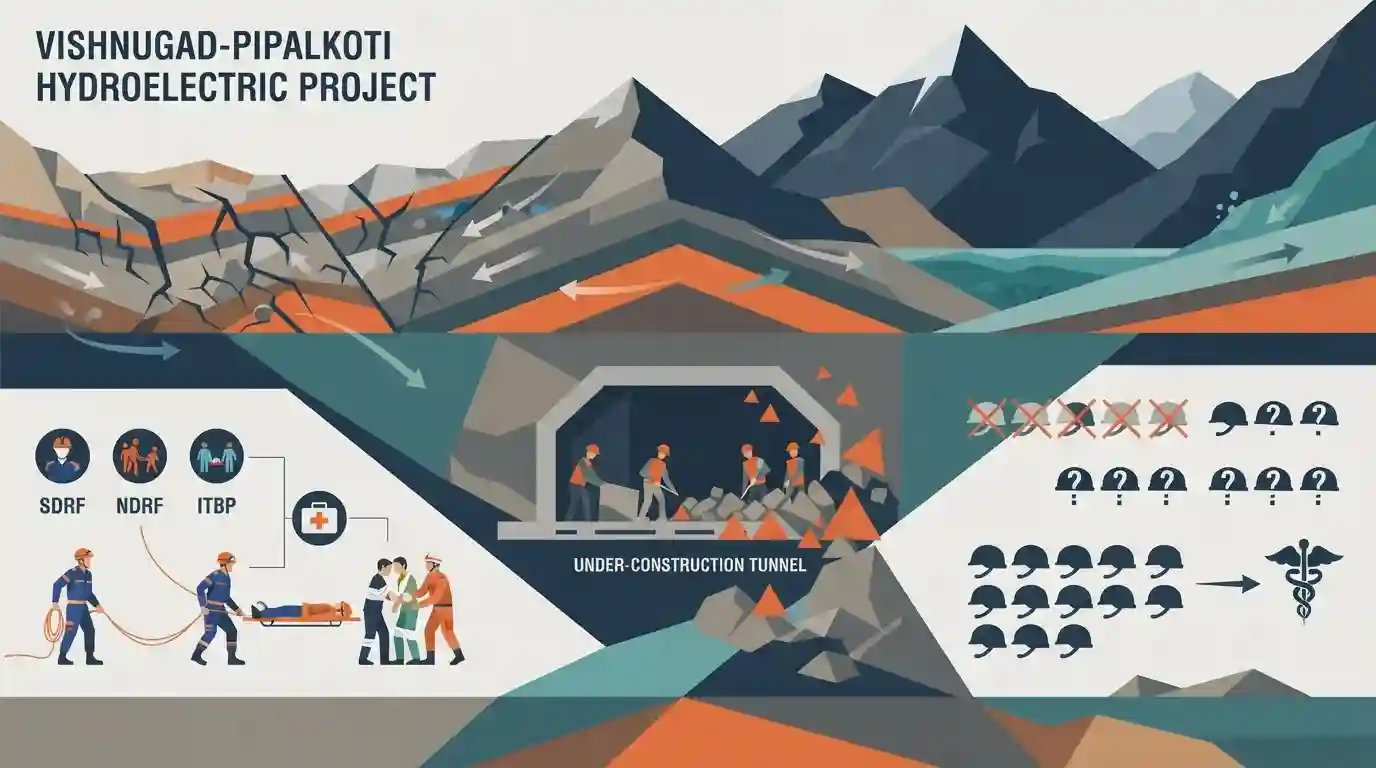
A tragic subsidence incident at the under-construction tunnel of the THDC Vishnugad-Pipalkoti Hydroelectric Project in Chamoli district resulted in the deaths of seven workers, with three still missing and 12 rescued with injuries. The disaster prompted immediate multi-agency rescue operations by the SDRF, NDRF, and ITBP amidst the challenging terrain. This event underscores the geological vulnerabilities and infrastructural risks prevalent in the fragile Himalayan ecology of Uttarakhand.
Key Points
- A severe subsidence event at the under-construction TRT tunnel of THDC's Vishnugad-Pipalkoti Hydroelectric Project in Chamoli trapped 22 workers after debris and water flooded the area.
- Multi-agency rescue operations comprising SDRF, NDRF, and ITBP were deployed, rescuing 12 injured individuals, while 7 casualties were confirmed and 3 remain missing.
- The incident highlights the acute geological fragility of the Himalayan region and the persistent risks associated with large-scale infrastructural and hydroelectric developments in Uttarakhand.
Important Terms
Vishnugad-Pipalkoti Hydroelectric Project

A 444-MW run-of-river hydropower project on the Alaknanda River in Chamoli district. Developed by THDC with World Bank funding, it aims to provide peaking power to the Northern Grid but faces geological vulnerabilities.
UPSC context
Important for UKPSC General Studies (Geography/Environment) testing knowledge of Uttarakhand's hydropower projects, river systems, and developmental impacts on Himalayan ecology.
THDC India Limited
A Mini Ratna PSU under the Ministry of Power (now under NTPC) originally formed to develop the Tehri Hydro Power Complex. It manages various energy projects, including the Vishnugad-Pipalkoti tunnel in Uttarakhand.
UPSC context
Relevant for UKPSC topics on public sector undertakings, state infrastructure, and energy sector development within Uttarakhand.
State Disaster Response Force (SDRF) Uttarakhand
A specialized search and rescue wing of the Uttarakhand Police formed in 2014. It conducts immediate relief operations during natural disasters, mountain rescues, and disaster-preparedness campaigns across the vulnerable state.
UPSC context
Highly relevant for UKPSC Disaster Management questions, as the state relies heavily on SDRF for managing its frequent Himalayan flash floods and landslides.
State Emergency Operation Centre (SEOC)
The 24x7 state-level monitoring and coordination hub in Dehradun. It processes meteorological warnings, manages emergency communications, and directs multi-agency rescue operations with local District Emergency Operation Centres.
UPSC context
Crucial for UKPSC Disaster Management modules, testing the institutional framework and state-level administrative response to crises in Uttarakhand.
Prelims Trap
"The Vishnugad-Pipalkoti is a major storage-based hydroelectric project on the Bhagirathi river."
Aspirants often confuse Tehri (Bhagirathi, reservoir) with Vishnugad-Pipalkoti, which is actually a run-of-the-river project located on the Alaknanda river in Chamoli.
Static Concepts Connected
What is the origin and flow-profile of the Alaknanda River?
- Glacial Origin: Originates at the confluence of the Satopanth and Bhagirath Kharak glaciers, located above Badrinath in Chamoli district.
- Panch Prayag System: Forms critical confluences (Panch Prayag) with Dhauliganga, Nandakini, Pindar, and Mandakini before merging with the Bhagirathi at Devprayag to form the Ganga.
- Hydel Potential: Hosts major run-of-the-river projects including Vishnuprayag, Tapovan Vishnugad, Vishnugad-Pipalkoti, and Srinagar Hydroelectric Projects.
What is the institutional framework for disaster response in Uttarakhand?
- SEOC Role: Acts as the nodal command center that coordinates multi-agency rescue efforts (SDRF, NDRF, ITBP, Army) during regional calamities.
- Geological Vulnerability: Because Uttarakhand falls in Seismic Zones IV and V, SDRF is specialized as the first-responder for mountain-specific infrastructural collapses and landslides.
Cross-Topic Patterns
Joshimath Subsidence & Hydro Projects
This disaster echoes the recent Joshimath land subsidence crisis, raising critical Mains questions on the carrying capacity of the Main Central Thrust (MCT) zone against heavy tunnel-boring infrastructure.
World Bank & Climate Finance
VPHEP receives major World Bank funding. This highlights the recurring paradox of using global climate finance for 'green' run-of-the-river hydro energy in geologically hyper-fragile Himalayan zones.

Expect a 'Match the following' question pairing major Uttarakhand hydro projects (VPHEP, Tapovan, Srinagar) with their rivers.
Linked PYQs · 3
Linked PYQs · 3
- 2024UKPSC_PRELIMSGS1
Match the hydroelectric projects with the river on which they are constructed : | Name of Project | River | |---|---| | A. Koteshwar | 1. Asan | | B. Kulhal | 2. Alaknanda | | C. Tapoban Vishnugad | 3. Bhagirathi | | D. Vishnuprayag | 4. Dhalui | A B C D
- 2016UKPSC_PRELIMSGS1
The biggest Hydro-Electric Project of Uttarakhand State is:
- 2012UKPSC_PRELIMSGS1
Which are called 'Duns' in Uttarakhand?
