Bus accident casualties rise as monsoon damages transport networks
Source:republicworld ↗
Why It Matters
This event underscores the high vulnerability of Himachal Pradesh's mountainous terrain to monsoon-induced disasters. It provides crucial context for HPAS Geography and Disaster Management topics, illustrating the severe human and economic costs of extreme weather events, and the critical role of agencies like the NDRF and state departments (PWD, Jal Shakti) in mitigation and response.
Summary
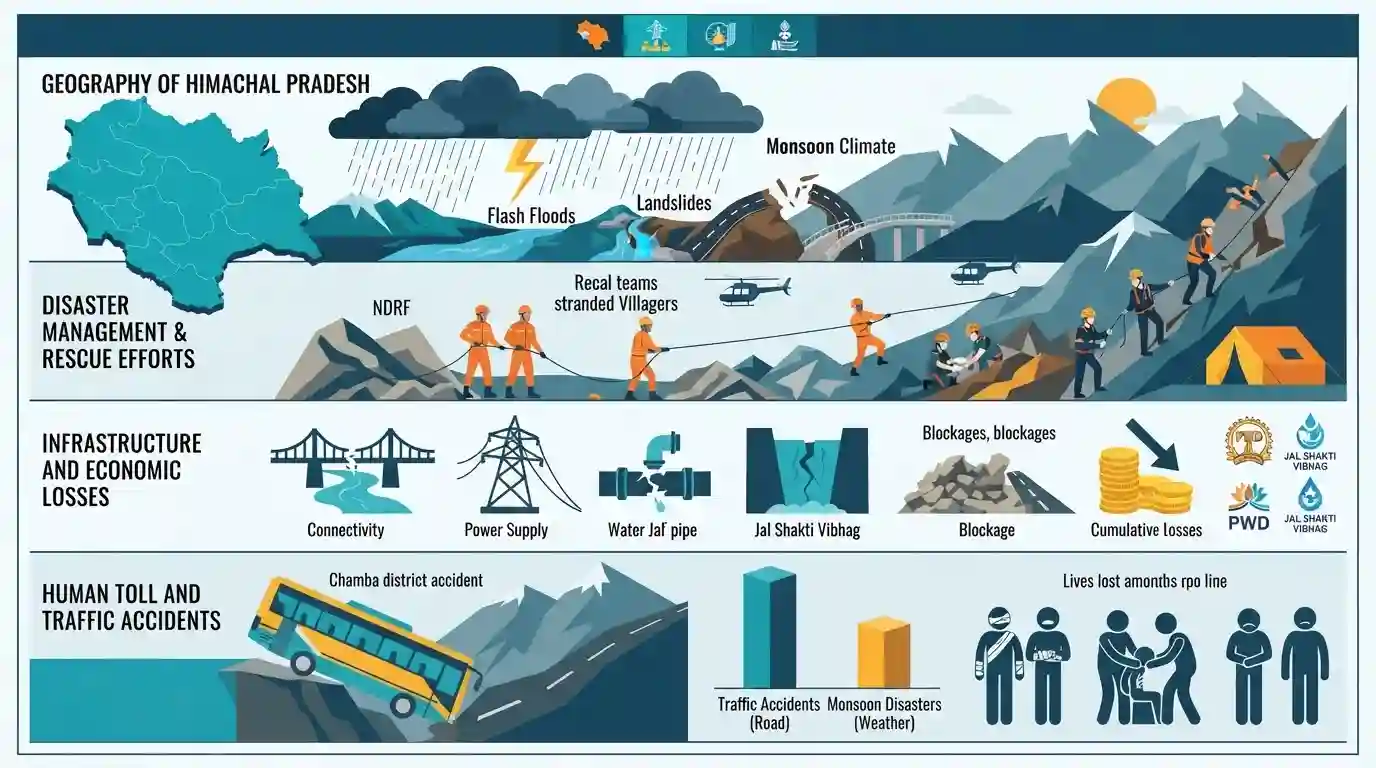
Heavy monsoon rains have triggered severe landslides, flash floods, and infrastructure collapse across Himachal Pradesh. A private bus accident in Chamba district killed 7 people and injured 11, adding to a rising death toll that currently stands at 65 from monsoon disasters and 78 from traffic accidents. The state has faced immense geographical and economic stress with 185 roads blocked and numerous power and water supply schemes disrupted. Cumulative financial losses are estimated at over Rs 834 crore, heavily hitting the PWD and Jal Shakti Vibhag. Rescue efforts by local authorities and the NDRF are ongoing, reflecting the urgent need for robust disaster management in the state's vulnerable terrain.
Key Points
- A tragic bus accident in Chamba district, Himachal Pradesh, claimed 7 lives and injured 11 when a private bus fell into a gorge near Teesa.
- Monsoon-induced disasters have severely disrupted life across the state, causing landslides, flash floods, and blocking 185 roads, particularly in Mandi, Kullu, Chamba, and Shimla districts.
- Infrastructure has suffered massive damage, with cumulative losses crossing Rs 834.67 crore, heavily impacting the Public Works Department (PWD) and Jal Shakti Vibhag.
- Rescue and relief operations involved multi-agency coordination, including the NDRF, State Police, Home Guards, Fire Services, and locals.
- Total monsoon-related deaths in the state since June 27 have reached 65, alongside 78 traffic fatalities, highlighting the region's vulnerability to extreme weather.
Important Terms
National Disaster Response Force (NDRF)

A specialized paramilitary force under the NDMA, established by the Disaster Management Act of 2005, responsible for skilled response to natural and man-made disasters, including search and rescue operations.
UPSC context
GS-3 Disaster Management. Tests knowledge of India's institutional framework for disaster response and mitigation.
State Emergency Operation Centre (SEOC)
A central command facility operating at the state level that monitors, communicates, and coordinates disaster relief efforts, tracking real-time disruptions like road closures and utility failures to direct emergency responses.
UPSC context
GS-3 Disaster Management. Highlights decentralised institutional frameworks for emergency response and real-time crisis coordination.
Public Works Department (PWD)
A state government body responsible for designing, building, and maintaining public infrastructure such as roads, bridges, and government buildings, playing a crucial role in disaster recovery by restoring vital connectivity.
UPSC context
GS-3 Infrastructure & Disaster Management. Tests understanding of state infrastructure resilience and post-disaster rehabilitation mechanisms.
Jal Shakti Vibhag
A dedicated Himachal Pradesh state department overseeing drinking water supply, sewerage, irrigation, and flood protection infrastructure, vital for managing regional water resources and restoring utility schemes during monsoon disasters.
UPSC context
GS-2 Governance & GS-3 Water Resources. Assesses awareness of state-specific institutional machinery for resource management.
Prelims Trap
"The NDRF is a specialized military force operating under the direct control of the Ministry of Defence during national disasters."
The NDRF is a specialized statutory force constituted under the Disaster Management Act, 2005. It functions under the Ministry of Home Affairs, not the Ministry of Defence.
Static Concepts Connected
What makes the Himalayan region highly vulnerable to frequent landslides and flash floods?
- Tectonic instability: As young fold mountains, the Himalayas are seismically active, causing continuous rock fracturing that weakens slope stability.
- Steep geomorphology: High-gradient slopes accelerate surface water runoff and gravity-driven mass wasting during heavy monsoon precipitation.
- Unscientific development: Deforestation, haphazard road-cutting, and dam construction alter natural drainage and destabilize fragile mountain ecosystems.
What is the statutory institutional framework for disaster management in India?
- NDMA: The National Disaster Management Authority, headed by the Prime Minister, is the apex statutory body for disaster policy and planning.
- SDMA and DDMA: State and District authorities are headed by Chief Ministers and District Magistrates respectively, responsible for executing localized disaster response plans.
- NDRF: A specialized response force constituted under the DM Act 2005, functioning under the Ministry of Home Affairs for threatening disaster situations.
Cross-Topic Patterns
Hill station carrying capacity
Recurrent Himalayan infrastructure collapse links directly to GS-1 urbanization themes, highlighting the urgent need for statutory carrying-capacity assessments before approving mass tourism and development projects.
Hydro-projects vs. geomorphology
The state's heavy reliance on run-of-river hydroelectric projects alters natural drainage channels, creating a compounding effect where monsoon flash floods cause disproportionate downstream damage.

Expect a multi-statement Prelims question testing the statutory mandate of NDRF/NDMA alongside the geomorphological traits of the Himalayas.
Linked PYQs · 3
Linked PYQs · 3
- 2024HPAS_PRELIMSGS1
Arrange the following climatic zones of Himachal Pradesh according to rainfall amount from lowest to highest : (1) Frigid aridic zone (2) Wet temperate zone (3) Humid sub-tropical zone (4) Sub-humid sub-tropical zone Choose the correct answer from the options given below :
- 2023HPAS_PRELIMSGS1
Consider the following statements : (1) The rainiest district in Himachal Pradesh is Kangra. (2) Rainfall in the Alpine region of Himachal Pradesh varies between 300-600 mm. (3) Winter season in Himachal Pradesh extends from October to March. (4) Mandi is the hottest place in Himachal Pradesh. Choose the correct answer from the options given below :
- 2025HPAS_PRELIMSGS1
When was the National Centre for Disaster Management established in India ?
