Fatal methanol poisoning reported from spurious liquor in Bhavnagar
Source:thedrinksbusiness ↗
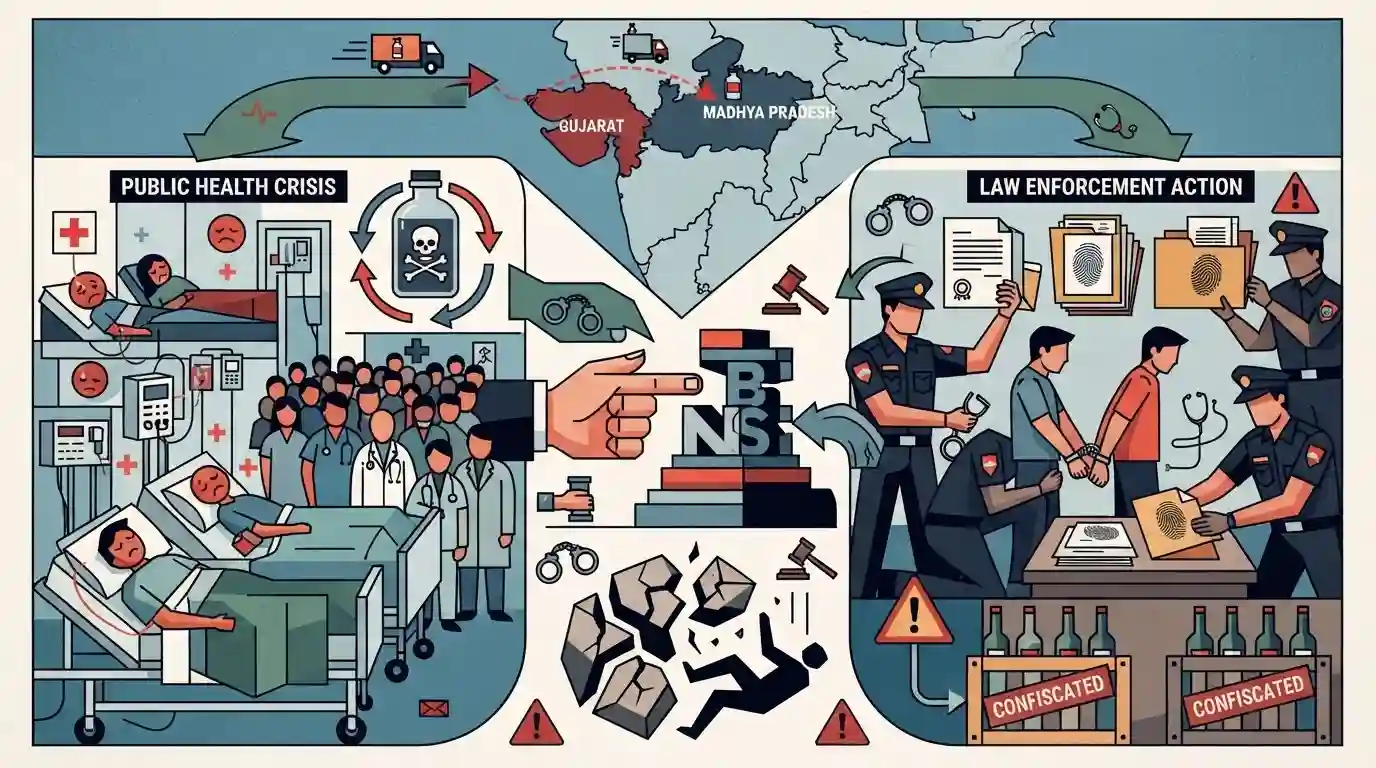
Why It Matters
This incident is crucial for understanding the governance and law-and-order challenges surrounding state prohibition laws (relating to DPSP Article 47). It highlights the public health dangers of methanol poisoning and introduces the application of the new Bharatiya Nyaya Sanhita (BNS) in prosecuting large-scale bootlegging and culpable homicide cases.
Summary
At least seven people died and approximately 30 were hospitalized in Gujarat's Bhavnagar district after consuming counterfeit alcohol laced with toxic methanol. Despite Gujarat being a dry state under the Gujarat Prohibition Act, an inter-state bootlegging network operating between Madhya Pradesh and Gujarat supplied the fatal chemical. Authorities have arrested multiple suspects and charged them with culpable homicide not amounting to murder and criminal conspiracy under the Bharatiya Nyaya Sanhita (BNS). The tragedy highlights the continuing public health and law enforcement challenges associated with the underground liquor trade in prohibition states.
Key Points
- Seven individuals died and nearly 30 were hospitalized in Bhavnagar, Gujarat, after consuming counterfeit liquor.
- Forensic analysis of the seized alcohol revealed a lethal methanol concentration of 38.59%.
- Gujarat is a dry state governed by the Gujarat Prohibition Act; however, illegal liquor networks continue to operate, often smuggling chemicals from neighboring states like Madhya Pradesh.
- Police have arrested several bootleggers and a supplier from Ujjain, registering cases under the Bharatiya Nyaya Sanhita (BNS) for culpable homicide not amounting to murder, causing hurt by poison, and criminal conspiracy.
Important Terms
Bharatiya Nyaya Sanhita (BNS)

India's updated criminal code replacing the Indian Penal Code. It defines and governs criminal offences, including culpable homicide and criminal conspiracy, establishing the legal framework for prosecuting offenders.
UPSC context
GS Paper 2 (Polity). Critical for understanding ongoing criminal justice reforms, statutory penal provisions, and law enforcement protocols.
Gujarat Prohibition Act
A 1949 law strictly prohibiting the manufacture, sale, transportation, and consumption of alcohol in Gujarat, treating all such activities as criminal offences with strict penalties.
UPSC context
GS Paper 2 (Governance). Essential for evaluating state prohibition policies, public health impacts, and the challenges of underground illicit economies.
Nilambagh Police
A primary 'A Division' police station located in Bhavnagar, Gujarat, responsible for maintaining local law and order and leading investigations into illegal inter-state bootlegging operations.
UPSC context
GS Paper 3 (Internal Security). Relevant as a case study in local law enforcement's role in dismantling organized inter-state crime networks.
Prelims Trap
"Alcohol regulation is placed on the Concurrent List to enable central intervention during inter-state smuggling."
Under the Seventh Schedule, intoxicating liquors are exclusively a State Subject (Entry 8, List II). The Centre cannot legislate on its intra-state trade, despite inter-state smuggling dynamics.
Static Concepts Connected
How does the Indian Constitution address alcohol regulation and prohibition?
- Article 47 (DPSP): Directs the State to endeavor to prohibit the consumption of intoxicating drinks and health-injurious drugs, except for medicinal purposes.
- State List (Entry 8): Entry 8 of List II (State List) gives state legislatures exclusive legislative power over the production, manufacture, possession, transport, and sale of intoxicating liquors.
What makes spurious liquor (hooch) chemically lethal?
- Methanol Adulteration: Spurious liquor is often illicitly laced with industrial methyl alcohol (methanol) rather than safe ethyl alcohol (ethanol) to increase potency and reduce manufacturing costs.
- Toxic Metabolism: The human liver converts methanol into formaldehyde and then formic acid, rapidly leading to severe metabolic acidosis, optic nerve damage (irreversible blindness), and death.
Cross-Topic Patterns
Prohibition vs. Cooperative Federalism
Inter-state bootlegging from Madhya Pradesh tests Gujarat's dry-state enforcement, highlighting the operational and border policing challenges created by asymmetrical alcohol policies between neighboring states.
BNS intersecting with State Acts
Charging suspects under the Bharatiya Nyaya Sanhita (BNS) for culpable homicide alongside the Gujarat Prohibition Act illustrates the concurrent application of national penal codes and stringent state-specific laws.

Expect a multi-statement Q combining Article 47 (DPSP), State List Entry 8, and the Gujarat Prohibition Act's Section 65A death penalty.
Linked PYQs · 2
Linked PYQs · 2
- 2024GPSC_PRELIMSGS1
The Directive Principles are non-justiciable in nature. This implies that 1. A citizen cannot move the Hon. court if the government fails to legally enforce the Directive Principles or even violate them in some instances. 2. The government cannot enact laws to implement Directive Principles. Select the correct answer code:
- 2026GPSC_PRELIMSGS1
Consider the following statements regarding the technical aspects of ethanol blending: 1. E20 means a blend of 20% ethanol by weight in petrol. 2. Higher ethanol blends may require modifications to the vehicle engine. 3. Ethanol has a lower energy value than petrol. Which of the above statements are correct?
