International Big Cat Alliance and Global Tiger Conservation Strategy
Source:Indian Express ↗
Why It Matters
Relevant for understanding India's global leadership in wildlife diplomacy, multilateral environmental frameworks, and species conservation strategies under GS Paper III.
Summary
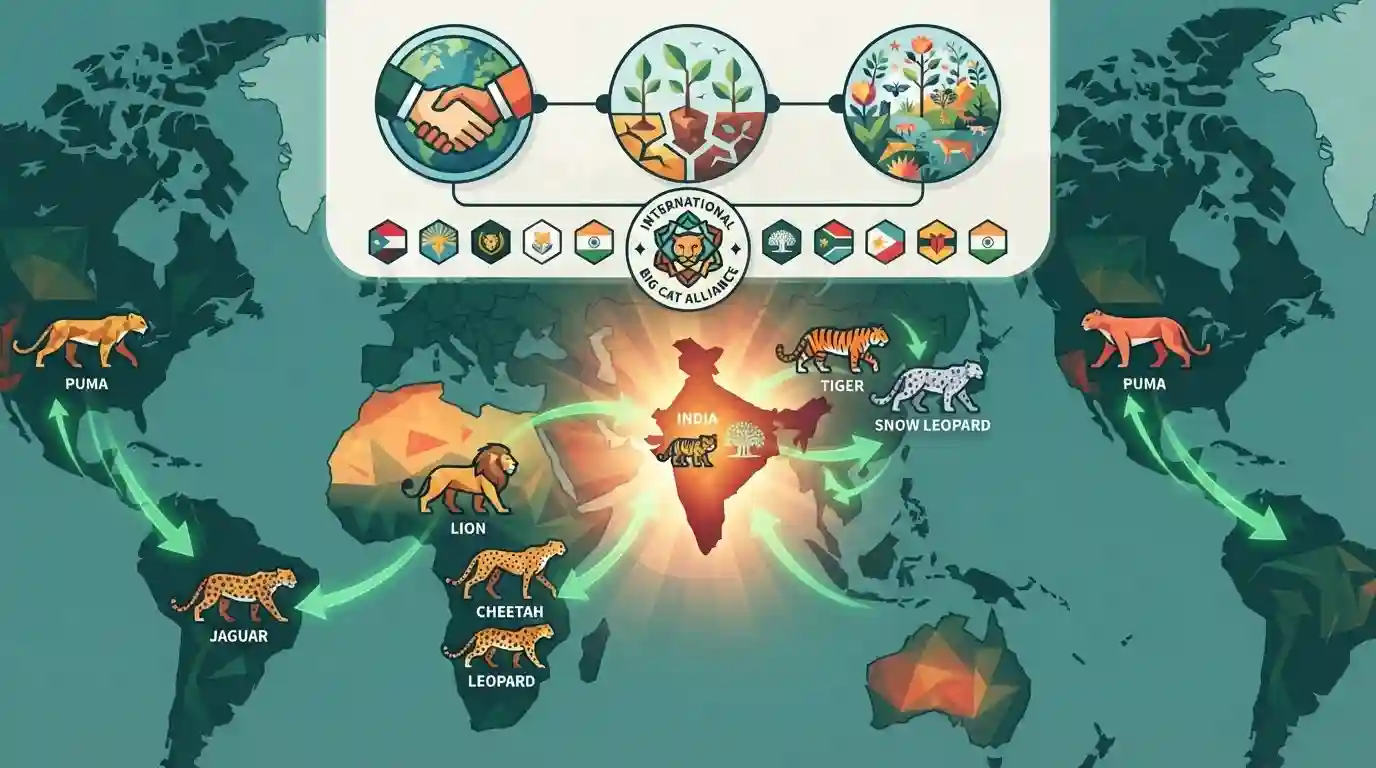
The article highlights India's leading role in global wildlife conservation through initiatives like Project Tiger and the International Big Cat Alliance (IBCA). It emphasizes the collaborative preservation of seven major big cat species across range countries, focusing on ecological security, habitat restoration, and transboundary cooperation.
Key Points
- India houses a significant portion of the world's wild tiger population, supported by successful conservation frameworks like Project Tiger and the Wildlife Protection Act.
- The International Big Cat Alliance (IBCA) focuses on conserving seven major big cats: tiger, lion, leopard, snow leopard, jaguar, puma, and cheetah.
- Conservation challenges extend beyond national borders, requiring international cooperation, capacity building, and knowledge sharing among range countries.
- Multilateral initiatives underscore biodiversity preservation, ecological restoration, and mitigating human-wildlife conflict.
Important Terms
International Big Cat Alliance

A treaty-based intergovernmental organization launched by India to ensure the protection and habitat restoration of the world's seven major big cat species through global collaboration.
UPSC context
UPSC Prelims/Mains (Environment & IR): Tests international conservation coalitions, multilateral diplomacy, and India's global leadership in biodiversity protection.
National Tiger Conservation Authority
A statutory body established under the Wildlife Protection Act, 1972, tasked with providing statutory authority and oversight for Project Tiger and tiger reserve management.
UPSC context
UPSC Prelims/Mains (Environment & Biodiversity): Tests statutory bodies, forest governance, and species-specific conservation frameworks in India.
Wild Life Protection Act 1972
India's core umbrella legislation enacted to provide legal protection to wild animals, birds, and plants, establishing national parks, sanctuaries, and scheduled conservation tiers.
UPSC context
UPSC Prelims/Mains (Environment & Ecology): Core legislation frequently tested for statutory mechanisms, species schedules, and protected area management.
Prelims Trap
India is home to all seven big cat species covered under the International Big Cat Alliance (IBCA).
Aspirants often assume India is home to all seven big cat species under IBCA. In reality, India hosts five (tiger, lion, leopard, snow leopard, cheetah), while jaguar and puma are native to the Americas.
Static Concepts Connected
What are the key institutional mechanisms and statutory bodies governing wildlife conservation in India?
- NTCA:: Established under the Wildlife Protection Act, 1972, chaired by the Union Environment Minister, providing oversight for tiger conservation.
- NBWL:: Statutory advisory body under WLPA 1972, reviewing wildlife matters, approving national parks and sanctuaries, and framing policies.
- WLPA 1972:: Enacted in 1972 to protect wild animals, birds, and plants, with six schedules providing varying degrees of protection.
Cross-Topic Patterns
Global Wildlife Diplomacy and Multilateralism
India's diplomatic leadership in multilateral conservation alliances (like IBCA and ISA) parallels its rising profile in global environmental governance and South-South cooperation.

IBCA membership criteria, headquarters location, and the specific 7 big cats vs India-native species are high-yield prelims traps.
Linked PYQs · 2
Linked PYQs · 2
- 2020PrelimsGS1
Among the following Tiger Reserves, which one has the largest area under "Critical Tiger Habitat"?
- 2024PrelimsGS1
Consider the following statements: 1. Lions do not have a particular breeding season. 2. Unlike most other big cats, cheetahs do not roar. 3. Unlike male lions, male leopards do not proclaim their territory by scent marking. Which of the statements given above are correct?
