International Big Cat Alliance and Global Wildlife Conservation
Source:Indian Express ↗
हे का महत्त्वाचे आहे
It highlights India's strategic leadership in multilateral environmental diplomacy through the International Big Cat Alliance (IBCA), focusing on biodiversity conservation and ecosystem management for apex predators, which is a core component of the UPSC GS3 syllabus.
सारांश
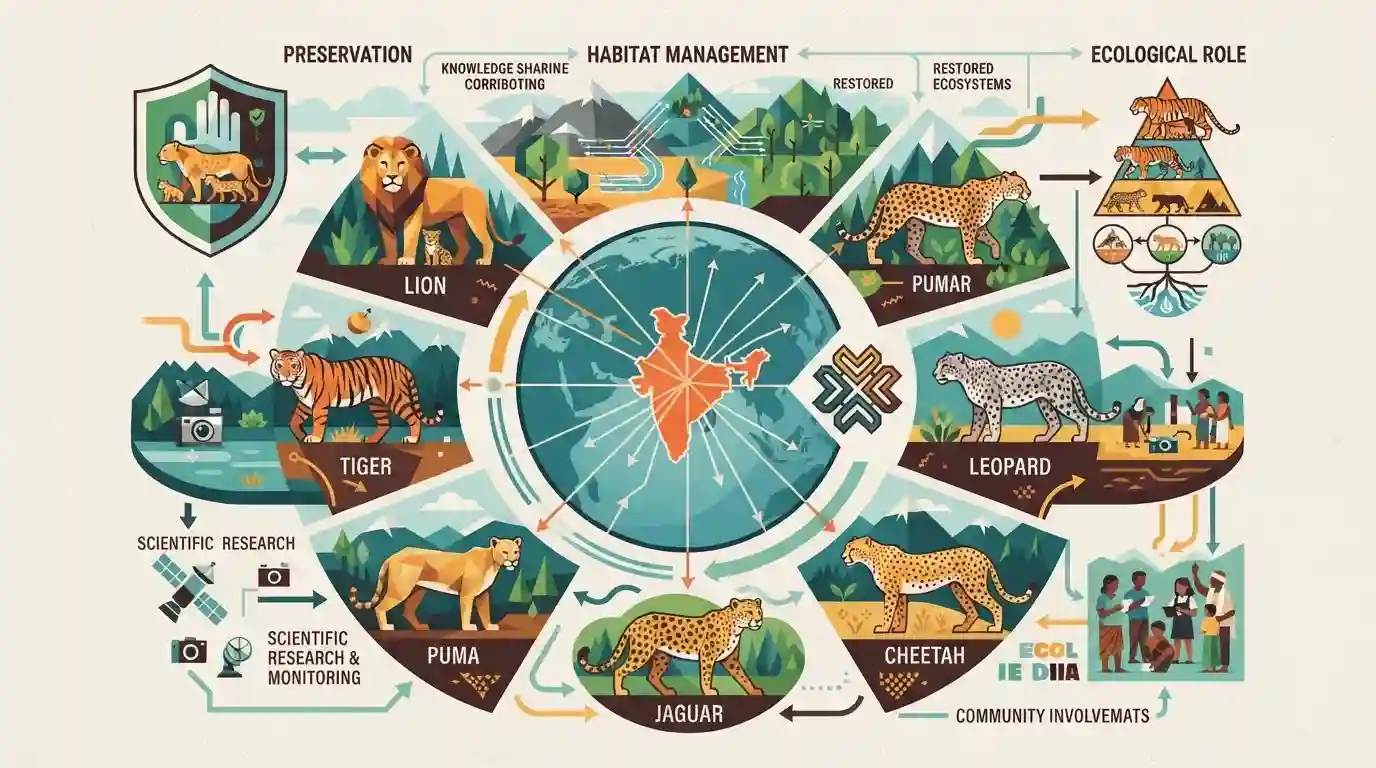
The article discusses the significance of the International Big Cat Alliance (IBCA) and India's leadership in global wildlife conservation, focusing on the preservation, habitat management, and ecological role of the seven major big cat species across the globe.
मुख्य मुद्दे
- The International Big Cat Alliance (IBCA) represents a major global conservation initiative spearheaded by India to protect seven major big cat species: tiger, lion, leopard, snow leopard, jaguar, puma, and cheetah.
- The alliance emphasizes global cooperation, knowledge sharing, habitat restoration, and financial mobilization to tackle shared threats like poaching, habitat fragmentation, and climate change affecting big cat populations.
- India's domestic success with Project Tiger and recent reintroduction initiatives (such as cheetah translocation) positions it as a leader in global wildlife diplomacy and conservation science.
- Conservation of apex predators is critical for maintaining healthy ecosystems, ensuring ecological balance, and safeguarding water and food security.
महत्त्वाच्या संज्ञा
International Big Cat Alliance (IBCA)

A global coalition launched by India to ensure the conservation and habitat protection of seven major big cat species worldwide through international cooperation, knowledge sharing, and financial support.
UPSC context
GS Paper III (Environment & Biodiversity). Tests India's global leadership in wildlife conservation and international environmental diplomacy.
Project Tiger
India's pioneering centrally sponsored wildlife conservation program launched in 1973 to protect dwindling tiger populations by establishing dedicated tiger reserves.
UPSC context
GS Paper III (Environment Conservation). Important for wildlife management, biodiversity protection, and species recovery strategies in India.
पूर्वपरीक्षा सापळा
India hosts all seven big cat species targeted by the International Big Cat Alliance within its native wild habitats.
Aspirants often assume India is home to all seven big cat species, but India naturally hosts five (tiger, lion, leopard, snow leopard, and cheetah via reintroduction); jaguars and pumas are native to the Americas.
संबंधित स्थिर संकल्पना
What are the key multilateral wildlife conventions and alliances India is founding member of?
- IBCA Origins:: Global initiative launched by India in 2023 for conserving seven major big cats across range countries. HQ in New Delhi.
- International Solar Alliance:: India-led initiative launched at COP26 (Glasgow) to promote solar energy deployment globally, headquartered in Gurugram, India.
- Global Tiger Forum:: Global platform for doubling tiger populations across range countries, launched under the St. Petersburg Declaration in 2010.
आंतर-विषय नमुने
IBCA & International Solar Alliance (ISA)
India's leadership in IBCA mirrors its coalition-building in the International Solar Alliance, fusing climate diplomacy with biodiversity conservation.
Apex Predators & Global Biodiversity Framework
Conservation of umbrella species directly supports catchment protection and climate resilience under international biodiversity frameworks like the Kunming-Montreal Global Biodiversity Framework.

Expect a match-the-following or statement-based question on IBCA's member range countries, covered species, and headquarters location.
संबंधित PYQ · 2
संबंधित PYQ · 2
- 2020PrelimsGS1
Among the following Tiger Reserves, which one has the largest area under "Critical Tiger Habitat"?
- 2024PrelimsGS1
Consider the following statements: 1. Lions do not have a particular breeding season. 2. Unlike most other big cats, cheetahs do not roar. 3. Unlike male lions, male leopards do not proclaim their territory by scent marking. Which of the statements given above are correct?
